

Buying cabinets
New-construction cabinet upgrades: take the package or choose the functions separately?
Start with the kitchen actually included in the home, then compare a decorative package with the individual storage changes you will use. A model-home picture and a package name cannot tell you what reaches your cabinet order.
Identify the included kitchen before pricing its upgrades
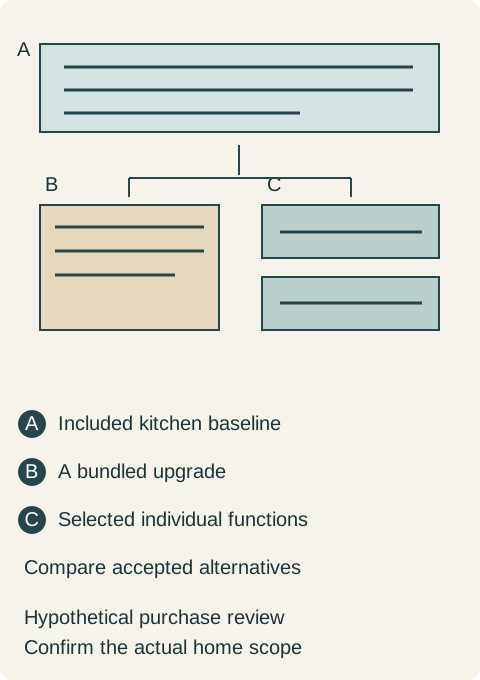
Choose a cabinet upgrade for what it changes in the kitchen you are actually buying. First obtain the included cabinet layout, fronts, finish and storage configuration. Then compare the offered package with any permitted individual options. A package can be good value when its contents are wanted; it can be expensive decoration when the functions the household needs remain outside it.
Do not use the model home's appearance as the baseline. Displayed cabinets, appliances, panels and accessories may belong to different selections, and the same community can have different plans or offerings. Ask for the included and proposed choices for the actual home. This step should come before ranking the upgrade names.
Separate appearance, construction and storage
A cabinet package may combine a finish, door style, drawer arrangement, construction option or decorative treatment. Ask which parts change. A new color does not necessarily provide a different interior, and an attractive drawer front does not prove there is a usable drawer behind it. Review the item schedule and the relevant elevation together.
Toll Brothers describes its Design Studio as a guided personalization process involving product and finish selections. That provides an example of the setting for these decisions, not evidence of any particular home's included cabinets, available packages or prices.
Reading note: Toll Brothers — The Design Studio Experience.
Keep necessary finishing components in the comparison. If a selected option changes visible ends, fillers or trim, ask how those pieces are covered. A whole-kitchen finish choice should not be priced as though it changes only the main doors. Confirm the complete arrangement offered, including the areas intentionally left unchanged.
Buy functions from the routine they improve
Walk through the household's storage before choosing extras. Identify where everyday pots, dishes, waste sorting and food reserves will go. A drawer bank can be valuable when it solves an actual retrieval problem; it adds less value when it replaces the only compartment that fits a needed tall item. Check the proposed contents rather than assuming more drawers always means a better kitchen.
Evaluate optional pull-outs by their actual arrangement and opening. Their useful space differs from the outer cabinet rectangle. Ask for the relevant product information or demonstration and compare it with ordinary shelving. Keep the room plan in view: changing one base configuration can require another place for the item it previously held.
Decorative functions also deserve an honest decision. If glass fronts are selected, decide what will be displayed. If the real contents are everyday packages the family prefers to hide, the package should not receive credit for useful display storage it will never provide. The owner may still love the appearance, but that is a different reason to buy it.
Compare the package with a complete accepted alternative
Ask whether individual options are genuinely offered with the chosen plan and base selection. Do not design an imaginary menu by combining options from different homes, collection levels or demonstration kitchens. If a function is available only within a package, that dependency is part of the purchase decision.
Keep countertops, hardware and appliance selections consistent unless a proposed cabinet option requires a documented change. Otherwise the difference between two totals can reflect several upgrades while being presented as the price of a cabinet function alone. Ask the design consultant to identify what each comparison holds constant.
For a hypothetical example, a decorative cabinet package costs $2400 and includes a preferred finish and glass-front treatment. A separately offered drawer change costs $900 and a waste-storage option $400, totaling $1300. The illustrative difference is $1100. These invented amounts are not builder prices or a claim that the options can actually be combined in a particular home.
The hypothetical buyer compares those alternatives using the same accepted base kitchen. The package's appearance is desirable, but the drawer and waste arrangements solve daily problems and remain available in the included finish. If the package were required to obtain those functions, the comparison would need to be rebuilt around that actual dependency.
Think carefully before planning to add it after completion
Some buyers prefer to keep included cabinets and change them later. Compare the actual later work rather than assuming every factory option can be fitted into a finished box. A future pull-out, drawer or front can depend on the selected cabinet dimensions, hardware system and available components. Ask about the specific intended modification.
Changes involving the cabinet layout or relationships to fixed surfaces deserve particular attention. A later alteration may affect surrounding work, while a removable organizer may not. The decision is not that upgrades are always cheaper now or later; it is whether the known alternative includes the work and compatibility needed to achieve the same result.
If future work is only an idea, avoid treating its expected savings as established. A buyer can knowingly accept the included configuration and revisit it later. That is clearer than paying for a package nobody wants because of an untested belief about what later modification will cost.
A household keeps the finish and changes the working storage
Imagine a household reviewing a model kitchen with upgraded paint, display doors and several storage features. The first reaction is to select the whole cabinet package to obtain that general impression. When the included elevation and separate option list are reviewed, the family finds that the decorative package does not include the drawer arrangement it actually wants.
The buyers inspect the offered functional alternatives and check their cookware and waste containers. They choose the drawer and waste options that fit, retain the included finish and closed upper fronts, and confirm the needed finished surfaces. They decline the decorative package because its glass cabinets would contain items they prefer to conceal. The order reflects a specific storage choice rather than a vague request for the model's kitchen.
Another household might choose the complete package because its appearance and functions are all valued. The method is the same: understand its contents, confirm dependencies and compare a real alternative. A package is not automatically wasteful, and a list of separate options is not automatically more economical.
Keep the selected options attached to the home's order
Before accepting the selection record, check the actual cabinet changes, finish identity, affected elevations and totals. Mark alternatives that were declined so they cannot return in a later summary as assumed selections. Ask when the builder needs decisions and how subsequent requests are handled; use its actual response for the home.
Retain the accepted record alongside the included baseline. It should explain what the upgrade bought and what stayed the same. That is useful at the next review and at delivery, and gives the household a clear basis for choosing cabinet functions without relying on a model-home memory or a package title.
Sources & further reading
- Toll Brothers — The Design Studio Experience