

For professionals
Cabinet designer training: learn the product line as well as the design software
A new designer needs more than fast renderings. Choose training by the work the person cannot yet complete: a feasible product selection, a usable room, an explainable quote or an accurate software drawing.
Choose the lesson for the work that is missing
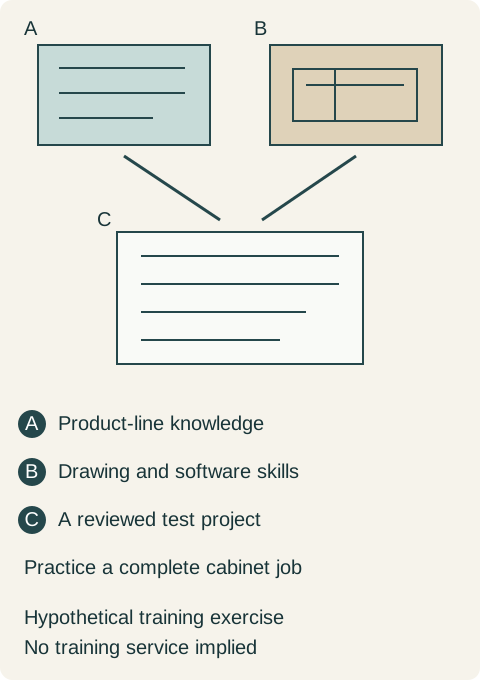
A new cabinet designer needs product knowledge and drawing skills, but those are different lessons. Software instruction can improve how quickly someone builds and revises a plan. Product training explains which cabinets, modifications, finished sides and storage fittings the selected line actually offers. Choose the next lesson by the person's current difficulty, then test it in a complete practice project.
This matters to a showroom hiring a designer, a contractor bringing quoting in house and an experienced interior designer learning a new cabinet range. A beautiful rendering can help a client understand a room. The person preparing it still needs to explain what will be ordered and which parts of the proposal require information from the site.
Decor Academy describes public professional-development resources that combine cabinet product knowledge with broader industry learning. It illustrates a manufacturer-supported learning route; it does not establish access to every course or offer training from usaKT.com.
Reading note: Decor Academy — What’s New at the Decor Academy?.
Find out whether the gap is software or product knowledge
Give the learner a clear room brief and an identified product range. If the person understands the proposed cabinets but cannot reliably place, label or revise them in the program, targeted software instruction is appropriate. If the drawing is fluent but its components cannot be found in the current range, product instruction needs attention.
Ask the learner to locate the information supporting a selection. Can they find the offered cabinet configuration, identify the exposed-end treatment and explain what a proposed storage fitting requires? Remembering a showroom display is less reliable than finding the current product information for the unit being quoted. Familiarity with another brand may help, but it does not establish this line's options.
Do not confuse a missing reference with poor judgment. An accurate answer may be that the current documents do not resolve a question and the supplier needs to clarify it. The useful skill is recognizing that uncertainty before it is sold as an included feature, then carrying the answer back into the drawing and item list.
Teach the room as a sequence of ordinary tasks
Product fluency alone does not produce a convenient kitchen. Ask the learner to show where groceries arrive, where the everyday dishes go and how the dishwasher is unloaded. Have them open the relevant fronts in the plan and explain the standing positions. A cabinet that exists in the catalog can still be a poor choice for the work assigned to it.
Use specific household objects for this exercise. A deep drawer proposed for pans needs to accommodate the pans the brief actually names; it should not earn credit from a generic image of organized cookware. Where physical testing or model-specific information is needed, the learner should identify it. The lesson is how to ask and answer the right design question, not how to declare every sketch verified.
Keep field observations separate from assumptions. Show the learner how the project records a known dimension, a proposed finished surface and a condition that still needs checking. The person should understand why a photograph can explain a corner without establishing its exact size. Training should make the next site question more precise.
Use an ordinary cabinet quote as a practical test
Have the learner connect the drawing to the cabinet schedule and explain the complete quoted scope. Follow a visible end, an appliance opening and a selected accessory through the documents. Ask what is included, what remains separate and where the supporting information can be found. A matching total is not enough if the quoted pieces do not create the pictured room.
Then introduce a realistic change. The client might select another refrigerator or want a drawer where a door was shown. Ask the learner to identify the affected cabinets, supporting panels and storage decisions before changing the image. The revised schedule should follow the actual change rather than preserving an attractive old price by accident.
Let an experienced colleague review the reasoning. The reviewer should explain the correction and what evidence would resolve it, instead of silently fixing the drawing. Otherwise the exercise produces a clean file while leaving the learner unable to repeat the work. Preserve the corrected example as a useful reference for the same type of question.
A convincing rendering reveals a product gap
Imagine a hypothetical showroom designer who can produce clear room views but has only recently started working with the selected cabinet line. In a practice kitchen, the designer uses a generic decorative side at the end of an island and assumes a storage fitting shown in another brand's display belongs to the quoted cabinet.
During review, the designer cannot identify either component in the current offer. The instructor helps find the actual end-panel choices and the fitting information. The learner revises the island as a complete assembly, shows the resulting interior and updates the quote. The image changes slightly, but the customer could now understand what the purchase includes.
For this hypothetical designer, another rendering-effects lesson would not address the discovered problem. The next instruction focuses on the selected product range and on recognizing when a supplier answer is needed. A different learner who already understands the components but repeatedly issues mislabeled revisions may need software and drawing-control practice instead.
Choose a learning resource with a defined use
Review what the proposed instruction actually covers and which product or software version it uses. A manufacturer resource can be useful for its own range; a software course can teach program operation. Neither should be credited with every aspect of room planning, pricing or site coordination merely because it uses the words kitchen design.
Ask whether the learner will work through a relevant exercise and receive feedback. A demonstration can show possibilities, while practice reveals whether the person can apply them. If the training uses a different product line, agree how the learner will verify the corresponding choices in the range the business actually sells.
Evaluate progress through the next complete job: the person can explain the cabinet selection, show a workable room sequence and produce a drawing and quote that agree. Keep review appropriate to the work that remains unfamiliar. The result worth paying for is clearer independent judgment, with unresolved questions recognized early, rather than a certificate or a polished image treated as proof of every other skill.
Sources & further reading
- Decor Academy — What’s New at the Decor Academy?