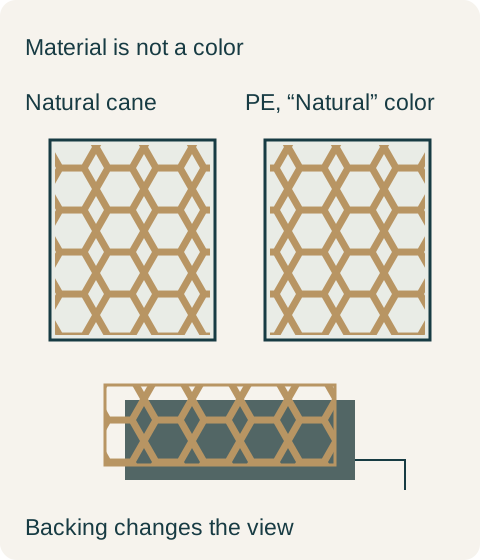
Choose natural cane when the plant material and its developing appearance are part of the reason for buying the cabinet. Choose a synthetic woven insert when the intended look matters more than botanical origin and the particular synthetic product suits the application. Neither choice follows from a photograph of a honeycomb pattern. Before judging the front, distinguish material from color, and then distinguish an open woven sheet from a woven face applied to a solid panel. Those decisions affect what the door shows, how it ages and what a replacement would involve.
“Natural” can identify a color of synthetic rattan
The Designs of Distinction catalog separates natural cane from PE synthetic rattan offered in a Natural color. It also notes that cane develops patina and may lose tension. Those short descriptions identify different material expectations. A color option cannot answer whether actual plant fiber is being purchased. Start with that distinction before deciding which sample looks better; otherwise an appealing name can silently choose the material for the owner. The selected weave and its construction still need to be evaluated as a finished cabinet insert.
That distinction is especially useful when a room rendering shows only a small woven area. A woven pattern can be repeated in a drawing without depicting the actual strand surface, joins or color variation. Use the selected finished sample to judge those details. If the specification says only natural rattan look, different bidders may reasonably price different constructions. A buyer who values the actual cane should identify natural woven cane as the material; a buyer who wants the color should not accidentally pay for a different material simply because the name sounded botanical.
Natural fiber brings change as well as texture
Decide which kind of change the household is willing to see. An owner buying natural fiber for its character may regard an evolving appearance differently from an owner trying to repeat a controlled woven accent across a wall of cabinets. Neither preference requires a claim that one material is always superior. The approval should describe the appearance the owner likes and what would make a later change unacceptable. A desire for real plant material and a demand for permanent sample-perfect uniformity should be reconciled before the material is ordered, not after the cabinet is used.
Diagram Conceptual cabinet-insert comparison: matching weave shapes and similar color names do not establish the same material. A backing panel closes the view behind the weave.
In a hypothetical indoor dining cabinet, the owner wants actual cane and accepts that its tone and tension may change. The fabricator presents natural cane and a Natural-colored PE weave with similar hexagonal openings. The owner selects the natural cane, approves its finished sample and chooses a frame construction with a separately replaceable insert. The approved design also includes an opaque inner panel because the cabinet stores mixed tableware. This accepts the plant material’s aging while keeping the storage visually quiet. The PE sample is not rejected as inferior; it simply does not meet this owner’s material preference.
A replaceable insert does not prevent stretching or promise that future cane will match the original patina. It makes a later material replacement possible without defining the entire door as disposable. The door drawing still needs to show how the insert and inner panel are held and removed. If a future replacement looks fresher than adjacent aged cane, that difference may remain visible; the owner’s acceptance of natural change should include that possibility. Buying real fiber for its character while requiring permanent sample-perfect uniformity would put conflicting expectations into the same order.
An open weave and a backed center panel are different products
WalzCraft describes cane applied to a flat center panel with a wood-veneer back. This is a backed product, not an unobstructed screen. The construction matters when the cabinet stores visually mixed objects: the weave can remain the visible accent while the backing closes the view. Conversely, a buyer expecting to see illuminated contents through the pattern would be disappointed by a closed panel, even if its front sample looked correct. The useful sample must therefore show the backing as well as the woven face.
WalzCraft also distinguishes the cane face from the frame species and the veneered reverse. That prompts a complete-door appearance review. Choosing an oak frame does not make every visible surface an oak surface. View the opening door from the side and rear, and decide whether the contrast is intentional. A cabinet seen only when closed and a freestanding piece viewed from both sides can make different demands on the reverse. The approval should reflect those views rather than imagine the front pattern continuing through the panel.
Judge the weave in the complete door
A dark backing can emphasize the holes in a light weave, while a closer-colored backing can make the pattern read more softly; this is an appearance comparison to make with the actual samples, not a material strength ranking. Likewise, the view into a lit cabinet can differ from the same open weave in front of an opaque panel. Put the selected weave, backing and frame together under the intended lighting. A loose sample held against a white sheet does not represent a finished dark-backed door. The hypothetical owner chooses the combined sample, so the approved appearance includes the quiet background that hides the tableware.
The final distinction is between accepting a material and accepting a complete insert assembly. In the hypothetical design, natural cane, the approved finish, an opaque inner panel and removable retention all remain part of the door choice. Replacing that with a similarly colored PE sheet changes the material; removing the inner panel changes the view; permanently bonding the assembly changes the service strategy. None of those changes is captured by a photograph of the same hexagonal weave. A useful cabinet specification preserves the decisions that made the woven front suitable for its owner.
Pure White
Cream White
Light Warm Gray
Gray
Navy
Black
Oak Tone
Dark Walnut Tone
Design study These finish studies are design references, not a list of currently orderable colors. Screens and lighting change the appearance; compare a physical sample before choosing.See all finish options →
Compare the actual countertop products, heat-source routine and fabrication proposal. A fired porcelain slab and resin-bound quartz are different materials, but neither label replaces a complete kitchen specification.
The sample shows the door frame, a separate center panel, the face frame and the cabinet box. Each component has its own place in this Shaker construction.
Shaker construction: door frame, center panel, face frame and cabinet box. The cutaway helps locate these parts; confirm each material in the specifications for the selected cabinet.
01 / Door frame
The Shaker door has rails and stiles around a separate center panel. The frame and center panel are different components; confirm their materials in the specifications for the selected cabinet.
02 / Face frame
The face frame surrounds the opening at the front of the cabinet box and sits behind the doors. The face frame, door frame and cabinet box are separate parts.
03 / Cabinet box
The sample exposes the cabinet sides, interior surfaces and layered edges. The image does not establish the wood species or material specification of a selected cabinet.