

Buying cabinets
Microwave drawer or swing-door microwave: choose the whole serving routine
Compare access from above with access through a door, then count the counter, cabinet storage and ordinary meal tasks each complete arrangement supports.
Pick the access you will use, then buy its cabinet
Choose a microwave drawer when its access from above works with the household’s actual dishes and a supported location is worth the base-cabinet space. Choose a swing-door microwave when loading through the front and its accepted placement give a better routine or preserve more valuable storage. Compare complete installed arrangements, not a drawer price against an appliance sitting in an unspecified cabinet.
Start with the food and its container. A shallow plate, tall mug and covered bowl create different sightlines and grips. Identify what regularly goes in together and whether another person uses the microwave while the main cook works. The preferred format should serve that ordinary meal, not only a single attractive showroom demonstration.
Opening is a task, not just a mechanical clearance
The cited Sharp manual documents its appliance’s powered drawer opening and controls. A microwave drawer is a specified appliance arrangement; putting an ordinary microwave in a furniture drawer does not create that installation.
Reading note: Sharp — Convection Microwave Drawer Operation Manual, part names and opening controls.
For the drawer candidate, rehearse opening, lowering the cold empty vessel, reaching its controls and lifting the vessel out. For the door candidate, include the actual hinge side and the approach through the opening. Keep handles, lids and appropriate hand space present. A bowl that fits inside may still be difficult to grasp at the chosen position.
Then close and reset each alternative. Does someone have to move around the open part before reaching the destination? Does the control sequence make sense to everyone who uses it? A preference for manual or powered movement should be tested on the actual candidates rather than inferred from a photograph.
Height belongs to the whole arrangement
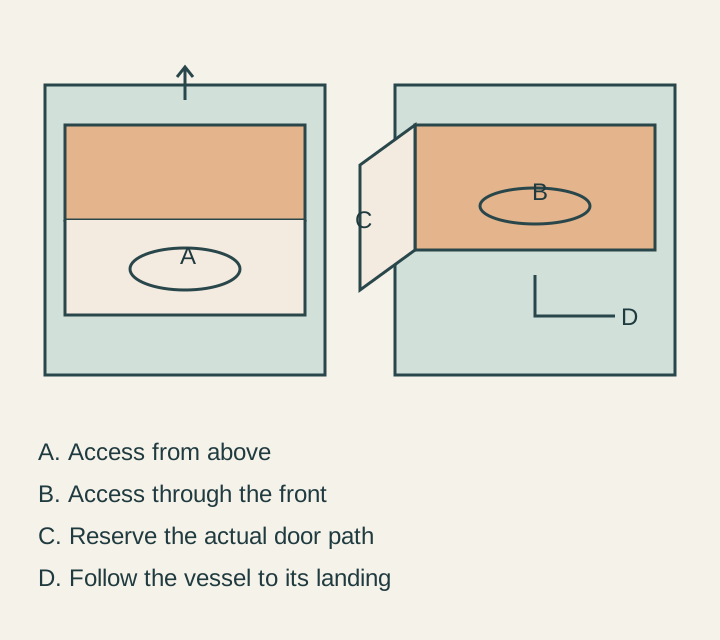
A drawer is often considered for a lower location, but below counter is not a personal-use approval. Check whether the intended person sees the food, lowers it steadily and retrieves it without an unwanted grip change. The countertop edge and control position remain in the trial.
A swing-door microwave may be proposed in a supported upper, lower or countertop arrangement. Name the actual one. Do not compare the drawer in a carefully chosen position with an arbitrarily inconvenient wall location and call the format itself better.
If the best swing-door position takes a valuable upper cabinet, include the displaced inventory. If the drawer takes the base cabinet nearest the dishwasher, show where that daily storage moves. Convenience purchased at the appliance can create inconvenience at the next task.
Find a landing that exists during dinner
Trace the vessel from cavity to a stable suitable counter in both proposals. Directly above is not automatically easy, and nearby does not establish an unobstructed transfer. Retain the open drawer or door while following the movement.
Use the kitchen’s real counter occupants. If the landing is also the main preparation surface, decide how those tasks coexist. A test with a permanently empty island does not represent a meal during which bowls, ingredients and serving dishes remain there.
Assess the expected load separately from empty fit. Use only cold stable representations within the person’s accepted ability for any handling trial. No format label establishes that a loaded container is manageable. The purchase should be based on a practical personal sequence.
Count the surfaces and storage honestly
If the swing-door option uses the counter, draw its operating footprint and whatever space its instructions require around it. Count only the remaining useful preparation segment. If it is built in, identify the supported model and trim arrangement before treating that counter as recovered.
The drawer alternative may clear the counter while replacing a particularly useful drawer bank. Give the former contents real homes and test their retrieval. A graphic showing new microwave capacity and the same untouched storage underneath can be counting one cabinet volume twice.
Compare nearby doors, stools and through traffic in the active states. A drawer may open mechanically while occupying a person’s route. A swing door may stand between the food and the counter. Waiting can be acceptable, but it should be an understood routine rather than a hidden surprise.
Compare the full purchase and daily reset
Price appliance, approved accessories, cabinet work, support, connections, counter alterations and affected finishes. Separate a true built-in alternative from an unsupported enclosure around a countertop model. An advertised appliance width alone does not determine its installation opening.
Check ordinary cleaning access and the removable internal pieces described by the selected instructions. Keep the product identity and an understood service/removal plan. This is not a promise that any future microwave will fit the same opening.
Imagine a hypothetical kitchen whose owners dislike losing their only clear counter to a microwave. The drawer candidate passes their covered-bowl and control trial, but it would replace the drawer holding daily dishes. The designer finds a tested nearby home for those dishes, and the open microwave still leaves an accepted meal route.
The owners choose the drawer and accept the complete cabinet change. Another household might reject that storage move and buy a supported swing-door arrangement instead. Approve the exact model, users, vessels, landing and displaced inventory together. The best format is the one whose entire routine remains useful after every cabinet is filled.
Sources & further reading
- Sharp — Convection Microwave Drawer Operation Manual, part names and opening controls