A glue sold for melamine can be suitable for a particular surface bond without being approved to carry a loaded cabinet connection. Do not approve a cabinet detail from the adhesive name or a strong-looking test value alone. Identify what touches the glue on each side, then identify which components actually support the load.
The coating is the bonding surface, not the core behind it
Titebond describes its Melamine Glue for joining porous materials such as wood, particleboard and MDF to synthetic surfaces including melamine and HPL. Its limitations separately exclude structural or load-bearing uses and applications outdoors or where moisture is likely. A suitable surface pairing therefore does not remove the application limits.
A melamine-faced panel contains a wood-based core, but the adhesive on its intact face contacts the coating. Its exposed cut edge presents a different surface. A small decorative solid-wood piece against that face is not the same interface as bonding coated faces together. The shop needs the actual surface pairing in its process specification; the phrase wood cabinet is too broad to establish it.
The named product page also publishes lap-shear results, including a row labeled melamine/melamine. That table should not be converted into a blanket rule about every coated-to-coated assembly, nor into an allowable weight for a shelf. A controlled joint test and a cabinet connection have different geometry, loading and construction. The explicit application limitation still governs.
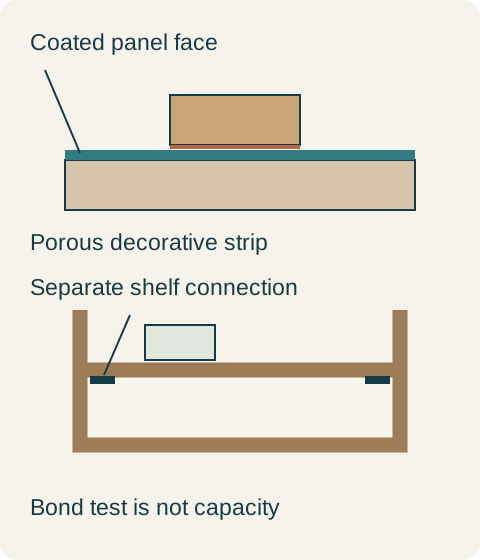
Teaching example Conceptual decorative strip bond and separate supported shelf detail. The drawing assigns different jobs; it gives no structural design, fastener schedule or load rating.
Keep the shelf connection; qualify the decorative strip separately
Consider a hypothetical dry-interior cabinet with a decorative wood strip applied to a coated end panel and a fixed shelf carrying stored dishes. The shop qualifies the decorative bond using the exact strip, coated surface and specified process. The buyer accepts it for that trim. A proposed change that would remove the shelf’s approved joinery and rely only on the same glue is rejected. The order keeps the established shelf connection and limits the adhesive approval to the decorative application.
This distinction does not mean that an added fastener automatically makes any glued construction satisfactory. The retained joint must be the complete specified assembly, including its supporting panels and connection details. The decorative trial does not establish the shelf capacity, and the shelf detail does not prove that every cosmetic strip will adhere to every finish.
Make substitutions at the interface level
Changing a raw mating edge to a factory-coated edge can change the glue interface while leaving the outside appearance almost identical. Likewise, moving the detail into an area with likely moisture changes the intended use. Either change requires a new qualified material and joining choice; a successful dry decorative trial is not a transferable approval for the revised detail.
The purchasing record should name the adhesive where relevant, show the actual mating faces and separate decorative attachment from the cabinet’s load-carrying connections. That makes a substitution review concrete. It also prevents a strength number copied from an adhesive sheet from becoming an unsupported promise about the completed cabinet.
Pure White
Cream White
Light Warm Gray
Gray
Navy
Black
Oak Tone
Dark Walnut Tone
Design study These finish studies are design references, not a list of currently orderable colors. Screens and lighting change the appearance; compare a physical sample before choosing.See all finish options →
A dado seats a panel in a channel, a rabbet seats it at an edge and a butt joint meets a surface without that recess. Geometry, retention and remaining material all matter.
A painted door, a wood-grain side and a plywood cabinet box can belong to the same cabinet. Here is how to read those parts, what the sample photos actually show, and which details to put on a quote.
The sample shows the door frame, a separate center panel, the face frame and the cabinet box. Each component has its own place in this Shaker construction.
Shaker construction: door frame, center panel, face frame and cabinet box. The cutaway helps locate these parts; confirm each material in the specifications for the selected cabinet.
01 / Door frame
The Shaker door has rails and stiles around a separate center panel. The frame and center panel are different components; confirm their materials in the specifications for the selected cabinet.
02 / Face frame
The face frame surrounds the opening at the front of the cabinet box and sits behind the doors. The face frame, door frame and cabinet box are separate parts.
03 / Cabinet box
The sample exposes the cabinet sides, interior surfaces and layered edges. The image does not establish the wood species or material specification of a selected cabinet.