Before buying a secondhand medicine cabinet, resolve its recall identity
A mirror cabinet can look intact and still require a specific recall response. Use a historical CPSC example to separate product identification from condition and installation-fit checks.
Do not make a secondhand or clearance medicine cabinet essential to the bathroom plan until you can identify the actual unit and check applicable recalls. A clean mirror, working hinge and attractive price cannot answer that question. If the identity remains unresolved, keep the purchase pending or choose an identifiable alternative; do not design the new vanity around an assumption that the cabinet is unaffected.
CPSC's January 16, 2014 RSI recall concerns specified Glacier Bay medicine cabinets whose mirror or back panel can separate. Its model/date scope identifies affected units; the remedy directs immediate stop-use, removal and return to The Home Depot for a full refund.
This is a historical notice, not a newly announced event or a claim about every cabinet sold under that brand. Check the current official page and its scope before applying it to an item. For an affected cabinet already installed, follow the notice and arrange appropriate help with removal rather than attempting an improvised repair or using this article as removal instructions.
A product photograph is not an identity record
Ask the seller for the product identification available for the actual item, its relevant markings and any original purchase or packaging information. Compare those with the identification instructions in the applicable notice. A listing title may describe a style or brand without identifying the manufactured unit. A similar-looking cabinet in another photograph does not complete the match.
When a marking is inaccessible, do not ask someone to loosen a hanging mirror cabinet simply to obtain a sales photograph. Seek identification assistance through the contact route in the notice or arrange a suitable professional assessment. If the necessary information cannot be obtained, record that uncertainty rather than converting it into a negative recall search result.
Keep recall status apart from ordinary condition
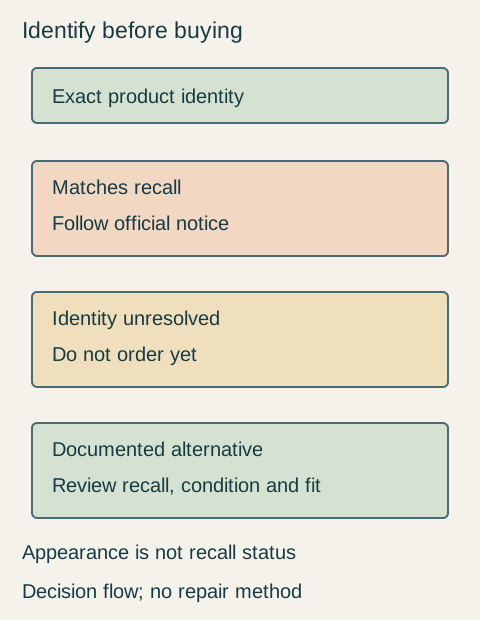
Teaching example A purchase decision begins with the cabinet identity, not its appearance. A match to a recall follows the official notice. An unresolved identity stays out of the purchase; a documented alternative still needs its own recall, condition and fit review. This flow does not certify any cabinet as safe.
A condition review asks whether parts are missing, damaged or altered. A recall check asks whether this identified product falls within an official action. Neither replaces the other. A cabinet may open smoothly and have no visible damage yet still match the notice. Conversely, failure to find a matching recall does not certify its physical condition or installation suitability.
Do not accept a seller's added adhesive, replacement fastener or statement that it has always worked as proof that the recall has been resolved. Establish the official remedy for that product and seek the relevant documented confirmation where applicable. The notice's route governs; an attractive used price does not justify inventing a different remedy.
Keep the bathroom purchase flexible until identification is settled
Hold the proposed mirror cabinet separate from the confirmed vanity, top and lighting choices. Its exterior size, recess requirement, storage and door motion may have influenced the layout. If it cannot be purchased, a replacement needs those relationships reviewed again. A similar outer width is not enough to preserve every assumption.
For the alternative, identify the real product, check recall information and condition, and review its instructions and fit. If it has no storage, assign the displaced daily items explicitly. If it requires a different mounting arrangement, include the actual wall work. The goal is a complete replacement proposal, not merely another reflective rectangle above the basin.
A bargain leaves the order before it dictates the room
In a hypothetical remodel, a buyer finds an older mirrored cabinet that seems to suit the planned vanity. Its shelf layout is appealing and its appearance is good. The listing, however, does not establish the exact identity needed to check a potentially relevant notice. The seller supplies a generic product photograph but cannot provide the remaining identification.
The buyer does not infer that the unit is recalled, and does not infer that it is clear. They decline that unresolved purchase. A documented alternative is then reviewed as a separate product, including current recall information, condition, installation requirements, door movement and its view from the chosen basin position.
The alternative holds the intended daily supplies, but its different mounting arrangement requires a revised wall treatment. The buyer accepts that identified scope and orders the alternative with the selected vanity, top and lighting relationship. The old bargain is removed from the plan rather than kept as a placeholder that could determine the finished wall.
For someone who already owns a cabinet confirmed to be affected, the next step is the official recall response, not resale or a cosmetic refresh. Resolve that action separately from choosing the replacement. The buying decision becomes clearer when the record says what the unit is, what the notice requires and which complete alternative will serve the bathroom.
Pure White
Cream White
Light Warm Gray
Gray
Navy
Black
Oak Tone
Dark Walnut Tone
Design study These finish studies are design references, not a list of currently orderable colors. Screens and lighting change the appearance; compare a physical sample before choosing.See all finish options →
A secondhand kitchen set is a fixed collection of real cabinets. Evaluate their condition, dimensions and finished sides before treating the set as a substitute for a new order.
Review the old mirror's wall footprint, mounting or recess, storage and lighting relationships before selecting the new mirror with the vanity. The visible glass is only part of the existing arrangement, and removing it can create work that cabinet measurements alone do not reveal.
The sample shows the door frame, a separate center panel, the face frame and the cabinet box. Each component has its own place in this Shaker construction.
Shaker construction: door frame, center panel, face frame and cabinet box. The cutaway helps locate these parts; confirm each material in the specifications for the selected cabinet.
01 / Door frame
The Shaker door has rails and stiles around a separate center panel. The frame and center panel are different components; confirm their materials in the specifications for the selected cabinet.
02 / Face frame
The face frame surrounds the opening at the front of the cabinet box and sits behind the doors. The face frame, door frame and cabinet box are separate parts.
03 / Cabinet box
The sample exposes the cabinet sides, interior surfaces and layered edges. The image does not establish the wood species or material specification of a selected cabinet.