MasterBrand and American Woodmark have merged: what changes in a cabinet sourcing plan?
The completed transaction changes corporate ownership. For a buyer comparing backup sources, different cabinet offers may still belong to the same parent group; evaluate that separately from product fit and dealer service.
If your cabinet sourcing plan lists MasterBrand and American Woodmark as independent corporate groups, update that assumption. You may still have useful competing products or sales channels to compare, but the ownership map has changed. Decide whether the second offer is meant to provide another design, another seller or a source under different ownership; those are different purchasing objectives.
MasterBrand announced completion of its merger with American Woodmark on May 28, 2026. American Woodmark became a wholly owned subsidiary of MasterBrand. This was a completed transaction, not merely a proposed combination.
Update the ownership layer without inventing an operating change
For a professional buying across projects, the direct consequence is that the named companies no longer represent separate parent groups. A worksheet that counted them that way before closing now overstates that particular form of source diversity. Correcting it does not require alleging a supply problem or rejecting either company's products.
The completion announcement does not establish that every product moves through the same plant, warehouse, order desk or dealer. Those operational relationships require their own evidence. Shared ownership cannot prove that two offers will experience identical interruptions; different ownership cannot prove that they share no upstream dependencies. Keep the source map at the level you can confirm.
For a homeowner comparing a single project, the practical effect may be modest. Two offers can still differ in the cabinets, design work, delivery scope and service actually proposed. Common ownership is not a reason to stop comparing them, and the announcement does not establish that one is a poor value. It changes what can be claimed about independence, rather than answering which offer suits the room.
Decide what the alternative is supposed to protect
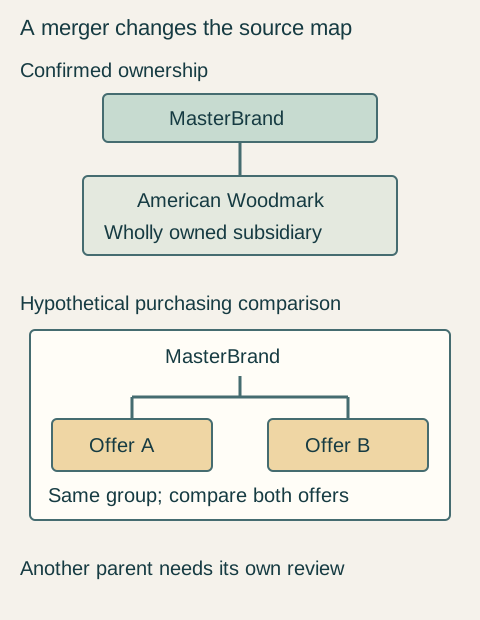
Diagram The completed transaction puts American Woodmark under MasterBrand. The lower purchasing example is hypothetical: different offers can remain useful comparisons while sharing a parent group. An independently owned alternative needs a separate qualification review. Lines show ownership/grouping, not common factories, identical products or guaranteed capacity.
If the concern is finding a different door style or interior, another product within a common group may meet the need. If the concern is the responsiveness of a particular seller, another sales channel may be worth evaluating. If the stated objective is avoiding reliance on a single parent group, neither a different brand badge nor another showroom is enough by itself.
Record the offered product line, selling entity, confirmed corporate group and the service route the quote actually provides. Leave manufacturing or distribution relationships unconfirmed where the seller has not documented them. This is a practical source map, not an attempt to infer financial strength or operational reliability from ownership alone.
An alternative under different ownership still has to qualify for the project. It may need a different finish allocation, cabinet configuration or installation scope. A name on a backup list does not reserve capacity or establish that the complete package can be supplied when needed. Keep those conditions visible before presenting the alternative as ready to replace the selected order.
Do not turn the merger into a product promise
The cited announcement does not declare cross-brand interchangeability of fronts, finishes or hardware. It also does not supply revised terms for an individual cabinet order. If a salesperson proposes a change on the basis of the merger, request the product-specific or order-specific information that authorizes that change. Do not infer either that all terms have changed or that none can change.
The same distinction applies to the company's anticipated business benefits. A corporate expectation is not a promised lead time, discount or service outcome for this purchase. Keep the accepted quotation and applicable documents attached to the actual seller and product, rather than replacing them with a headline about a larger company.
A project buyer keeps the preferred order and revises the backup plan
Consider a hypothetical contractor preparing cabinetry for separate upcoming projects. The team has a preferred offer and another offer it describes as an independent manufacturer backup. Its documented ownership review now places both within the merged group. The second offer remains a useful product-and-service comparison, but it no longer satisfies the team's separate-parent objective.
The contractor does not cancel the preferred selection on that basis. Its cabinet arrangement and confirmed scope still meet the immediate project's requirements. Instead, the team qualifies another potential source under different ownership for a later, unreleased project, using that project's full cabinet and finishing requirements. The alternative uses its own approved configuration; it is not treated as a source of interchangeable replacement parts for the first order.
The team releases the preferred complete order for the immediate project. It keeps the separately reviewed alternative available for a later selection, explicitly without claiming reserved stock or capacity. This preserves the current project's product choice while making the future sourcing plan match the actual ownership objective. Another buyer who only wanted competing designs could retain the original two offers and need no additional supplier search.
The useful response to this merger is a precise purchasing record: which group stands behind each offer, what kind of alternative it provides and what remains unconfirmed. Update that record before calling two brand names independent supply protection. Keep the final cabinet choice grounded in the actual project, not in an assumed benefit or risk from the corporate transaction.
Pure White
Cream White
Light Warm Gray
Gray
Navy
Black
Oak Tone
Dark Walnut Tone
Design study These finish studies are design references, not a list of currently orderable colors. Screens and lighting change the appearance; compare a physical sample before choosing.See all finish options →
The sample shows the door frame, a separate center panel, the face frame and the cabinet box. Each component has its own place in this Shaker construction.
Shaker construction: door frame, center panel, face frame and cabinet box. The cutaway helps locate these parts; confirm each material in the specifications for the selected cabinet.
01 / Door frame
The Shaker door has rails and stiles around a separate center panel. The frame and center panel are different components; confirm their materials in the specifications for the selected cabinet.
02 / Face frame
The face frame surrounds the opening at the front of the cabinet box and sits behind the doors. The face frame, door frame and cabinet box are separate parts.
03 / Cabinet box
The sample exposes the cabinet sides, interior surfaces and layered edges. The image does not establish the wood species or material specification of a selected cabinet.