

Construction & materials
Marquetry cabinet fronts: choose grain-direction contrast before approving the pattern
A real-veneer composition can use changing grain direction, different woods or both. Compare finished material relationships and the complete offered front, rather than approving only a decorative drawing.
Choose a marquetry cabinet front by deciding what creates its pattern. The effect may come mainly from changing the direction of similar veneer, from contrasting woods, or from both. Those choices produce different things to approve. A drawing can establish geometry, but it cannot fully represent the finished relationship of the wood pieces. Review the actual material arrangement before treating a favorite motif as a complete cabinet specification.
FormWood describes sketch faces as decorative arrangements of real veneer pieces, including geometric patterns and marquetry compositions. Its examples include cabinetry. This establishes a material format, not that every cabinet provider offers custom marquetry.
Reading note: FormWood: custom veneer sketch faces and marquetry.
Decide whether direction or color should carry the design
Begin with an ordinary description of the desired result. You may want an angular pattern that remains quiet because neighboring pieces have related colors. Or you may want a clearly outlined motif made from contrasting woods. Do not let a pattern name stand in for that decision. Similar geometry can carry a different visual emphasis when its material relationship changes.
Ask the provider which proposed arrangement it can actually supply. A design that relies on precise contrast needs representative material approval; a direction-led design needs a way to judge the relationship between neighboring grain fields. The goal is to establish the offered effect, rather than demand that natural veneer reproduce every tonal block of a digital drawing exactly.
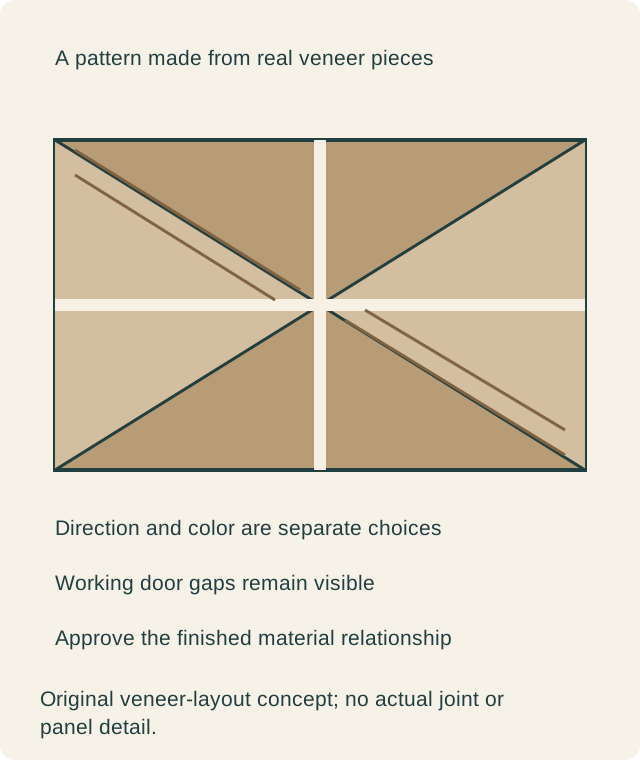
A finished sample should contain the relationship
A sample of each wood placed separately on a desk may help narrow selection, but it does not yet show how the pieces meet in the composition. Seek the provider’s available way to review a representative joined arrangement with the intended finish. Identify what the sample represents and which remaining variation the buyer is accepting.
Look at it upright and from the positions where the cabinet will be seen. The purpose is not to discover a universally correct viewing angle. It is to decide whether the selected relationship remains welcome in the actual room. If a subtle arrangement only reads the way you want in one carefully staged position, discuss that finding before ordering a large prominent group.
Keep a veneer pattern separate from ordinary grain continuity
A cabinet can have continuous grain across its fronts without being a decorative assembled composition. Conversely, a marquetry front can have its own complete motif without continuing into the neighboring door. State which result is wanted. Requesting matched veneer does not clearly distinguish these intentions.
This also helps define where custom work ends. A patterned focal cabinet may sit beside quieter fronts whose job is to coordinate in tone, rather than reproduce the same geometric pieces. Decide that boundary deliberately. Extending a motif onto every end, filler and adjacent cabinet can turn a focused material choice into an unresolved room-wide commission.
The pattern does not replace the working cabinet
Place the accepted composition on an elevation that includes real doors, drawers and hardware. Mark whether a motif belongs within an individual front or is intended to read across a group. Working gaps should remain honest parts of that view. Do not approve artwork that can only look complete if separate moving fronts are treated as an unbroken panel.
Also review how the proposed face ends at the perimeter. Ask what edge and back treatment complete the offered front, and how its panel assembly is specified. The decorative veneer layout does not itself establish the core, backer, hardware or fabrication method. Those details need a complete provider proposal, not assumptions based on the intricacy of the face.
A hypothetical dining cabinet chooses direction with restrained color
Imagine a dining-area cabinet intended to be the room’s main wood feature. The first concept uses a strong light-and-dark motif. The owners like its geometry but find the contrast too assertive beside the dining table. They ask the provider for an available composition that lets direction carry more of the pattern and keeps the overall tone closer together.
In this hypothetical case, a representative finished arrangement gives them the quieter effect they wanted. They approve that material relationship and restrict the composition to the focal cabinet group. The adjacent storage uses a coordinated ordinary veneer treatment. The elevation identifies the moving fronts, with the motif arranged around their actual divisions rather than hiding those divisions in a rendering.
The owners have not established that restrained marquetry is better. Another room may need the stronger color contrast, and its buyer can approve that just as clearly. Here the complete decision is a defined grain-and-color relationship in a defined location. The geometry survives, while the material emphasis changes to suit the room.
Plan future service around an identifiable composition
Keep the accepted drawing, material description, finish and front positions together. A later replacement should be assessed against that record and the existing installation. Matching a species name alone may not reproduce the original composition or the relationship the buyer selected. Ask what service the provider can realistically offer for the finished front.
If spare material or a spare front is proposed, identify what it actually preserves. Loose veneer is not a completed, fitted and finished replacement. A spare component also needs a location and appropriate storage arrangement. Neither choice should be described as guaranteeing an invisible repair years later. The useful purpose is to retain identifiable information and components for a future assessment.
Order the complete material choice
A quote should connect the custom face arrangement with its actual cabinet fronts and the provider responsible for fabrication. Confirm what the approval covers before releasing the work. A drawing may approve geometry, a representative sample may approve material relationships, and the cabinet specification must still define the complete parts being supplied.
Marquetry becomes a sound purchase when those approvals agree. The buyer knows whether direction, color or both create the effect, has seen a representative finished relationship, and has accepted how it occupies the working cabinet. The result is more specific than ordering decorative veneer and more honest than expecting a drawing to eliminate all natural wood variation.
Sources & further reading
- FormWood: custom veneer sketch faces and marquetry