

Construction & materials
Live-edge wood countertop or a machined outline: choose the actual usable shape
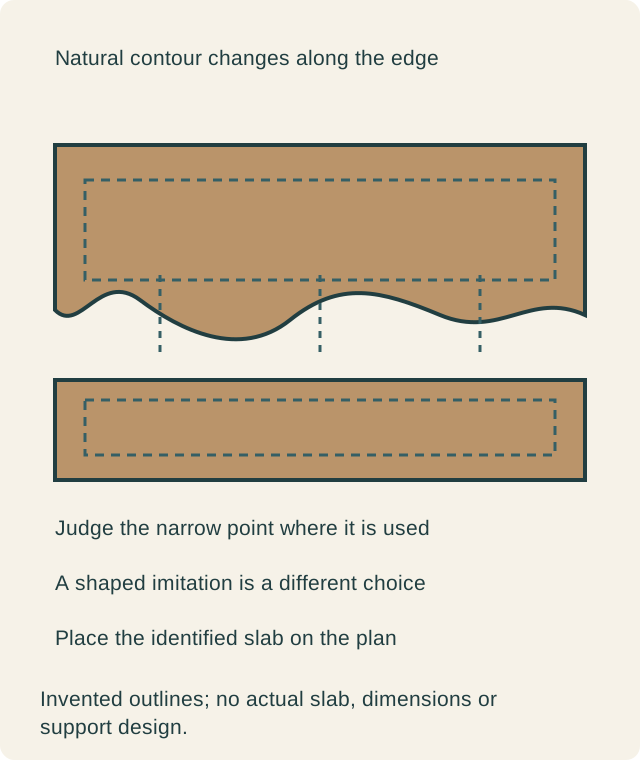
A natural perimeter changes the countertop’s plan shape, not only its side profile. Review the identified slab at seats, working positions and cabinet ends before choosing it over a deliberately machined outline.
Choose a live-edge wood countertop when the actual slab’s changing outline is part of what you want to live with. Choose a machined perimeter when predictable working and seating positions matter more than retaining that particular natural contour. These are choices about the plan shape of the top, not simply whether its side has a rounded or square profile. The useful comparison places both alternatives over the real cabinets and seats.
Grothouse describes live edge as the natural bark-side contour of the wood, with the bark removed. It requires customers to select the actual raw slab before production. The purchase therefore begins with a particular piece, not only a species and a generic rectangle.
Reading note: Grothouse:Live Edge Wood Countertops.
Review the contour where a person actually sits
At an island seat, a projecting area and a recessed area can place the front edge differently relative to the cabinet below. Draw the actual proposed outline at the occupied positions. Do not approve seating from the slab’s widest point if a person will use a narrower part.
Use a full-size paper or cardboard outline where practical. Put the intended seat in place and set a plate or serving tray on the mockup. The exercise evaluates the preferred shape and use; the cabinet maker and fabricator still need to resolve the finished assembly and support.
Someone may enjoy the irregular edge as a deliberate dining feature. Another may find that a changing front line complicates where people sit. Neither response can be settled by a beautiful overhead photograph. The household should try the part of the outline it will approach every day.
Working space has a location, not just an area
A slab can provide an attractive amount of total surface while offering less useful depth at the intended preparation point. Mark where a board, appliance or serving dish will actually stand. Check the relationship of that object to both the irregular front and the cabinet behind it.
Do not solve every conflict by moving the entire slab forward. That changes other relationships, including the back edge and the visible overhang at the ends. Compare an adjusted cabinet arrangement, a different slab or a machined outline if the preferred piece does not serve the fixed task.
Choose which edge faces the room
The same piece can produce different results when turned or repositioned. Review the proposed orientation with its end cuts and visible features identified. A striking natural sweep may belong on the seating side, while a controlled rear line may suit the working side, if that is the actual proposed fabrication.
Include the route past the island. A prominent projection can be attractive without being the right edge beside a frequently used passage. Show the outermost outline rather than drawing only a nominal width line through the middle of the slab.
A natural edge and a shaped imitation are different offers
Grothouse’s FAQ distinguishes natural-edge possibilities from its offered faux live-edge profile. It also describes whole-slab purchase and final shop drawings for its own program. Those are specific supplier terms, not rules for every wood-countertop maker.
Reading note: Grothouse:Live EdgeFAQ.
An intentionally machined irregular edge may satisfy someone who wants the visual rhythm but needs a more controlled plan. Describe it accurately and compare the actual example. It does not need to be dismissed as inferior, but it should not be sold as the retained contour of the selected tree if that is not what the maker is providing.
Conversely, a buyer who values the particular natural outline should not accept a generic shaped replacement without another decision. The slab’s identity is part of the appearance choice. A nearby piece of the same species is not automatically a continuation of the original selection.
See the finished surface and the edge’s character
A raw slab is not the delivered countertop. Ask how the proposed finish changes the appearance and how the maker resolves visible irregularities in the selected piece. Use a relevant finished example to understand what the hand will encounter along the edge, without scraping or modifying a sample yourself.
Keep the surface’s intended use separate. A live edge does not establish permission to cut food directly on the top or identify its maintenance. Select the finish for the household’s routine and retain the applicable instructions. The organic outline and the working treatment are separate decisions on the same top.
A hypothetical island keeps wood and changes the outline
Imagine owners who like a particular slab for a serving island with regular family seating. A full-size outline reveals that the most appealing curve pulls back at the seat used most often. Moving the slab would improve that place but create an unwanted projection along the main passage.
In this hypothetical comparison, they choose a machined outline in the wood proposal instead. They retain the warm material and the room’s seating arrangement without requiring the natural contour to fit every fixed position. The rejected slab was not defective; its shape did not suit the use they wanted to preserve.
Another household could move the seating positions and keep the natural edge. That is a different, equally reviewable choice if the surrounding plan supports it. The important result is deciding which part changes before the cabinet and countertop are fabricated.
Keep the ends and junctions deliberate
If the top meets a wall, another surface or a separate dining extension, show how the irregular portion ends. Do not let a natural edge become an unresolved junction hidden by a decorative photograph. A controlled cut can be part of a natural-edge design when it is explicitly selected.
The underside and support should be resolved for the actual slab and cabinet arrangement. A dramatic-looking overhang is not a support specification. The buyer needs the proposed finished shape and installation scope, without guessing capacity from the apparent thickness of a large piece of wood.
Order the selected piece and its accepted outline
Keep the slab identity, orientation, finished outline, visible-edge treatment and relevant cuts together with the approved drawing. If the piece changes, compare the new outline at the same working and seating positions. A supplier’s broad species description cannot preserve a one-piece visual selection by itself.
The right choice gives the household a surface whose shape it enjoys and can use. Sometimes that is the retained natural contour; sometimes it is a controlled edge that keeps the rest of the kitchen working. Either should be chosen from the actual top in the actual plan.
Sources & further reading
- Grothouse:Live Edge Wood Countertops
- Grothouse:Live EdgeFAQ