

Bath & laundry planning
Two laundry basins or one large utility sink?
Choose two basins when a recurring wet task genuinely needs separate working spaces at the same time. Choose one larger bowl when accommodating the actual object and retaining a useful dry landing area matter more than division. The purchase should compare usable bowl shapes, the full cabinet bay and the complete sequence; counting basins alone does not establish either working capacity or convenience.
Choose two basins when a recurring wet task genuinely needs separate working spaces at the same time. Choose one larger bowl when accommodating the actual object and retaining a useful dry landing area matter more than division. The purchase should compare usable bowl shapes, the full cabinet bay and the complete sequence; counting basins alone does not establish either working capacity or convenience.
Decide what the second basin will do
Give each basin a specific role during an ordinary session. One might hold an appropriate task in progress while the other remains available for a separate compatible activity. Describe those activities and the household's accepted handling method. Merely saying wash and rinse does not prove that two permanent bowls are necessary, particularly when the owner normally completes one small item before starting another.
Mustee's catalog distinguishes double laundry-tub configurations from large laundry tubs. These are different working layouts, not simply different names for one capacity.
Reading note: E. L. Mustee & Sons: double laundry-tub configurations.
Keep unrelated utility tasks in the discussion. If the laundry sink also receives cleaning equipment, identify how the owner separates those activities from garment care under the relevant product instructions. Two bowls do not automatically provide an appropriate separation protocol. The cabinet decision should describe the accepted use without inventing hygiene performance from the existence of a divider.
Compare the object that must actually fit
Select representative objects or garments used in the real routine. Measure the shape that needs to enter the bowl and test the intended movement with a safe dry mockup. A sink's total outside width does not reveal the clear working span of either half. A divider can reduce the continuous space even when the overall sink is wider than the single-bowl alternative.
Do not assume the object can simply rest across the divider. Whether that is appropriate depends on the object, selected sink and task. If the real job needs an uninterrupted bowl, compare the selected single basin directly with one side of the double arrangement. Conversely, a long bowl can be larger than necessary if the owner only needs a small controlled area and would value independent space beside it.
Count the cabinet and dry surface together
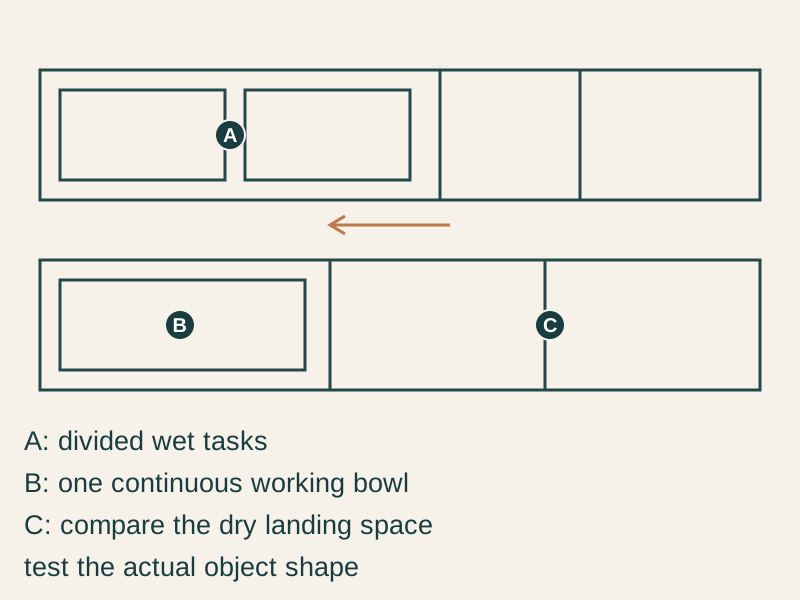
- A
- A: divided wet tasks
- B
- B: one continuous working bowl
- C
- C: compare the dry landing space
Show the selected sink's cabinet and support requirements, actual plumbing and service access. With a divided product, ask whether it is one integrated sink body or separate fixtures and have the connection arrangement reviewed accordingly. The number of bowls visible above the counter should not be used to predict the drain layout or usable storage below.
Then add the dry landing surface the task needs. A broad double sink can consume the place where a basket, prepared item or removed accessory should sit. If that object moves to the folding counter, include the lost folding availability. A purchase that improves the wet stage while constantly clearing another work surface may be less convenient than its extra bowl initially suggests.
Test a specific allocation of wall space
Imagine a hypothetical laundry wall with 72 inches allocated to wet work and adjacent storage. Proposal A uses 42 inches for the reviewed double-basin bay and 30 inches for a dry cabinet. Proposal B uses 30 inches for a reviewed single-basin bay and 42 inches for the dry cabinet. Both total 72 inches. These are invented project allocations, not manufacturer minimum cabinet widths.
The owner tests the actual wet task in each bowl arrangement. In this example, the separate activities do not overlap: the owner ordinarily finishes one before beginning the next. The needed object fits the single basin's verified working shape, and the larger dry cabinet receives the basket and supplies without taking over the room's folding area.
The household therefore selects Proposal B. It accepts using the basin sequentially in exchange for the useful dry position. If a recurring accepted process had needed simultaneous separate bowls, Proposal A might have justified its larger wet allocation. The decision comes from a tested sequence rather than the rule that two bowls must always provide more utility.
Check the faucet and user's movement
Identify how the selected faucet serves the working areas. A fitting that appears centered in an elevation does not prove the user can place the water where needed comfortably. Review the actual faucet, bowl geometry and the operating reach together. Avoid assigning a universal faucet reach to a two-bowl sink based on a photograph of another product.
Have the person who uses the room test the nearest and farthest ordinary positions. Include lifting the item out and moving it to the chosen landing place. More separation between bowls may require a movement that one user finds reasonable and another cannot comfortably repeat. Their accepted handling movement is a purchasing input, separate from whether the cabinet fits the wall.
Approve an actual wet-work arrangement
Keep bowl configuration, fixture identity, faucet choice, dry landing area and reviewed cabinet/plumbing arrangement together. If a sink substitution changes the divider position or bowl shapes, repeat the object and transfer test. A similar overall width does not preserve the same usable interior. Also revisit the under-counter storage when the outlets or mounting arrangements change.
Favor the divided arrangement when the second bowl has a recurring job that must coexist with the first and the remaining dry space still works. Favor a single large basin when uninterrupted object fit and a stronger adjacent cabinet serve the real sequence. The useful purchase gives both wet work and the things surrounding it an appropriate place, rather than maximizing the number of cavities in the sink.
Sources & further reading
- E. L. Mustee & Sons: double laundry-tub configurations