

Bath & laundry planning
A second washer or one larger machine: what should the laundry cabinets give up?
Buy a second washer when separate loads need to run at the same time and the whole room can support their sorting, transfer and drying. Buy a larger single machine when the recurring problem is fitting one suitable load. Extra drums and extra drum capacity solve different problems; neither automatically justifies losing the laundry cabinet that currently keeps work moving.
Buy a second washer when separate loads need to run at the same time and the whole room can support their sorting, transfer and drying. Buy a larger single machine when the recurring problem is fitting one suitable load. Extra drums and extra drum capacity solve different problems; neither automatically justifies losing the laundry cabinet that currently keeps work moving.
Identify the queue before choosing more equipment
Start with an ordinary busy laundry session. Record which items wait together, which must remain separate, and what prevents the next step. A backlog caused by delayed unloading is different from a bulky item that cannot be washed in the current machine. A second washer cannot remove the delay if nobody is available to empty either one. A larger drum cannot combine items whose care instructions require different treatment.
Separate regular demand from exceptional demand. A large holiday bedding session may be handled differently from the small independent loads that appear throughout the week. Do not purchase a permanent second equipment bay merely because the room occasionally has baskets on the floor. Find out whether those baskets contain wash-ready loads or clothes waiting for sorting, stain assessment, drying or return to bedrooms.
LG describes its SideKick pedestal washer as capable of independent or simultaneous operation with the main washer above. This establishes a second-wash architecture, not suitability for every appliance combination.
Reading note: LG USA: SideKick pedestal washers.
Compare two complete storage arrangements
A second full-size machine can consume the bay that otherwise holds supplies, hampers or a folding surface. A compatible pedestal washer uses a different geometry, but it also changes the lower drawer movement and the main machine's height. Compare the actual configurations available for the selected equipment. A second drum should not be counted as a storage drawer simply because it occupies a pedestal-shaped position.
In the larger-single-machine alternative, assign the remaining cabinet to a named job. If it stores the household's separated laundry bags and the equipment for handling small items, losing it may make two-machine operation harder. Conversely, a tall cabinet full of seldom-used possessions may be a reasonable sacrifice when an independently washable daily load has nowhere to go. The value lies in the work enabled by the bay, not its label.
Test the drying stage as carefully as the washing stage
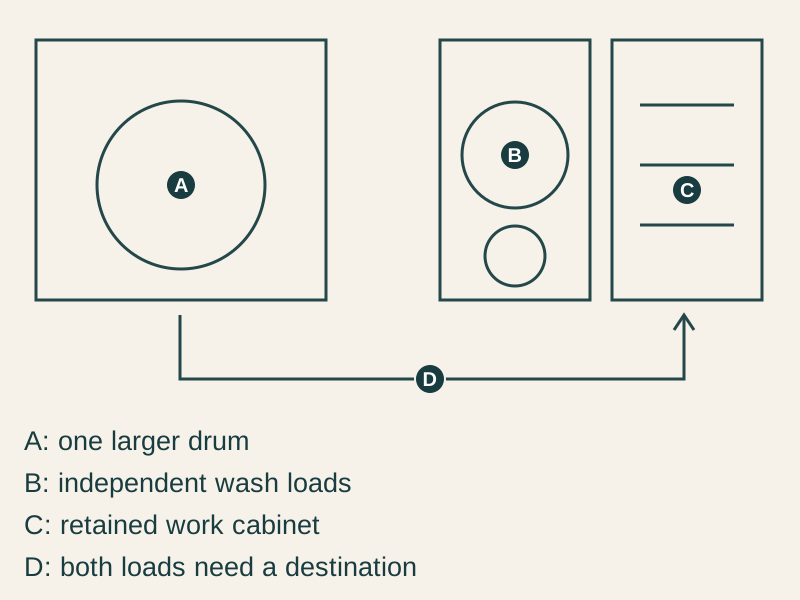
- A
- A: one larger drum
- B
- B: independent wash loads
- C
- C: retained work cabinet
- D
- D: both loads need a destination
Run both proposed wash streams through the next step on paper. Items intended for machine drying need a usable transfer position and an available drying arrangement. Garments intended for other care need their own destination. Two wet loads emerging close together can create an additional waiting pile if the household has bought washing capacity without the corresponding handling space.
Do not convert that observation into a claim that a second dryer is always necessary. It may be entirely reasonable to run an independent small wash while a larger load is elsewhere in the process. The point is to show where both loads go. A countertop promised simultaneously as folding space, temporary wet staging and the landing area for two full baskets is being allocated repeatedly.
Work through a specific decision
Consider a household that regularly separates small loads for their own care while ordinary laundry also waits. Its cabinet holds sorting bags and provides the only reliable transfer surface. This is a hypothetical purchasing case.
In this hypothetical example, the owner first compares a second full-size washer that replaces that cabinet. Washing can overlap, but the removed storage has no accepted destination. Both users end up setting supplies on the transfer surface and moving them whenever clothing comes out. In this example, increasing the number of wash positions reduces the number of useful handling positions.
The owner then checks a compatible smaller second-wash arrangement while retaining a separate work cabinet. The appliance documentation, installation proposal and users' reach tests support that particular combination. The smaller drum accepts the independently assigned loads under their applicable care instructions. The household chooses this arrangement because it clears a recurring separate-load queue while preserving the work surface. The conclusion would reverse if those loads did not fit the selected secondary machine.
Decide how much duplication the household will maintain
A second machine brings a second set of routine care tasks and another equipment identity to keep with the room documents. Decide who checks the relevant compartments, handles supplies and notices when a load has finished. An appliance that belongs to everybody can easily become a machine whose damp contents belong to nobody. Clear responsibility matters more than assigning an attractive cabinet front beside it.
Consider future replacement as part of the order. Independent operation does not mean unrestricted interchangeability. If the smaller washer forms a supported assembly with another machine, a future replacement must be checked against that relationship. Leave the cabinet supplier with the actual equipment configuration and the agreed access sequence rather than an instruction to fit two generic washers into the room.
Choose the bottleneck you are willing to remove
Choose one larger machine when ordinary load suitability and usable bulk capacity are the real constraint, and the retained cabinet supports sorting and return. Favor another washing position when separation and overlap occur often enough to justify its equipment and spatial demands. Neither choice should be credited with faster total laundry until the drying, handling and unloading sequence has been compared.
Before ordering, put the rejected alternative beside the chosen one and name the job lost with it. If that job has no credible home, the equipment decision is not finished. A useful laundry purchase gives every ordinary load a place to arrive, be processed and leave; adding a drum is valuable only when it improves that complete route.
Sources & further reading
- LG USA: SideKick pedestal washers