

Bath & laundry planning
A rolling laundry cart or a fixed cabinet between the machines?
Choose a rolling cart when moving the stored group is a useful part of the work and the room has a defined place for the cart outside its bay. Choose a fixed cabinet when predictable closed storage and a permanent reviewed surface serve the routine better. A cart does not create flexible space if every time it moves, it blocks the only aisle or another cabinet the household needs.
Choose a rolling cart when moving the stored group is a useful part of the work and the room has a defined place for the cart outside its bay. Choose a fixed cabinet when predictable closed storage and a permanent reviewed surface serve the routine better. A cart does not create flexible space if every time it moves, it blocks the only aisle or another cabinet the household needs.
Give the moving object a destination
Describe what the cart carries and where it goes during an ordinary load. A small accessory group brought to the folding area is a different brief from supplies that remain between the machines. If the cart never needs to travel, compare whether its wheels provide value or simply reduce the room available for its interior.
IKEA identifies lockable casters on the referenced RÅSKOG cart. Parking features belong to that product; they do not establish that every cart is a suitable work support.
Reading note: IKEA USA: RÅSKOG utility cart with lockable casters.
The cart's second position must exist before purchase. Draw it with the nearby doors and the person using the room. Calling it movable is not an answer to where it waits when the appliance bay must be clear. If the proposed destination is the room passage, the claimed flexibility is being borrowed from circulation.
Compare the complete fixed cabinet
Show the cabinet's actual compartments, door or drawer movement and any supported counter. Assign the same appropriate inventory that would travel on the cart. A closed cabinet may provide a useful boundary for certain household contents, but the relevant product-storage and household-access conditions still have to be met; a door alone does not establish that every item belongs there.
Keep appliance access separate from furniture appearance. A fixed cabinet between machines should follow the reviewed installed envelopes and permit the accepted service arrangement. A cart does not exempt the room from those requirements either. Its handles, wheels and carried contents can project beyond the footprint shown by an empty shelf frame.
Test retrieval with the cart loaded as intended
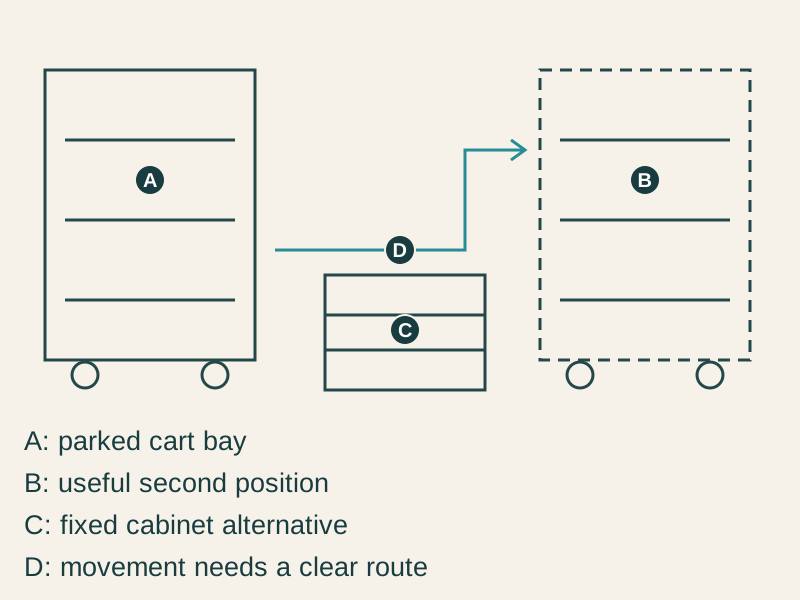
- A
- A: parked cart bay
- B
- B: useful second position
- C
- C: fixed cabinet alternative
- D
- D: movement needs a clear route
Use safe representative objects to simulate the assigned group. Check how the user grasps the cart, brings it out, turns and returns it without catching on handles or neighboring appliance doors. Review the selected cart's actual use instructions and limits. Do not infer support or stability from the existence of locking wheels.
Decide whether the cart is only storage or also a proposed work surface. If the household expects to fold clothing on top, choose and verify an appropriate actual configuration. A narrow shelf containing products does not become a folding counter because it is temporarily pulled into the center of the room. The task needs an adequate surface in its working position.
Compare a mobile accessory station
Imagine a hypothetical room with an accepted parking bay beside the equipment and a working position near the folding area. The cart carries handling accessories that travel together, so moving it actually brings the needed tools to the task.
In the trial, moving the cart brings the group to the work without taking over the passage. The selected cart's documented arrangement accepts the intended contents, and the owner can return it after the load. A fixed cabinet in the same bay would require repeated separate trips for those accessories. This household chooses the cart for an actual transport job.
Another room has only the parked bay. Pulling the same cart out occupies the standing position needed to unload the dryer, and leaving it there blocks the exit. That household chooses a fixed cabinet whose contents the users can comfortably retrieve instead. The product has not become worse; the second room cannot provide the operating space that would make mobility valuable.
Preserve service access without inventing a rolling counter
Identify what remains when the cart leaves. Any fixed countertop spanning the bay still needs its own reviewed support. Do not use a movable cart as an assumed structural leg for a top that the appliance installer may need to work beneath. If a removable work surface is intended instead, document that actual arrangement and its setup.
Finally, walk through an interrupted task. The cart, its contents and the laundry basket need acceptable temporary homes, and the user should understand how the selected parked arrangement is secured. Choose mobility when travel and return are deliberate useful actions. Choose the fixed cabinet when its stable location and actual compartments perform the work more reliably. The stronger purchase accounts for every occupied state rather than treating wheels as extra floor space.
Compare the finished bay when the cart is absent
Check the opening without the cart parked in it. Adjacent cabinet sides, countertop edges and any rear surface will then be visible and reachable. Include their accepted finished treatment in the fixed work, rather than asking the cart to conceal an incomplete cabinet installation. A fixed cabinet and an empty cart bay can require different end conditions even when they use the same outside width.
Measure the cart's complete removal path beneath any permanent top, including its highest fixed feature and the user's grip. A cart can fit in the closed bay but lose the hand position needed to bring it out. If contents must be removed before every ordinary move, include that unloading in the trial. Mobility bought for a complete accessory group should not depend on dismantling that group first.
Compare delivered scopes too: the fixed cabinet's usable hardware and any counter are one proposal, while the cart plus its finished parking bay is another. Do not compare a complete installed cabinet with the cart's retail price alone.
Sources & further reading
- IKEA USA: RÅSKOG utility cart with lockable casters