

Bath & laundry planning
Laundry tower or separately stacked machines: buy the replacement strategy too
Compare an integrated laundry tower with a separately stacked pair by identifying what the project will buy, operate, service and eventually replace. Similar tall outlines can hide different equipment identities and control arrangements. Separate machines offer useful flexibility only when their supported combinations and future choices are realistic; an integrated arrangement is attractive only when its complete package fits the household and the finished cabinetry.
Compare an integrated laundry tower with a separately stacked pair by identifying what the project will buy, operate, service and eventually replace. Similar tall outlines can hide different equipment identities and control arrangements. Separate machines offer useful flexibility only when their supported combinations and future choices are realistic; an integrated arrangement is attractive only when its complete package fits the household and the finished cabinetry.
Clarify what each quotation contains
The word tower is used loosely in shopping conversations. Ask whether the proposal contains a complete integrated product or separately identified washer and dryer models joined with the specified stacking system. Keep that identity in the cabinet plan. A photograph showing two circles cannot establish the equipment's construction, accessory requirements or replacement options.
Whirlpool's comparison distinguishes laundry centers from separately stackable washer-dryer sets. Structure and flexibility belong in the purchasing comparison, alongside the equipment's appearance.
Reading note: Whirlpool: laundry centers compared with separately stackable equipment.
Read the actual order as a set of items. The appliance proposal should identify the required accessories and configuration, while the cabinet proposal identifies the surrounding panels, storage and finished enclosure. A lower appliance price is not necessarily a lower completed price if essential components have moved to another quotation. Compare equivalent finished arrangements before deciding that either architecture is better value.
Try the controls and loading positions together
A control layout convenient for one user can be awkward for another. Test the actual candidate arrangement rather than assuming that every tall pair has the same operating position. Reaching a button is only part of the task: the person must also read it, select the intended operation, open the relevant door and handle the clothing.
The cabinet beside the equipment should be tested during that sequence. Its depth and opening direction can remove the place where the user would otherwise stand. A tall storage unit that completes an elevation may be less useful than a shallower cabinet or a clear transfer position. Preserve the difference between an equipment choice that helps the user and an enclosure that merely makes the choice look built in.
Ask what happens when only one function needs attention
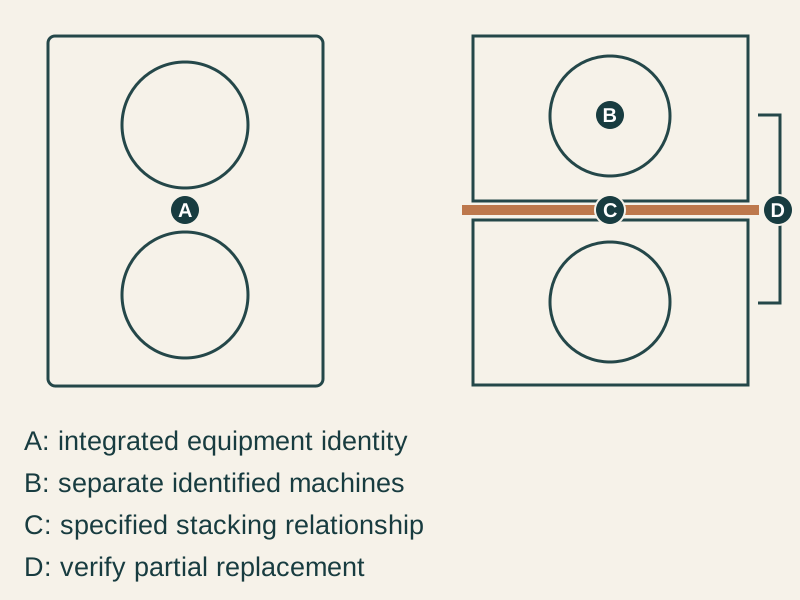
- A
- A: integrated equipment identity
- B
- B: separate identified machines
- C
- C: specified stacking relationship
- D
- D: verify partial replacement
Discuss a washer fault and a dryer fault separately with the appliance provider. Find out what access the selected system needs and whether surrounding work must move. Do not infer a service procedure from the number of exterior panels. An integrated product does not automatically require complete replacement for every repair, and separately named appliances do not guarantee that either can be removed without handling the other.
For a separate stack, ask how a replacement would be selected if the original pairing is no longer available. Retaining a working dryer is useful only if a documented compatible washer and stacking arrangement can actually be obtained when needed. The prudent purchase preserves model identities and an understandable access route; it does not promise that the owner can freely combine unrelated future machines.
Compare a partial-replacement scenario
Imagine an owner comparing Proposal A, an identified integrated tower, with Proposal B, separately identified appliances and their specified stacking kit. Both reviewed installations fit the room. This is a hypothetical purchasing comparison.
The owner's main concern is retaining one working function if the other becomes uneconomic to repair. The seller can explain the service path for both proposals, but cannot establish a supported replacement combination that would preserve the original upper machine in Proposal B. The owner therefore removes unrestricted partial replacement from the list of benefits credited to that proposal.
After comparing the actual control positions, load capabilities and completed enclosure, this owner chooses Proposal A. A different result would be reasonable if Proposal B had a supported configuration that met the user's priorities better. The lesson is to buy verified flexibility rather than paying for an assumed future that nobody has defined. This example does not predict parts availability or equipment life.
Keep the furniture from deciding equipment identity
The cabinet drawing should show the selected assembly's full installed shape and the open state needed for ordinary work. Match the enclosing panels to that shape only after the equipment choice is settled. If the cabinetry has already been fixed around a generic tower outline, ask what changes are needed for the actual product rather than forcing that product to resemble the rendering.
Consider the top of the assembly and the storage beside it as separate opportunities. An upper cabinet may look orderly but provide little practical access across tall equipment. Assign its contents only after an actual reach and retrieval test. Leaving an area without cabinetry can be a sound decision when the supposed storage would obstruct operation or make the equipment harder to access.
Compare the purchase over more than installation day
Keep the complete proposal, manuals and accepted accessory list together. Record which decorative parts can be removed, where their fasteners are reached and which trade handles that work. A visible seam should not be used as the sole evidence that a panel will come off when the equipment requires attention.
Choose the integrated arrangement when its verified package and controls serve the household well and its service consequences are understood. Choose separately stacked equipment when the supported pairing offers capabilities or configuration advantages that matter to the owner. Either can support a useful cabinet wall. The stronger order explains how the chosen equipment enters the room, works beside the storage and can receive service after the room is finished.
Sources & further reading
- Whirlpool: laundry centers compared with separately stackable equipment