

Bath & laundry planning
Does the laundry need a mending station or just a folding counter?
Reserve a mending station when someone in the household actually repairs clothes and the room can support the whole task without repeatedly displacing laundry. A folding counter is the better purchase when repairs are occasional, happen comfortably elsewhere or would require an impractical permanent equipment setup. A sewing machine stored beneath a counter does not by itself turn that counter into a usable repair station.
Reserve a mending station when someone in the household actually repairs clothes and the room can support the whole task without repeatedly displacing laundry. A folding counter is the better purchase when repairs are occasional, happen comfortably elsewhere or would require an impractical permanent equipment setup. A sewing machine stored beneath a counter does not by itself turn that counter into a usable repair station.
Name the repairs the household will perform
Start with the real operator and the work they expect to do. Reattaching a button with a small kit, repairing a seam at a machine and handling a bulky garment have different space and equipment needs. Decide which activities belong in this room. Do not buy a comprehensive sewing installation for an imagined future hobby if the actual requirement is a reachable, organized hand-mending kit.
Include the decision to send certain repairs elsewhere. A garment can be identified, tagged and set aside for professional repair without the laundry room becoming a sewing workshop. If that is the owner's routine, a small appropriate staging location may solve the problem more directly than removing a useful drawer bank to create a permanent knee opening.
Brother's support instructions show that removing the extension table changes the working configuration of listed sewing machines. Evaluate the actual machine's relevant configurations when planning its work surface.
Reading note: Brother USA support: removing an extension table for free-arm sewing.
Separate storage fit from working fit
A machine may fit inside a cabinet in its case while requiring a different footprint with its accessories fitted. Bring the actual case, machine, pedal, cords and routinely used attachments to the planning exercise. Identify what stays together, what is removed during work and where removed components will wait. A cabinet should not force the user to put a necessary accessory on the floor because its storage space disappears during use.
The working surface also needs room for the fabric. Trace how the garment arrives at the needle or hand-working position and where its weight rests. A narrow opening beside the machine may technically leave room for the appliance but allow fabric to catch on a cabinet handle or drop into a basket. Review the complete operation with the person who will perform it rather than deriving a sewing space from equipment width alone.
Compare seated work and standing folding
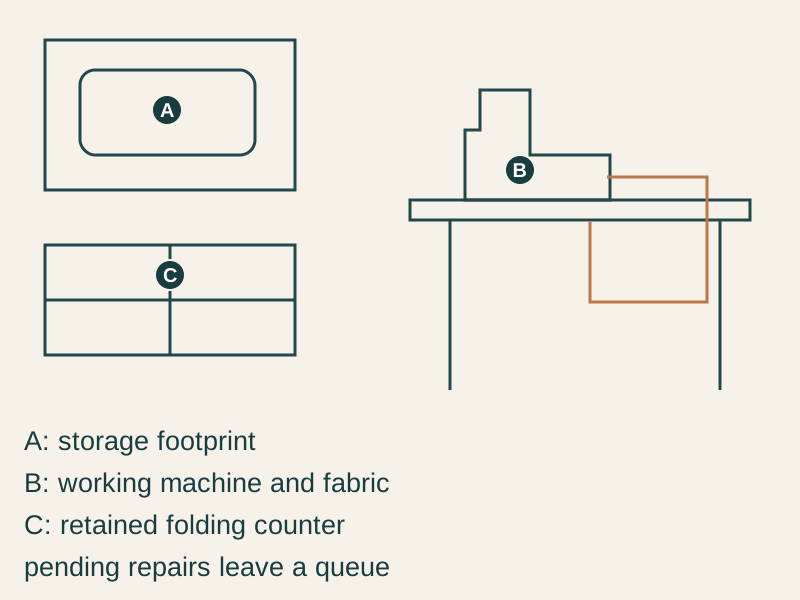
- A
- A: storage footprint
- B
- B: working machine and fabric
- C
- C: retained folding counter
Choose the actual working position with the operator and the relevant equipment. A counter successful for standing folding is not automatically the desired sewing height. If the plan uses seating, include the chair, the way it approaches, the operator's feet and the route out. A permanent knee bay removes cabinet capacity, so show which existing contents lose their home.
An adjustable or portable work surface may be worth comparing when the room cannot dedicate one position to both tasks. Its value depends on where it is stored and how easily the user can set it up, not merely on whether it can be purchased. Avoid assuming that a loose board laid across other furniture provides a suitable work support. Select an actual arrangement for the proposed task.
Follow a repair through to completion
Imagine a hypothetical household that occasionally makes small machine and hand repairs. Its laundry counter is also needed for the ordinary clean load, so the trial tests whether mending can coexist with folding.
The first plan puts a permanently exposed sewing machine at the center of that counter. The operator likes the immediate availability, but folding begins only after the machine and accessories move elsewhere. In the trial, they have no accepted temporary home and are left on the floor. A station meant to reduce setup has simply transferred its setup work into every folding session.
The revised proposal retains the folding counter and places a suitable separate work arrangement nearby. Its machine storage accepts the complete packed group, and the operator can retrieve it without emptying laundry supplies. A small pending-repair container separates identified garments from clean clothing ready to return. The owner chooses this configuration after accepting the deliberate setup for the less frequent repair session.
Prevent an unfinished repair from becoming permanent storage
Decide what happens when a repair is interrupted. The garment, loose parts and tools need an appropriate controlled destination; the machine does not make those objects safe or organized merely by sitting on a countertop. Specify the household's access and handling needs for the actual equipment and small tools. Keep these separate from the amount of empty drawer space in a rendering.
Give pending and completed garments different next steps. A repaired piece ready to return should not join the same undecided pile as something awaiting parts or an external appointment. A modest labeled container can support that distinction, but it should have a known owner and review routine. Otherwise a new cabinet compartment can preserve the backlog more neatly without helping a single repair finish.
Buy the station only when the operator will use it
Run through retrieval, setup, the representative repair, interruption and cleanup. Include the ordinary laundry work taking place in the same room. Frequent repairs may justify a dedicated station that remains ready without occupying the folding surface. Occasional work may be better served by protected equipment storage and a separate suitable surface that can be prepared when needed.
Approve the work position, machine configurations, accessory storage and garment destinations together. Choose a dedicated mending area when those parts form a credible regular routine. Keep the folding-centered cabinet plan when that is the room's dependable job and repairs have a workable alternative. The useful investment supports an identified person's repair habits rather than adding a machine-shaped promise to the laundry elevation.
Sources & further reading
- Brother USA support: removing an extension table for free-arm sewing