

Bath & laundry planning
A flat drying shelf for knitwear or more enclosed laundry storage?
Reserve horizontal drying space when garments that actually need that treatment appear regularly and can remain there without stopping other laundry work. Keep enclosed storage when those garments have a suitable flat-drying location elsewhere and the cabinet would otherwise lose necessary supplies. The choice depends on a garment's occupied footprint through drying, not the number of empty shelves visible in a showroom.
Reserve horizontal drying space when garments that actually need that treatment appear regularly and can remain there without stopping other laundry work. Keep enclosed storage when those garments have a suitable flat-drying location elsewhere and the cabinet would otherwise lose necessary supplies. The choice depends on a garment's occupied footprint through drying, not the number of empty shelves visible in a showroom.
Begin with garments rather than an accessory
Read the care instructions on the items the household really owns. Separate garments needing flat support from pieces that can use another permitted method. A hanging rail does not reproduce a supported horizontal surface, and an ordinary cabinet shelf does not become a drying system simply because it is level. Identify an actual candidate designed for the intended use, with an accepted location and operating arrangement.
Woolmark recommends flat drying wool knitwear unless the garment's care label permits tumble drying. That care distinction explains why some households need horizontal space.
Reading note: Woolmark: drying wool garments.
Gather the relevant garments and arrange them as they would be treated. Include sleeves and the space needed to position each item. Counting sweaters by their folded storage size understates the surface they occupy while drying. Conversely, permanently allocating several levels for garments rarely washed at home can remove storage used every day.
Measure occupied surface, not shelf count
Compare the candidate's usable support area with the laid-out garment. A wide outer cabinet can contain a much smaller working panel because the mechanism and frame also need room. If an item drapes over its edge or must be folded in an unintended way, increasing the number of panels does not resolve that fit problem.
Study access to every occupied level. The user should be able to place and remove an item according to its care without dragging it across another garment. The required configuration may remain open or extended while in use; show that condition on the room plan. A photograph of a neatly closed cabinet cannot establish how the room works during drying.
Account for the occupied drying time
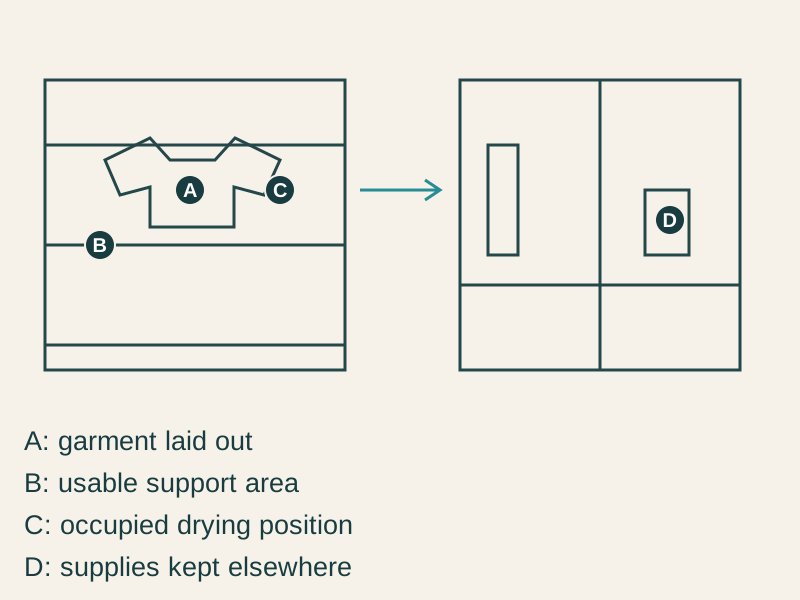
- A
- A: garment laid out
- B
- B: usable support area
- C
- C: occupied drying position
- D
- D: supplies kept elsewhere
Compare the laundry schedule with the time the surface is occupied, using observation of the household's own routine. Do not assign a promised drying duration from a cabinet illustration. If another garment arrives before a surface is available, identify its accepted destination. Additional washing capacity is irrelevant when the next required care stage has no receiving place.
Check what other work uses the same floor position. A panel extending over a basket route may prevent a later transfer even though the machine doors can open. A fixed flat-drying area may be easier to leave undisturbed, while a movable accessory may be reasonable when it can remain in an assigned location. Evaluate the complete arrangement rather than assuming retraction always saves useful space.
Compare a realistic allocation
Imagine a household that regularly washes 2 garments needing flat support in the same session. The first proposal offers 2 levels, but only 1 has sufficient usable area for either of the actual garments. The other level cannot accommodate either piece in its required arrangement. These are hypothetical planning counts, not accessory capacities.
Both garments cannot be assigned to that single suitable level at the same time. The household can change the washing sequence, provide another appropriate surface or select a different configuration. It should not approve the smaller arrangement by counting the unusable second level as an available drying place.
In the alternative proposal, an accepted flat-drying location outside the cabinet can accommodate the planned session. The laundry cabinet retains a compartment for supplies that otherwise occupy the folding counter. This owner keeps storage. Another household without that separate location may reasonably give the cabinet bay to a properly fitting drying arrangement.
Show what leaves the cabinet
Inventory the doors or drawers sacrificed to the drying system. Relocate supplies by category and access frequency, then test whether they interfere with the retained work surfaces. If the replacement shelf merely moves detergent onto the only folding area, the comparison has exchanged a visible drying problem for an everyday storage problem.
Ask how the selected support is kept ready for garment care and how its parts are accessed for ordinary cleaning under their instructions. Identify where the accessory is stored between sessions if it is removable. Avoid giving the same narrow gap to a stored accessory, a hamper and an open panel in different drawings.
Approve the working state
Keep the chosen accessory identity, support arrangement, usable surface and open position with the cabinet order. Record which garment group it serves and which storage moves elsewhere. This makes it possible to review a proposed substitution by its actual function rather than by the words drying shelf.
A horizontal drying allocation earns its place when a recurring garment requirement fits and can complete its care there. Enclosed storage earns its place when it supports the laundry routine and suitable garment care is already provided elsewhere. A useful room makes both the occupied garment and the displaced supplies visible before the cabinetry is purchased.
Sources & further reading
- Woolmark: drying wool garments