

Bath & laundry planning
Garment steamer or ironing station: which belongs in the laundry cabinet plan?
Choose the garment-care method that produces the finish the household actually wants, then buy storage and working space for the complete equipment. A steamer can need a tall working garment position; an ironing station needs its deployed board and access around it. Comparing only the sizes of the appliances when stored can lead to buying a cabinet that hides the equipment successfully but leaves nowhere useful to operate it.
Choose the garment-care method that produces the finish the household actually wants, then buy storage and working space for the complete equipment. A steamer can need a tall working garment position; an ironing station needs its deployed board and access around it. Comparing only the sizes of the appliances when stored can lead to buying a cabinet that hides the equipment successfully but leaves nowhere useful to operate it.
Define the finish before choosing the cabinet accessory
Bring representative garments to the equipment decision. Identify whether the owner expects a pressed edge, a particular collar finish or a less structured everyday result. Check the garment care information and the candidate equipment's instructions. The word steam appears on several product types and does not make their methods, accessories or results interchangeable.
Rowenta presents irons, garment steamers and steam stations as distinct garment-care choices. Select the actual format before assigning its cabinet space.
Reading note: Rowenta USA: irons, steamers and garment-care formats.
The cabinet brief should name the selected task rather than simply request a hidden ironing area. If the household rarely presses but regularly prepares hanging garments, a board-centered design may reserve valuable floor space for an infrequent operation. If the owner wants a finish that the shortlisted steamer does not provide, a smaller storage footprint does not make it an equivalent replacement for the ironing arrangement.
Draw the equipment in use
For a steamer proposal, show the exact product, its intended support, the garment position and the user's working movement according to the instructions. Do not assume that a cabinet door, ordinary drawer pull or decorative rail is a suitable garment support. The hanging location has to belong to a reviewed arrangement, with a clear route to lift garments on and off.
For an ironing proposal, show the board fully deployed and the operator's position alongside it. Include garment overhang and the motion needed to reach the work, not merely the board's narrow outline. If the system folds or rotates out of a cabinet, review the whole travel and its support. A cabinet accessory that fits when closed can still occupy the passage the room needs while someone is ironing.
Keep working equipment separate from stored equipment
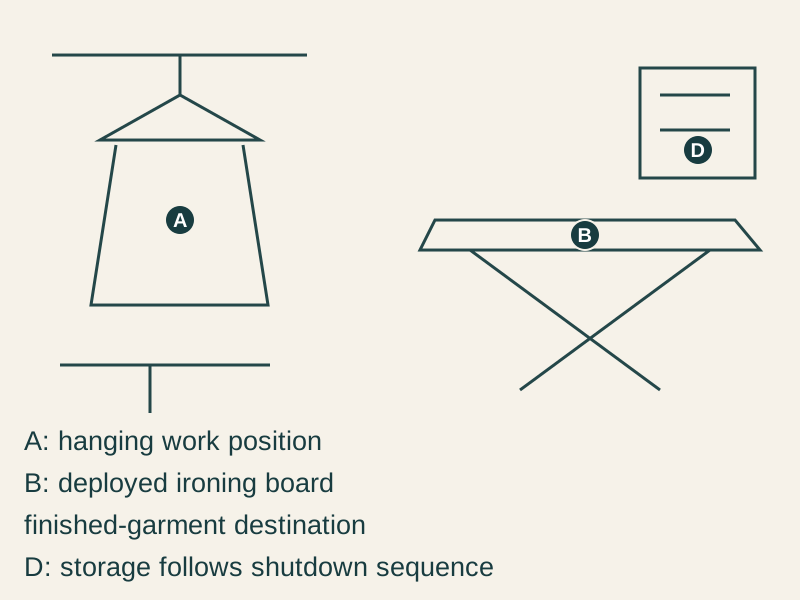
- A
- A: hanging work position
- B
- B: deployed ironing board
- D
- D: storage follows shutdown sequence
A built-in cabinet is not automatically a permitted operating enclosure. Decide whether equipment is removed for use or designed to operate in its installed position, then follow the actual product requirements. A steam hose, water container or power cord should not be given an improvised route through a closing door simply because the appliance's main body fits inside.
Follow the equipment's instructions for shutdown, cooling, water handling and storage. The cabinet plan should provide the sequence and positions needed to follow them. It should not invent a universal waiting time or presume that a lined compartment makes warm equipment suitable to put away. A place for the item after use is a different task from a place that makes it immediately disappear during use.
Compare the room through a realistic session
Imagine a hypothetical household that usually prepares clothes in a hanging position and occasionally uses a separately chosen pressing routine. Both methods have been checked against its garments and selected equipment.
The first cabinet proposal contains a fold-out ironing board across the room's only through-route. It fits when closed and looks orderly in the elevation. When the owner walks through the preparation sequence, somebody carrying a laundry basket must wait until the board is folded. The cabinet has solved storage while creating a recurring conflict during the work.
The alternative gives the frequently used hanging process an independently reviewed operating position, keeps its equipment in an appropriate removable-storage arrangement and retains a separate suitable board for the less frequent pressing task. The owner accepts moving that board into its usable position on the occasions it is needed. This choice follows the frequency of the two tasks; it does not claim that the steamer replaces the iron.
Give unfinished and finished garments different positions
Decide where clothes wait before treatment and where they go afterward. A single hanging rod that must hold both groups can require continual shuffling. This is especially noticeable when the next garment needs to occupy the exact support position being used by completed pieces. A second appropriate destination may be more useful than adding another supply drawer.
Keep those garment positions out of neighboring cabinet openings and appliance doors. Test the longest ordinary piece with its hanger and the actual removal motion. If a counter lies below the garments, decide whether it is still available for folding during this work. Do not credit the same space as fully available to both tasks without testing their overlap.
Purchase a routine the household will repeat
Compare retrieving the equipment, setting up, preparing clothes, shutting down and returning everything to storage. An occasional extra setup step can be acceptable when it avoids a permanent obstruction. For a daily routine, however, repeated rearrangement may justify reserving a more convenient working position even if the cabinet volume is smaller.
Approve the selected equipment format, operating location, storage location and garment destinations together. Choose a steamer-centered cabinet plan when that actual method serves the regular work and its complete arrangement fits. Choose an ironing-centered arrangement when pressing is the recurring priority and the deployed board works in the room. A useful laundry cabinet supports how clothes are prepared, rather than selecting the method merely because an accessory can be hidden.
Sources & further reading
- Rowenta USA: irons, steamers and garment-care formats