

Bath & laundry planning
A drying cabinet or an open drying zone: which belongs in the laundry plan?
Compare a purpose-built drying appliance with a complete open drying area. The choice changes how wet clothes occupy the room, not just how a tall cabinet looks.
Buy a drying cabinet when a defined no-tumble drying task justifies a dedicated appliance and its installation. Keep an open drying zone when suitable hanging and flat-drying supports already serve the household without taking over other work. Compare both as complete laundry arrangements. An ordinary enclosed storage cabinet is not a substitute for a purpose-built drying appliance, and a new appliance does not make every garment suitable for heated drying.
First identify the clothes that bypass the tumble dryer
Follow the care instructions on the actual items. Separate garments that may hang from those that need flat support, and identify any limits on heat or the drying method. A collection of clothes that all avoid the tumble dryer may still require different arrangements. The fact that they fit behind one tall door does not establish that they can be dried together in one cycle.
Then look at the household's usual batch rather than its entire wardrobe. Are a few shirts left on hangers, or do spread-out items occupy the folding counter whenever laundry is done? How soon must that surface be available again? These observations reveal whether the problem is a missing support, an unsuitable drying location or a recurring need worth buying equipment to address.
Staber's DCR-1000 guide illustrates a purpose-built drying cabinet with folding shelves and a warm-air system for no-tumble drying. The example identifies a product type; it does not establish suitability for every fabric or permission to reproduce it inside a wooden cabinet.
Reading note: Staber — Residential Drying Cabinet DCR-1000 specification guide.
Draw an open drying area that actually works
The open alternative needs more than a rod in leftover space. Give hanging garments their full drop and provide appropriate flat support for items that require it. Check loading and removal with the supports occupied. If a folding rack is part of the plan, include where it stands during use and where it goes afterward. Its stored thickness is not its working footprint.
Keep the folding surface available if drying and folding occur at the same time. A proposed counter cannot be counted once as a flat-drying area and again as an empty countertop during the same load. The household may accept a shared surface used at different times, but that sequence should match its routine rather than a promise made to preserve a tidy elevation.
The room conditions still matter. Confirm that the proposed drying location and moisture handling are suitable for the project. Open supports do not themselves establish appropriate drying conditions, just as closing the door on wet clothing does not solve moisture management. The cabinet finish is selected after this use of the room is resolved.
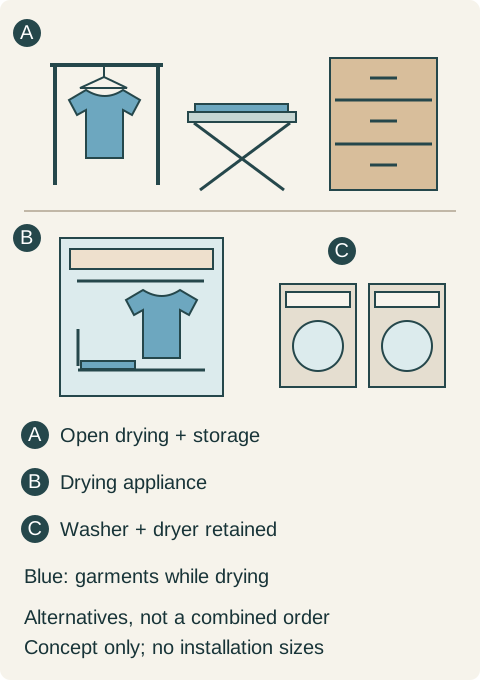
What the appliance replaces—and what it leaves in place
A drying cabinet may gather suitable garments into a defined equipment position. It does not wash them, fold them or put them away. Compare its intended task with the tumble dryer the household already uses; do not silently delete that machine if it still handles ordinary loads. A steam clothing-care appliance chosen for refreshing garments is also a different purchase from equipment selected to dry the household's wet laundry.
Review the proposed internal arrangement with the actual garments. Folding a shelf away to make room for a long item can remove a flat-drying position. Do not add every possible shelf and hanging configuration together as if all were available simultaneously. The selected configuration, permitted loading and appropriate settings need confirmation for that appliance and those items.
The surrounding cabinet order follows the reviewed equipment installation. Account for its air requirements, connections, door operation and service access using current instructions and the responsible installer. No furniture door, overhead bridge or continuous top should be included merely because a product photograph looks built in. Obtain the equipment and installation scope together with the neighboring storage quote.
A household chooses the open arrangement
Consider a hypothetical laundry renovation in which the owners usually tumble-dry ordinary loads but dry knitwear flat and hang a few other suitable items. Their frustration is that the knitwear covers the only folding counter. They initially ask for a drying cabinet, assuming that eliminating the visible rack will also make the room work better.
The revised open plan gives the flat-drying rack a dedicated position clear of the loading route, keeps a separate hanging area, and leaves the folding counter available. During a full-size trial, the usual drying batch fits its intended supports while the owners can still unload the dryer and fold clothes. Drying duration is acceptable in their existing routine; the trial is a space and handling check, not a measured comparison of appliance performance.
The appliance alternative occupies the position proposed for an ordinary supply cabinet. Its complete quote includes the reviewed installation and the remaining supports needed for any garments outside the appliance's confirmed use. The owners would gain an enclosed drying position but lose supply storage and take on an additional appliance. They have not identified a recurring drying task that the workable open plan fails to serve.
They therefore order the supply cabinet, dedicated open supports and separate folding surface, retaining both existing laundry machines. They omit the drying appliance and the extra upper cabinet that would obstruct the hanging garments. This decision keeps a visible drying area by choice; it does not pretend that an empty showroom laundry is the everyday goal.
When the other choice deserves another look
A household whose compatible drying loads repeatedly displace necessary work may reach the opposite conclusion. It should compare the intended appliance in its approved configuration with a properly designed open alternative, including installation, ordinary operation and where dry items go next. A useful demonstration uses representative permitted garments and the intended support arrangement, rather than relying on a closed door or a headline capacity.
Choose the package that completes the actual laundry sequence. For the example household, better open supports solve the problem and preserve storage. For a buyer with a demonstrated equipment need, the dedicated drying cabinet earns its place as an appliance, with the remaining cabinets sized around it.
Sources & further reading
- Staber — Residential Drying Cabinet DCR-1000 specification guide