

Bath & laundry planning
Automatic detergent dosing or manual supplies: what storage changes?
Automatic detergent dosing can reduce how often the regular detergent container is handled, but it does not eliminate its refill storage or the rest of the laundry inventory. Buy cabinets around the actual dosing system, products and refill task. Keep a manual-supply arrangement when its flexibility suits the household better. The right comparison separates everyday handling from periodic replenishment instead of deleting the detergent cabinet when the machine gains a reservoir.
Automatic detergent dosing can reduce how often the regular detergent container is handled, but it does not eliminate its refill storage or the rest of the laundry inventory. Buy cabinets around the actual dosing system, products and refill task. Keep a manual-supply arrangement when its flexibility suits the household better. The right comparison separates everyday handling from periodic replenishment instead of deleting the detergent cabinet when the machine gains a reservoir.
Identify what the equipment actually dispenses
Read the selected washer's instructions for the available dispensing system and permitted products. Do not assume that a reservoir described for detergent handles every other laundry product or that every automatic system works the same way. Name what remains manually handled, including items used only for particular loads. Those articles still need appropriate storage in the room or another accepted location.
Whirlpool describes Load & Go as a detergent-storage and automatic-dispensing system that needs refilling. A reservoir changes the frequency of container handling; it does not remove that task.
Reading note: Whirlpool: Load & Go detergent dispensing and refill.
Keep the equipment feature separate from a promised result. This cabinet comparison does not establish a universal quantity of detergent saved or a fixed number of loads between refills. Those depend on the specific system and its conditions. The relevant purchase question here is where the user retrieves the refill container and how it reaches the selected dispenser without disrupting the rest of the room.
Map everyday use and refill use separately
For manual dosing, trial the actual container, measuring method and placement near the machine under the applicable instructions. Identify the ordinary reach and return movement. A narrow pullout may look well positioned but be inconvenient if its opening does not let the user grasp and lift the full container in the intended way.
For automatic dosing, walk through retrieving the refill supply, opening the real dispenser, filling as instructed and returning the container. Do not locate the reserve solely by how rarely it is used. A heavy or awkward container still has to be managed when replenishment occurs. Test that movement with an appropriate safe mockup rather than attempting a spill-prone rehearsal with actual product.
Count the inventory that remains outside the machine
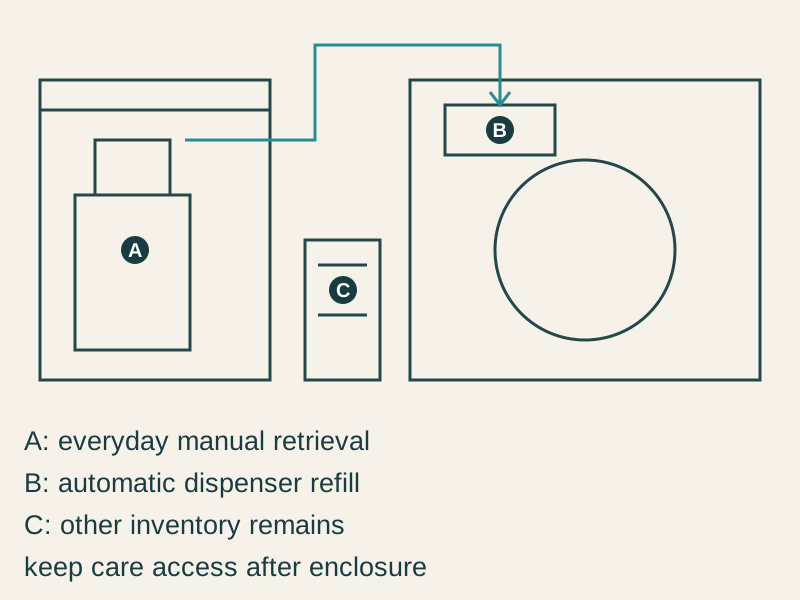
- A
- A: everyday manual retrieval
- B
- B: automatic dispenser refill
- C
- C: other inventory remains
List routine detergent, products for specific accepted uses and backup stock separately. Automatic dispensing may change which item deserves the closest position, but it does not make their original containers smaller. Compare the assigned cabinet interior with the real packages and their retrieval movements, not merely the volume advertised for the machine's reservoir.
Avoid transferring products into unmarked decorative vessels just to fit a preferred drawer layout. Preserve the applicable product information and storage requirements in the household's arrangement. The cabinet design should accommodate the chosen products appropriately or the household should knowingly change what it buys. A rendered collection of identical jars is not evidence that the actual laundry inventory will fit.
Compare a cabinet reallocation
Imagine a hypothetical household that keeps refill detergent, products used only for selected loads and laundry tools alongside its routine detergent. The automatic system changes daily dispensing, but each retained item still needs a suitable location based on its actual package and storage instructions.
In the manual proposal, the routinely handled detergent occupies the easiest suitable cabinet position and the reserve sits elsewhere. In the automatic proposal, the refill task occurs less often in the owner's accepted routine, so that nearest position can serve the accessories now retrieved more frequently. The reserve still has an appropriate home and the owner can complete the refill movement.
The household selects the automatic arrangement for this redistribution, retaining the cabinet rather than deleting it. The gain is fewer routine container movements and a better location for the items still used by hand. If the selected refill movement were awkward or the household frequently used products outside that system, a manual arrangement could remain the more useful purchase. The example does not promise measurable detergent or time savings.
Check access to the dispenser after cabinets are added
Identify the actual dispenser location and opening movement before choosing overhead cabinets, side panels and a countertop. A closed-machine outline does not show a drawer or lid extended for refilling. An apparently clear upper cabinet can still interfere with the way the user holds a container over the relevant opening.
Review the product's routine care as well as adding detergent. A removable compartment may require a different path from ordinary operation. Preserve the actual manufacturer-described access, and have the complete appliance installation reviewed independently. A convenient storage shelf cannot compensate for a dispenser that the finished room prevents the user from maintaining.
Decide which flexibility the household values
Ask how consistently the home follows one suitable routine and who operates the equipment. A stable, clearly understood automatic arrangement may be convenient. A household that needs varied permitted handling may prefer manual control, or may need a clear documented procedure for switching between its machine's supported modes. Cabinet planning should reflect the chosen routine without inventing capabilities the washer does not provide.
Approve the system identity, remaining manual inventory, refill movement, appropriate product storage and dispenser-care path together. Keep the most useful cabinet position assigned to the task that truly happens there most often, while making periodic tasks feasible too. Automatic dosing earns a storage change when the real workflow supports it; a reservoir alone is not a reason to remove a cabinet that the laundry room still needs.
Sources & further reading
- Whirlpool: Load & Go detergent dispensing and refill