

Bath & laundry planning
Compact or full-size laundry machines: compare the complete cabinet wall
Choose compact laundry equipment when its actual load capabilities suit the household and the recovered room makes another necessary task work. Choose full-size equipment when the selected larger drum serves recurring loads that the compact alternative cannot handle acceptably. The useful comparison includes the cabinet, counter and handling space gained or lost; a narrow appliance by itself does not prove a better small laundry room.
Choose compact laundry equipment when its actual load capabilities suit the household and the recovered room makes another necessary task work. Choose full-size equipment when the selected larger drum serves recurring loads that the compact alternative cannot handle acceptably. The useful comparison includes the cabinet, counter and handling space gained or lost; a narrow appliance by itself does not prove a better small laundry room.
State what the smaller footprint must buy
Start with a specific improvement. Perhaps the full-size pair prevents a door from opening normally, leaves no position for a basket, or consumes the only possible cabinet for household supplies. Draw the compact proposal with that improvement completed. An unexplained strip beside smaller appliances should not be credited as valuable storage before a cabinet with a useful interior can actually fit there.
Keep compact separate from stacked. A compact pair may stand side by side; a larger compatible pair may be stacked. Those arrangements change width and height differently. Compare the actual alternatives available to the project, including the access needed to operate the upper machine. Otherwise the exercise can accidentally credit compact equipment with a space saving that came primarily from stacking.
Whirlpool's sizing guide treats compact, standard and stacked equipment as distinct planning categories. Its general dimensions are a starting point, not an installation drawing for a selected pair.
Reading note: Whirlpool: washer and dryer dimensions and installation categories.
Compare ordinary loads rather than a capacity label
Describe the loads the household expects to process, including its regular bulky pieces and the items kept separate for care. Check each shortlisted machine's documentation for its actual capabilities. A numerical drum capacity does not by itself show whether the owner's particular bedding, garment mix or preferred care method belongs in that machine.
Frequency matters as much as bulk. A household comfortable washing smaller groups more often may reasonably favor compact equipment. Someone who can only attend to laundry during a limited weekly window may place more value on a larger appropriate load. Neither lifestyle deserves an assumed cycle-time advantage. Compare the owner's available attention and the selected equipment's operation without inventing universal performance differences.
Count usable cabinet space after installation conditions
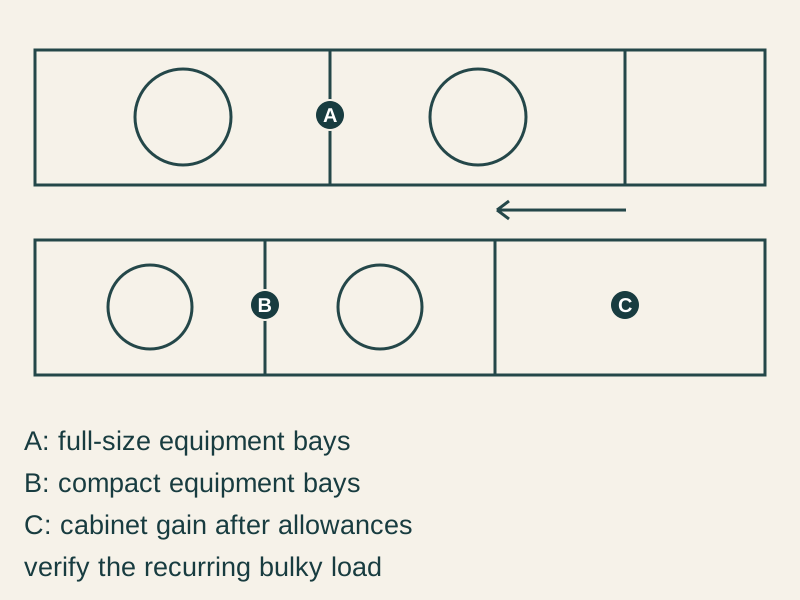
- A
- A: full-size equipment bays
- B
- B: compact equipment bays
- C
- C: cabinet gain after allowances
Lay out complete appliance envelopes, the reviewed connection positions, end treatments and cabinet construction. A reduction in machine width does not always equal the same increase in usable drawer width. A cabinet needs its own sides and moving parts, and a narrow leftover gap may not accept the supplies that motivated the change.
Also compare depth. A compact arrangement can change the counter's front edge, rear access and relation to upper cabinets. If the new counter is shallower, trial the actual basket and folding task on that surface. If a deeper common counter remains, identify its support and the reach to stored objects behind the smaller machine. Do not purchase a lower-capacity arrangement for a cabinet benefit that disappears in the completed elevation.
Work through the recovered space
Imagine a hypothetical finished wall 78 inches long. One reviewed full-size proposal allocates 60 inches to the two appliance bays and 18 inches to a cabinet. A reviewed compact proposal allocates 52 inches to the bays and 26 inches to a cabinet. Both total 78 inches. These are invented layout allocations, including project-specific allowances, not typical machine widths or required clearances.
In this hypothetical example, the compact choice recovers 8 inches of cabinet width. The owner tests the proposed 26-inch cabinet interior with the actual sorting bags. It holds the assigned group, while the 18-inch alternative does not. This demonstrates a specific storage gain; it does not claim an 8-inch improvement in internal width, because the two cabinet constructions still have to be reviewed.
The same owner finds that a regularly washed bulky item is not an accepted load in the shortlisted compact washer. Before choosing, the household identifies a workable separate routine for that item and decides whether it is willing to keep using it. In this example, the compact arrangement is selected only after that recurring exception is consciously accepted. A household unwilling to make that accommodation should retain the larger suitable equipment and revise its storage brief.
Test the whole day of laundry
Place the real baskets in the room and walk through sorting, opening, transfer, drying and return. A cabinet gained on the wall can still block the operating position if its open front occupies the only free floor area. Likewise, a compact machine with an inconvenient control or opening position may defeat the access improvement promised by its smaller body.
Think about what happens when a load finishes while another task occupies the surface. The added cabinet may be most useful for taking supplies off the counter, leaving that counter available for clothing. Its value need not be a dramatic increase in total storage volume. A modest drawer that prevents continual clearing and restaging can make a smaller room work more consistently than a larger cabinet used for miscellaneous overflow.
Approve a complete room choice
Retain the shortlisted model identities and configuration with the cabinet drawing. If the appliance choice changes later, recheck the finished bay, connections, door position and load assumptions. An opening labeled compact does not preserve all those relationships, and leaving a service route does not make it fit every future compact machine.
Choose the compact pair when its limits are acceptable and the completed cabinet gain performs a real recurring job. Choose the larger pair when its suitable load capability matters more than the alternative storage arrangement. The final order should explain both the clothes the machines will handle and the work the surrounding cabinets will support. That distinguishes a practical space saving from a smaller appliance placed in an otherwise unresolved room.
Sources & further reading
- Whirlpool: washer and dryer dimensions and installation categories