

Bath & laundry planning
A powered laundry receiver inside cabinetry or a carried-basket station?
A powered laundry-transport system deserves a cabinet allocation when a reviewed system can connect the real collection locations to a receiver that can be emptied, maintained and handed off to washing. Keep a carried-basket station when it completes that route more simply or when the receiver would remove essential sorting and handling space. Moving clothing to the laundry room is only the arrival stage of the work.
A powered laundry-transport system deserves a cabinet allocation when a reviewed system can connect the real collection locations to a receiver that can be emptied, maintained and handed off to washing. Keep a carried-basket station when it completes that route more simply or when the receiver would remove essential sorting and handling space. Moving clothing to the laundry room is only the arrival stage of the work.
Separate the transport purchase from the receiving cabinet
Identify the actual system, its collection ports and receiving equipment. A powered transport arrangement has different components from a same-floor pass-through opening or a gravity chute. A cabinet drawing cannot approve the transport route through the building. Have the appropriate system and project parties resolve that route before the cabinet is committed to a generic chute label.
Laundry Jet describes its Plus Vuelo receiving equipment as installed inside custom cabinetry. This is a cabinet-integration architecture, not evidence that any cabinet or house accepts the system.
Reading note: Laundry Jet: cabinet-integrated receiving equipment.
The cabinet supplier needs the selected unit and its current installation information, together with the project's accepted interfaces. Keep the system's own supports, connections and access requirements distinct from the furniture's appearance. A full-height front can conceal equipment visually while still being the wrong enclosure for it.
Draw the arrival and unloading states
Show where clothing arrives and what receives it after the equipment's prescribed cycle. Include the actual container or collection position, the person attending it and the next transfer. Do not give the same compartment to a full receiving container and a permanently stored ironing accessory.
Show how the person reaches and empties the receiver under the selected system's instructions. An opening can expose the chamber without giving usable handling access. A door that opens fully while the room is empty may conflict with a basket or another worker during laundry. Include the ordinary work surrounding the receiver rather than treating it as a display appliance.
Preserve the decisions that transport does not make
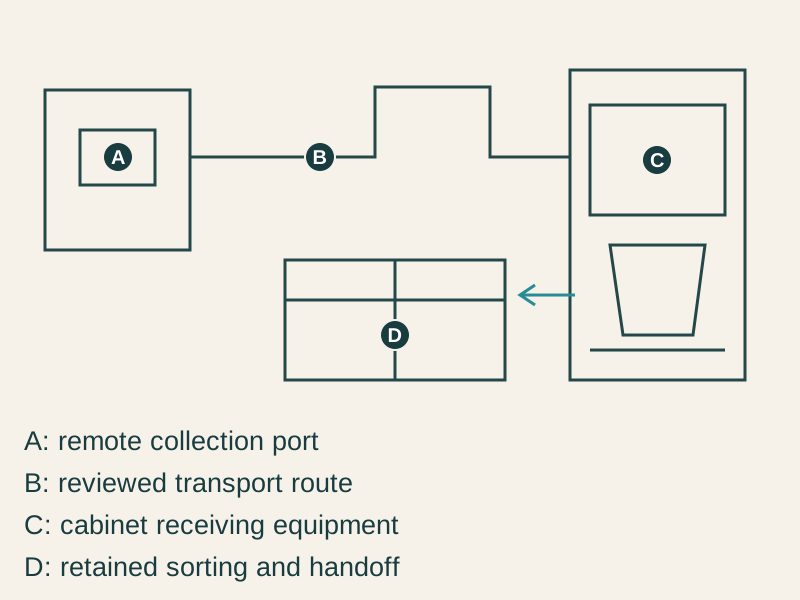
- A
- A: remote collection port
- B
- B: reviewed transport route
- C
- C: cabinet receiving equipment
- D
- D: retained sorting and handoff
Items arriving at the laundry still need assessment for their individual care and the household's chosen sorting. The transport system does not by itself establish that everything arriving together belongs in one wash load. Provide a place to distinguish the next tasks without immediately covering the only folding surface.
Trace clean clothing separately. A proposed return feature is another defined system arrangement to review; it should not be assumed to follow from buying an inbound receiver. If clean laundry will be carried back, compare that route honestly. An inbound transport purchase can be useful without being described as an automatically completed laundry loop.
Compare the lost cabinet job
For the carried-basket proposal, show where full containers wait, where they are emptied and where they go afterward. Name the supplies stored in the adjacent cabinet. For the receiver proposal, remove that cabinet's volume from the storage inventory and relocate its contents. Nominally preserving a wall of doors does not preserve its former storage behind the doors.
Retained counters also need real assignments. A receiver that eliminates a basket trip but forces routine sorting into another room creates a different work pattern. That may be accepted, but it belongs in the comparison. The owner should know which movements disappear and which are added.
Work through a hypothetical choice
Imagine a home where the transport route and selected receiver are accepted for the project. The first cabinet proposal places the receiver in the bay that holds sorting containers. Supplies from that bay would move onto the only useful laundry counter. This is a hypothetical project comparison.
The owners redraw the arrangement so the receiver's unloading position and an independent sorting cabinet coexist, while the folding surface remains available. The revised cabinet scope includes the equipment's reviewed access and the agreed installation interfaces. They choose the transport system because the recurring incoming route improves without sacrificing the work after arrival.
If the room cannot retain an accepted sorting and unloading arrangement, the basket station remains the stronger complete proposal. The system should not receive credit for the revised layout unless that layout actually fits the project. An appealing collection port in a bedroom cannot settle the receiving-room decision.
Ask what happens when the receiver is unavailable
Agree on an ordinary fallback for laundry collection while the system is being attended to or is unavailable. The household needs to know where clothing goes and how the laundry room receives it. Keep that temporary collection from blocking the selected access route to the equipment.
Record who attends the unit, who transfers the arrived clothing and who checks the collection locations. Automation changes the movement of items, but the proposal still needs named human tasks. It is easier to evaluate the purchase when those tasks are explicit rather than absorbed into the phrase laundry convenience.
Keep the enclosure replaceable on paper
Retain the unit identity, approved cabinet arrangement, accessible interfaces and project responsibilities together. Before accepting a different receiving unit, review the enclosure again. Similar-looking fronts do not establish equivalent equipment space or service access.
Choose cabinet-integrated transport when it improves the full incoming route and leaves a workable laundry station around the receiver. Choose carried baskets when their arrival, sorting and return are already practical or when system integration remains unresolved. The useful purchase ends with clothing ready for its next care decision, not merely hidden behind a closed door.
Sources & further reading
- Laundry Jet: cabinet-integrated receiving equipment