

Bath & laundry planning
One laundry room or two smaller stations: where should cabinet capacity go?
Create two laundry stations when both have a distinct recurring job, an accountable user and a complete usable workflow. Keep one central room when equipment, work surface and supplies would otherwise be duplicated without making the household's ordinary laundry easier to finish. Splitting machines between locations is not the same as creating two complete stations; each also needs its own storage, transfer and return arrangements.
Create two laundry stations when both have a distinct recurring job, an accountable user and a complete usable workflow. Keep one central room when equipment, work surface and supplies would otherwise be duplicated without making the household's ordinary laundry easier to finish. Splitting machines between locations is not the same as creating two complete stations; each also needs its own storage, transfer and return arrangements.
Define what each station will own
Assign clothes by their real origin, care or destination and identify the person handling them. Do not send difficult work between stations without showing that transfer. A compact secondary unit may serve its own modest routine while a main room handles other groups, but the separation must be intentional rather than a daily search for whichever machine happens to be free.
LG's showcase-home release describes laundry equipment in an owner's-suite closet and the main laundry. This is a historical layout example, not proof that two stations benefit a typical home.
Reading note: LG: laundry locations in the New American Home showcase.
Have each proposed installation reviewed for the actual equipment and site. A successful central room does not prove that a second location is ready for appliances. Keep that feasibility work in the scope comparison, alongside what cabinets and surfaces can fit after the selected equipment arrangement is resolved.
Duplicate only the storage the second routine needs
List the active products and handling accessories used at each location. A secondary station may need a smaller assigned inventory, but not an unexplained requirement to fetch its ordinary supplies from the other room every time. That recurring trip can remove the convenience that justified the second installation.
At the same time, avoid copying the main room's whole cabinet order. Shared reserve inventory may have an accepted common location, while active use stays local. Separate that deliberate replenishment from everyday fetching. Store the actual chosen products under their applicable conditions and household-access arrangements rather than assuming that a shallow decorative cabinet serves all supplies equally well.
Require a complete place for finished clothes
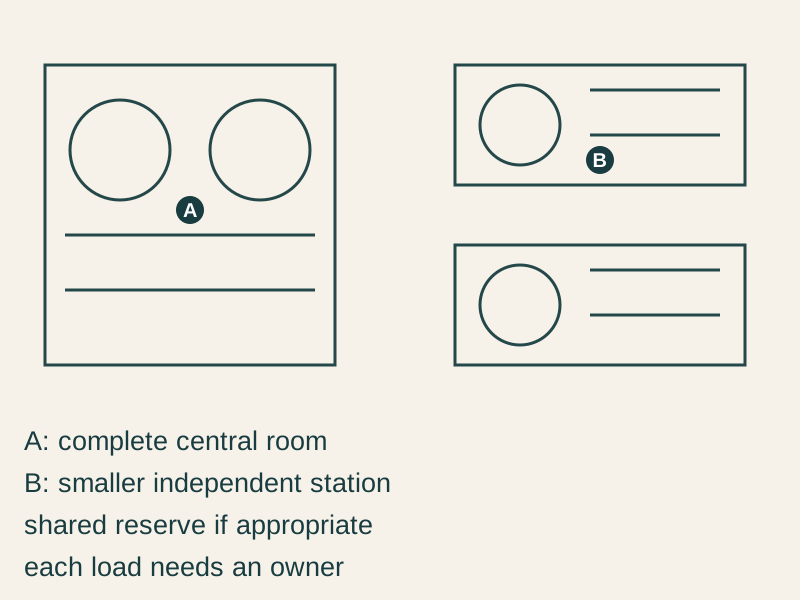
- A
- A: complete central room
- B
- B: smaller independent station
Where does clothing go when each machine finishes? A secondary station may need only a small suitable landing when its contents return directly to a nearby closet. Another routine may require meaningful folding and staging. Name the task before approving the cabinet and do not depend on the appliance housing as an unreviewed working surface.
Compare interruptions too. If the second station can wash but its user must carry the wet load or finished basket to the main room's only usable preparation area, decide whether that is still acceptable. The equipment has shortened one journey while creating another. Two independent-looking front elevations do not reveal that hidden dependency.
Compare a split household brief
Imagine a hypothetical home with separate living areas whose clothing has distinct return destinations. The secondary installation accommodates the reviewed equipment, but its proposed room has no accepted folding position.
The owner first assumes that separate living areas should each have a laundry station. Walking the work shows that both areas rely on the central room's existing counter. Clothes from the smaller station would travel there anyway, while the home would also keep a second active supply inventory and another equipment-care routine.
The revised proposal retains the central installation, improves its grouped receiving and return cabinets, and provides suitable collection and receiving points in the other area. This owner chooses one complete laundry room over two incomplete workflows. A home whose separate areas each have an operator, accepted handling space and independent return may reasonably choose two stations instead.
Keep capacity and responsibility separate
Two machines can offer overlapping operation only when the users and subsequent stages can handle it. Decide who starts, transfers and empties each station. Do not assume an additional appliance creates another person available to finish the work. A remote notification or a tidy cabinet does not assign responsibility for a load that has finished.
Also decide how exceptions move. A garment unsuitable for the secondary equipment might have an identified main-room route. Keep that occasional exception distinct from a second station that routinely cannot complete its assigned work. A credible small station has clear limits; it does not need to promise the main room's entire capability.
Buy two completed briefs or one stronger room
Prepare an equivalent scope for each alternative, including equipment arrangements, storage, work surfaces, ordinary care and any shared replenishment. A second location should not look inexpensive only because it borrows all the main room's functions without accounting for the trips. Compare the value of improving the existing room and its collection network with the value of a genuinely complete secondary routine.
Choose two when the independent tasks recur and each station earns its equipment and cabinets. Choose one when a better central surface, grouped transfer and clear ownership solve the real problem. The useful purchase follows who completes which work, rather than treating every available appliance niche as a reason for another laundry station.
Sources & further reading
- LG: laundry locations in the New American Home showcase