Choosing a cabinet interior that is practical to wipe clean
Inspect finished corners, shelf edges and accessible surfaces, and obtain the care instructions for the actual interior rather than judging it only by color.
A cabinet interior is practical to clean when its surfaces are identifiable, its edges are properly finished for the product, and ordinary wiping can reach the places where residue collects. Compare those details on a representative finished cabinet. A light color can make a spill easier to see, but it does not establish stain resistance, moisture resistance or compatibility with a particular cleaner.
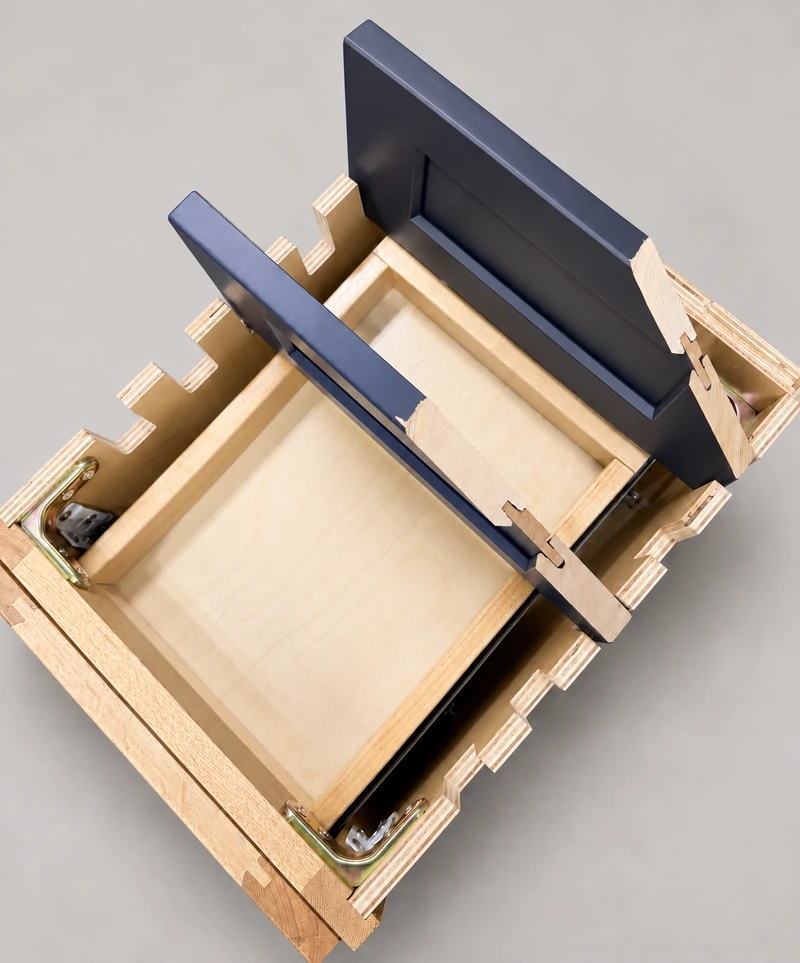
Physical sample The sample lets you locate bottom-to-side junctions and edges worth checking on a finished interior. The cutaway does not establish the finish chemistry, cleanability rating or moisture resistance.
Look beyond the broad shelf surface
Open the sample cabinet and follow the joint where the bottom meets the sides and back. Examine the shelf’s front edge, corners and any exposed fastening details. These areas may be less obvious in product photographs than the broad interior face. Note rough-looking edges or gaps and ask whether they represent the quoted finished product or only the display’s construction.
With permission, use a clean, dry, soft cloth to assess access on a safe sample area. Does it reach the corner without catching on a protruding detail? Can you see what you are wiping? This is an access check, not a stain or scratch test. Do not apply food, liquid or cleaning chemicals to a sales sample unless the owner has explicitly agreed to a suitable demonstration.
Identify the interior finish separately from the doors
The finish outside the cabinet may differ from the material facing its interior. Ask for the interior surface name, shelf finish and edge treatment instead of applying the door’s care instructions automatically. If the cabinet has a decorative interior option, clarify which surfaces change and whether the shelf edge remains the same.
KraftMaid’s care guidance uses gentle cleaning and thorough drying and cautions against abrasive cleaners. It is a useful manufacturer example, but another cabinet’s exact interior finish still needs its own compatible care instructions.
If an adjustable shelf can be removed according to the product instructions, confirm how its supports are released and retained. Do not pull a shelf out of a display by force. Knowing the approved procedure can make a later cleanup easier without damaging a shelf rest or losing a small part.
A removable tray or liner may help contain ordinary residue, but check whether its material is compatible with the finish and whether it can be lifted out without scraping adjacent surfaces. Adhesive backing should not be assumed acceptable. Avoid treating a liner as waterproofing or as a way to hide a damaged panel; spills can still require inspection around its edges and beneath it.
A worked comparison of attractive interiors
Imagine comparing a bright interior with an uneven-looking shelf-front seam against a slightly darker interior with a finished edge that is easy to reach. The bright surface may reveal crumbs more clearly, but that alone does not settle maintenance. Examine the seam on the actual product, ask what finish it uses, and obtain the approved cleaning method before deciding.
Now imagine adding a removable container for items that sometimes leave residue. Check the container’s contact surface and whether you can lift it without dragging it across the cabinet. If you need to empty the entire cabinet to reach a hidden corner, recognize that maintenance effort in your choice. A glossy photograph rarely shows that part of ownership.
Approve details that can be checked at delivery
Keep the selected interior surface, shelf treatment, visible-edge details and care document with the order. Photograph the representative finished corner and edge you approved. If a sample is unfinished or damaged, obtain a clearer reference rather than assuming the delivered interior will resolve every rough area.
Before filling the new cabinet, inspect for construction debris, damaged finish or unexpected exposed edges and report concerns. Follow the actual product’s cleaning instructions for the first wipe-down. If an interior later swells, peels or changes color, document it and seek an assessment instead of escalating to stronger chemicals. Cleanability is a combination of access, a known finish and suitable care; no single color or surface nickname proves all of those qualities.
Pure White
Cream White
Light Warm Gray
Gray
Navy
Black
Oak Tone
Dark Walnut Tone
Design study These finish studies are design references, not a list of currently orderable colors. Screens and lighting change the appearance; compare a physical sample before choosing.See all finish options →
A painted door, a wood-grain side and a plywood cabinet box can belong to the same cabinet. Here is how to read those parts, what the sample photos actually show, and which details to put on a quote.
Identify whether the visible cabinet end is an applied decorative panel, a finished structural side or a different construction option before approving the quote.
The sample shows the door frame, a separate center panel, the face frame and the cabinet box. Each component has its own place in this Shaker construction.
Shaker construction: door frame, center panel, face frame and cabinet box. The cutaway helps locate these parts; confirm each material in the specifications for the selected cabinet.
01 / Door frame
The Shaker door has rails and stiles around a separate center panel. The frame and center panel are different components; confirm their materials in the specifications for the selected cabinet.
02 / Face frame
The face frame surrounds the opening at the front of the cabinet box and sits behind the doors. The face frame, door frame and cabinet box are separate parts.
03 / Cabinet box
The sample exposes the cabinet sides, interior surfaces and layered edges. The image does not establish the wood species or material specification of a selected cabinet.