

Buying cabinets
Knob or touch controls on induction: choose how you change the meal, not just the glass
Try selecting and returning to different cooking positions, understand shared and individual controls, and buy the complete cooktop with its cabinet requirements and control-piece routine settled.
Compare the full sequence from choosing a pan to changing its setting
Choose a knob-controlled induction candidate when its actual selection and adjustment sequence is clearer and more comfortable for the regular cooks. Choose a touch-controlled candidate when its offered interface makes the same meal easier to manage. In both cases, the cookware arrangement and complete cabinet installation still need to work.
Do not buy solely because rotating feels familiar or a flat surface looks simpler. A shared knob can involve selecting a cooking position before adjustment. Touch controls can be individual or shared in different ways. The useful comparison is what this person does to this pan on this exact appliance.
Identify the interface the product actually supplies
Gaggenau describes a covered CI arrangement combining a touch power control with a magnetic knob for selecting cooking positions and adjusting power. Rotary and touch functions can therefore coexist on a particular product.
Reading note: Gaggenau USA — 200 Series CI induction cooktop, control architecture.
Ask the seller to demonstrate the proposed model and identify every action needed for the household's ordinary cooking. Find out which control selects a pan or zone, which changes it and what information confirms that selection. A knob on the glass does not mean every function has its own permanent physical switch.
For a touch candidate, establish whether the relevant controls are dedicated to each position or reused after selection. A photograph showing many marks is not a demonstration of the actual sequence. Keep the current product instructions with the model, especially where a similar-looking generation has different controls.
Start with an ordinary multi-pan meal
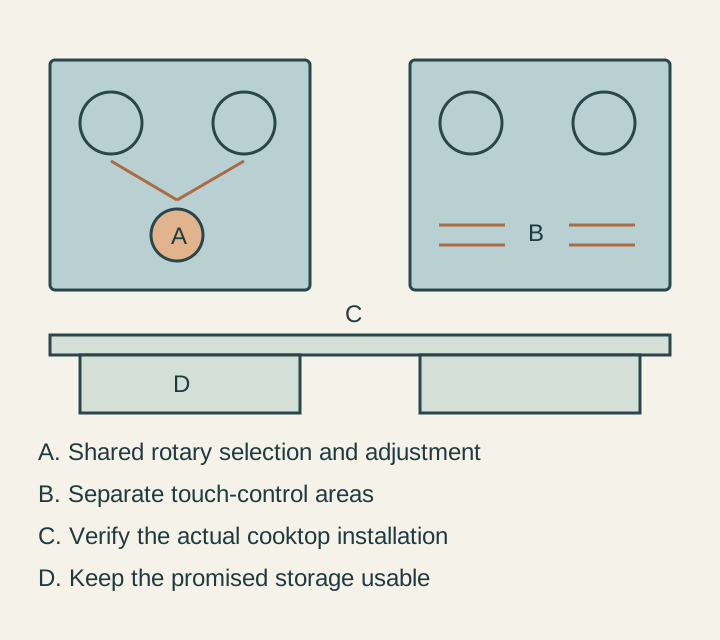
Place the real cold, empty cookware on the proposed cooking layout. Include handles, lids and the items that normally wait nearby. In an appropriate inactive demonstration, ask the user to identify the intended position, follow the documented selection and adjustment sequence, then move to another position.
Return to the first pan after that other action. Can the user tell which setting will change before making the adjustment? This return is often missing from a demonstration that starts with an empty surface and changes only one position.
Repeat with the busiest recurring cookware arrangement. If a handle obscures the display or occupies the hand's approach, identify the actual conflict. The candidate might need a different permitted cookware arrangement, or another interface could suit the same meal better.
Observe selection information as well as finger movement
The number of taps or turns is only part of the task. Look at how the chosen cooking position is identified, where the setting appears and how the user confirms the intended result. A short sequence that leaves the person uncertain is not automatically preferable to a slightly longer sequence they understand.
Use the actual room lighting and viewing angle where practical. Have every regular cook complete the same demonstration. Familiarity can help one person while another finds the product's markings unclear; the buying decision should acknowledge both experiences.
If the household expects shared cooking, have users explain their handoff. What can the second person see when approaching the appliance? They should understand the current selection rather than assume it remains on the pan they last used. This is a comprehension trial, not a promise that any interface prevents mistakes.
Consider the control piece throughout ownership
If the selected design uses a removable control piece, establish the documented handling and care routine. Identify where that exact compatible part goes when it is removed as directed and who returns it. Do not count an unspecified replacement as automatically interchangeable.
Keep its storage away from a cabinet assignment that makes the part difficult to find during the intended routine. If the household chooses to leave it in its permitted normal position, evaluate that actual choice instead of crediting an imagined permanently bare surface.
Check all expected functions under the product's instructions, including any control-lock or cleaning-related mode the buyer intends to use. The act of removing a piece, the presence of a knob and the absence of one are not substitutes for confirming those functions.
Cooking layout remains a separate purchase test
After the interface trial, confirm the same vessels work together in a supported configuration. A preferred control method cannot compensate for a recurring pot group that does not fit. Nor should an unsuitable pan force a conclusion that every touch or knob design is poor.
If another candidate changes flexible cooking areas, supported accessories or other features, compare those changes independently. The complete price difference may buy several things. Identify which demonstrated benefit the household wants rather than assigning all value to the control method.
For actual cooking behavior, use a suitable demonstration of the offered equipment. The cold trial answers layout, reach and understanding. It does not establish heating response, simmering or results simply because the user likes the control.
Keep the cabinet order tied to the complete appliance
Draw the selected appliance's body, controls, required connections and installation reservations in the actual counter and cabinet section. Determine whether any separate control assembly is part of that product. The visible interface alone does not establish what occupies the space below or in front.
Reserve the model's required spaces before counting the remaining utensil drawer. If a different candidate changes that arrangement, test the displaced tools in their proposed new location. Do not keep an unchanged organizer order merely because both products have the same shopping width.
Confirm the counter opening and supported mounting with the responsible professionals, along with the ventilation arrangement and affected surfaces. A change from one interface to another can accompany a different complete appliance; it is not necessarily a small interchangeable component purchase.
Buy the demonstrated routine at a complete price
Compare the selected cooktop, supplied controls, required accessories, installation and actual cabinet or counter changes. Include a separate control part where required rather than assuming it is present in a generic package. Keep common work constant.
Imagine a hypothetical household that initially favors a rotary control because it dislikes the old cooktop's shared touch selection. The new knob candidate is also shared. During the full meal trial, a regular user still loses track of which cooking position is selected after moving between pans.
A touch candidate with a different documented control arrangement is clearer to that user and the other regular cook. Both cookware and the cabinet section pass, with the displaced utensil group given a tested home. They buy that complete touch-controlled arrangement.
Another household may prefer the rotary sequence after the same trial and accept its control-piece care. Save the model, multi-pan return sequence, exact supplied parts and cabinet section together. The better method is the one the users understand during the meal and the kitchen can accommodate as a finished installation.
Sources & further reading
- Gaggenau USA — 200 Series CI induction cooktop, control architecture