A kitchen charging drawer needs room for the moving power assembly
Size the drawer around the outlet box, cable-management arms and plugged-in devices. An outlet face that fits the back panel does not prove that the whole assembly can move.
A charging drawer should be specified as a complete moving power assembly with a compatible drawer and electrical supply. The drawer must accommodate the outlet body, its cable-management mechanism and the devices while plugged in. A small socket opening in the drawer back is only one part of that fit.
Follow the power through the moving parts
The Docking Drawer Blade anatomy identifies the receptacle, cable-management arms and cord as parts of the assembly. Its cabinet diagram separately identifies drawer depth, cabinet depth and the space behind the drawer box. That separation matters: unused space inside the drawer does not replace space required behind it.
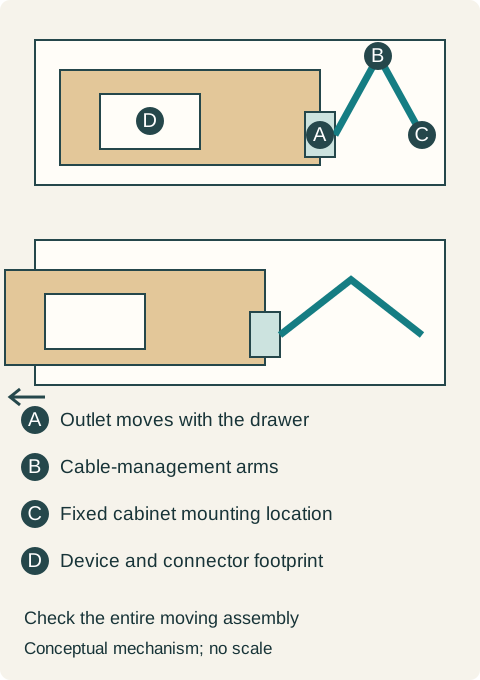
The drawer-mounted portion moves while the cabinet mounting position stays fixed. The arms manage that relative motion. Check the full path against slides, cabinet rails and neighboring drawers, not just the mechanism folded behind a closed drawer. A divider installed later must not enter the moving zone.
This is a purpose-designed product comparison. A loose power strip placed in a drawer does not reproduce the specified assembly. Select the exact outlet configuration and use its current installation instructions with the cabinet and electrical trades.
Read the shallow-drawer dimensions as separate tests
For the Blade Series shallow-drawer arrangement in the cited spec book, the minimum drawer-box outside width is 15 inches, minimum internal height is 3 inches, minimum space behind the box is 2 inches and maximum base-cabinet depth is 24 inches. These values belong to that documented arrangement; other drawer types have different specifications.
Width is measured outside the box, while height is measured inside it. The rear space is behind the box within the cabinet, not the depth of the empty tray. Passing one condition cannot offset failing another. A wide drawer with insufficient rear space still needs a different documented configuration or a different location.
The manufacturer provides additional details for nonstandard conditions. Those details need to be selected and coordinated, not improvised by removing drawer structure. Include access to the in-cabinet supply and the component's service needs in the cabinet design.
Teaching example Conceptual plan of a purpose-designed moving outlet: the socket body travels with the drawer, while articulated cable-management arms connect toward a fixed cabinet mounting point. The rear zone and the connected device inside both occupy space. This is not a mounting template.
The device layout comes after the assembly envelope
Place the devices with their actual plugs and cables attached. A tablet that lies flat without its connector may occupy more length while charging. Orient the outlet so users can insert and remove the intended connector without forcing it against the drawer side. Leave the mechanism's reserved area clear.
Decide whether the drawer is for charging phones, tablets or another stated collection. It should not silently become general storage that crowds the devices and conceals the outlet. Device care, charging conditions and the manufacturer's installation requirements still apply; the drawer's closed appearance is not a reason to ignore them.
One candidate fails even though the devices fit
In a hypothetical comparison, the first drawer has an outside width of 18 inches and an internal height of 3.5 inches within a 24-inch base cabinet, but only 1.5 inches behind its box. The phones fit inside, yet that rear space fails the cited shallow-drawer requirement. A neighboring drawer has the same width, height and cabinet depth with 2.25 inches behind the box; its checked arm path is clear.
The charging function goes into the neighboring drawer after the complete selected arrangement and supply are verified. Its placemats move into a measured unpowered drawer. The first drawer remains ordinary storage. No cabinet side is cut merely to recover the attractive original location.
The order should name the complete outlet assembly, the applicable mounting arrangement and the cabinet measurements used to verify it. Have the responsible electrician resolve the supply and required protection. The homeowner's useful check is that the specified assembly can move freely and the intended devices can be plugged in, retrieved and returned without occupying its reserved space.
Pure White
Cream White
Light Warm Gray
Gray
Navy
Black
Oak Tone
Dark Walnut Tone
Design study These finish studies are design references, not a list of currently orderable colors. Screens and lighting change the appearance; compare a physical sample before choosing.See all finish options →
Front proportions do not tell you the usable height inside. Group the actual objects, test their stored and removal positions, then compare the drawer combinations the selected cabinet system supports.
The sample shows the door frame, a separate center panel, the face frame and the cabinet box. Each component has its own place in this Shaker construction.
Shaker construction: door frame, center panel, face frame and cabinet box. The cutaway helps locate these parts; confirm each material in the specifications for the selected cabinet.
01 / Door frame
The Shaker door has rails and stiles around a separate center panel. The frame and center panel are different components; confirm their materials in the specifications for the selected cabinet.
02 / Face frame
The face frame surrounds the opening at the front of the cabinet box and sits behind the doors. The face frame, door frame and cabinet box are separate parts.
03 / Cabinet box
The sample exposes the cabinet sides, interior surfaces and layered edges. The image does not establish the wood species or material specification of a selected cabinet.