

Buying cabinets
Kitchen budget: upgrade appliances or cabinet storage?
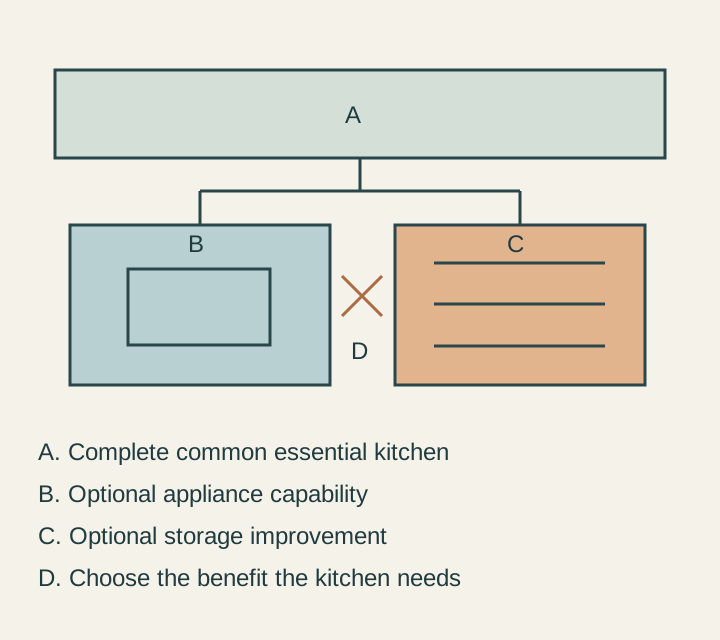
Keep a complete essential kitchen as the common baseline, then choose between an optional appliance capability and a tested cabinet-access improvement with the same remaining allowance.
Choose the improvement after the essential kitchen works
Put the remaining allowance toward an appliance when its demonstrated additional capability solves work the household values more than the competing cabinet improvement. Put it toward storage when the tested cabinet change makes important daily items easier to use and the accepted base appliances already handle the required cooking and cleanup.
Neither decision means buying an incomplete version of the other category. The base cabinets still need their required parts and usable storage. The base appliances must perform the tasks the family accepts. If the essential kitchen is not yet defined and priced, there is no reliable remaining allowance to allocate.
Establish a common completed baseline
IKEA's featured-kitchen breakdowns separate cabinets and appliances and identify exclusions from the displayed totals. Separate categories are useful, but a product-category total alone is not the complete kitchen scope.
Reading note: IKEA USA — Kitchen renovation ideas and costs, separate product categories.
For this choice, hold the required room work, accepted base equipment and complete cabinet package constant. Keep installation, connections, required panels and other necessary project items in the common baseline. Leave unpriced work visible rather than treating it as available money.
Then describe a genuine optional change on each side. An appliance upgrade that requires different support, utilities or surrounding cabinets must include those changes in its increment. A storage upgrade must include the cabinet construction and installation actually needed, not just an organizer's purchase price.
Say what the appliance increment does
Name the additional task, not the brand tier. It might be a particular simultaneous cooking arrangement or a supported access method that the family prefers. Demonstrate it with the actual cookware, food-storage collection or dish load relevant to that task.
Compare against the accepted base appliance under the same conditions. If the base already performs the job satisfactorily, the incremental benefit may be a preference rather than a missing necessity. It can still be worth buying, provided the owner values it honestly.
Include any work the upgraded appliance creates elsewhere. If its cabinet consumes a tray drawer or a useful stretch of preparation counter, reassign those functions before crediting the upgrade with a net improvement.
Say what the storage increment changes
Identify the actual item group and the difference between the base and upgraded retrieval sequence. A different drawer arrangement may eliminate the need to lift one object to reach another. A specialized insert may instead rearrange objects without helping the troublesome task.
Try the whole retained group in the final supported configuration. Do not demonstrate the organizer empty or remove the awkward cookware that motivated the change. Check closing, loading and return as well as the first retrieval.
Keep hardware quality, usable access and appearance distinct. A more decorative door can be a legitimate visual preference, but it should not be described as a storage-access improvement without a changed task. Conversely, a modest-looking interior can be valuable if it repeatedly resolves the household's problem.
Use the same limited allowance
Assume a hypothetical complete essential kitchen costs US$22000 and the household's chosen project limit is US$26000, leaving US$4000. An optional appliance change costs an assumed US$3000 including its effects; the storage change costs US$2500. Together they add US$5500, exceeding that allowance by US$1500. These are invented teaching totals, not supplier quotes or market estimates.
In the same hypothetical example, the appliance option produces US$25000 total and leaves US$1000 below the chosen limit. The storage option produces US$24500 and leaves US$1500. The unspent difference does not prove either benefit is better; it shows that both alternatives can be considered separately, while the pair cannot be silently combined.
Keep the scope of every assumed total equivalent. In a real project, replace teaching values with complete current written quotes. Do not make the comparison fit by dropping necessary work from one side, using a conditional promotion as guaranteed money or converting an unknown amount to zero.
Compare repeated work without inventing payback
Rehearse representative meals and normal storage use. Which improvement removes the frustration that actually matters to the people using the kitchen? A daily drawer benefit may outrank an occasional cooking feature, or a valued entertaining task may legitimately decide the purchase.
Frequency is one consideration, not an automatic formula. Do not convert a few observed movements into a promised lifetime saving or assume the more expensive equipment raises resale value. The owner is choosing an accepted experience within this project.
When people disagree, identify whose task each improvement serves and test both. A family member who seldom cooks may still have a real dish-return or breakfast task. Make the trade visible rather than awarding every discretionary dollar to the person selecting the appliance package.
Check what can realistically wait
If either change is proposed for later, obtain an actual compatible future path before assigning that flexibility value. An interior accessory might require specific mounting or cabinet dimensions. An appliance change might affect a counter opening or the entire surrounding cabinet.
Do not label a later upgrade easy merely because it appears smaller in the drawing. Compare the required work with the owner's willingness to revisit the kitchen. Where future compatibility is unknown, keep it unknown rather than promising the rejected option can be added cheaply.
There is also a valid choice to retain the completed baseline and spend neither increment now. If neither demonstrated improvement justifies its price to the household, the existence of unused allowance is not a reason to order more equipment.
A storage improvement wins a direct trial
Imagine a hypothetical household whose accepted base cooking appliances handle its ordinary meals. A more elaborate appliance proposal offers a supported extra task, but the family values it mainly for an occasional event. Its daily frustration is moving several pans to reach a frequently used pot.
The storage alternative provides a tested arrangement that holds the complete cookware group and improves that retrieval without taking the required preparation surface. The family accepts the base appliance task for the occasional event and chooses the cabinet improvement.
Another household may choose the demonstrated cooking capability and accept the base storage sequence. Keep the common baseline, complete incremental scopes and accepted task tradeoff with the selected cabinet order. That record explains why the money went where it did, without calling either appliances or cabinets universally more important.
Sources & further reading
- IKEA USA — Kitchen renovation ideas and costs, separate product categories