

Buying cabinets
Keep the appliances when buying new cabinets, or replace the whole group?
Retain appliances that still meet the household brief when their refitting and cabinet constraints are acceptable. Replace selectively or as a group when a demonstrated need justifies the full change.
A cabinet purchase does not automatically require new appliances
Keep the existing appliances when their actual condition, performance for your meals and installation in the new cabinets remain acceptable. Replace the whole group when the household gains enough from the accepted replacements to justify their complete cost and cabinet consequences. Also compare selective replacement. A useful oven should not have to leave merely because the refrigerator no longer works for the family.
Start with the tasks that prompted the cabinet project. If the problems are inaccessible cookware and an awkward preparation run, new appliances may leave those problems untouched. If the refrigerator cannot hold the accepted groceries or the cooking arrangement repeatedly fails an important meal, cabinet work creates a chance to address that equipment problem deliberately.
Separate a known problem from a guessed remaining life
Record the exact installed models and the observed reasons to keep or replace each. Note faults, unsatisfactory tasks and any current service assessment. Age can inform the questions you ask, but it does not supply a guaranteed failure date. Do not assign an invented remaining life or assume that replacing everything eliminates future repair risk.
If an important appliance has an unresolved fault, obtain a relevant service assessment before designing a highly fitted cabinet arrangement around it. The assessment may support repair, replacement or further investigation. This guide cannot turn an unidentified noise or intermittent symptom into a verdict.
Keep appearance in the decision, too. A homeowner can value a coordinated new front enough to buy it, but call that an appearance preference. Do not describe a still-accepted machine as functionally obsolete simply because its handle differs from the proposed group.
Design from the actual retained installation
GE’s cooktop buying guidance directs buyers to the installation instructions for exact cutout dimensions before cutting cabinets or countertops. A retained model also needs its actual documentation in the new cabinet design.
Reading note: GE Appliances — Cooktop Buying Tips, installation information.
Give the cabinet designer the model identity and the supported arrangement for every appliance being retained. Include the existing accessories that will move with it and identify what is missing. A photograph of a familiar front cannot establish the body, connections or installation opening behind it.
Show the retained equipment in the proposed cabinet section and elevation. A refrigerator can remain the same machine yet meet a different neighboring wall or taller panel after the remodel. An oven moved to a new cabinet has a new support and interface to verify. Previously installed is not a blanket approval of every new location.
Check the operating arrangement as well as closed fit. Use cool, empty cookware and ordinary containers to test access, loading and the surrounding counter. The purpose of new cabinets is partly to improve this working relationship. Do not preserve an inconvenient interface solely because the appliance itself is being kept.
Count removal and refitting as real work
A retained appliance is already owned; it is not necessarily free to keep through construction. Define who disconnects, removes, protects, stores, reinstalls and checks it, with the appropriate work assigned to responsible professionals. Include access and any model-specific parts needed for the accepted reinstallation.
Document its condition before the handoff and identify the storage location. If the household will use it temporarily elsewhere, that arrangement needs separate acceptance. An appliance awaiting installation should not become an unplanned jobsite table or be repeatedly moved without an agreed handling plan.
Bring the retained and new proposals to the same completion point. Compare purchase cost where applicable, handling, connection work, cabinet changes, counter modifications and disposal or removal scope. Keep quoted costs separate from a hoped-for future sale of the old machine. A possible resale receipt is not money already recovered.
Avoid paying for a future replacement promise
A tightly fitted surround can make the room look deliberate. It also needs honest boundaries. You can record the current opening and preserve a practical way to remove the appliance, but you cannot guarantee that an unknown future product will use the same dimensions, panels or connections.
Ask what cabinet components can be replaced independently if a later machine differs. A removable decorative part may be useful, but it is not permission to omit necessary support or required clearances. Compare an accepted current design with a clearly identified alternative; do not redesign the kitchen around an imaginary future model.
If a retained appliance forces a cabinet compromise you dislike today, include that cost now. Keeping it for a hoped-for short interval can be expensive if the project requires a special front and then another reconstruction. Conversely, buying new equipment merely to avoid every imaginable later alteration can spend heavily without solving an actual present need.
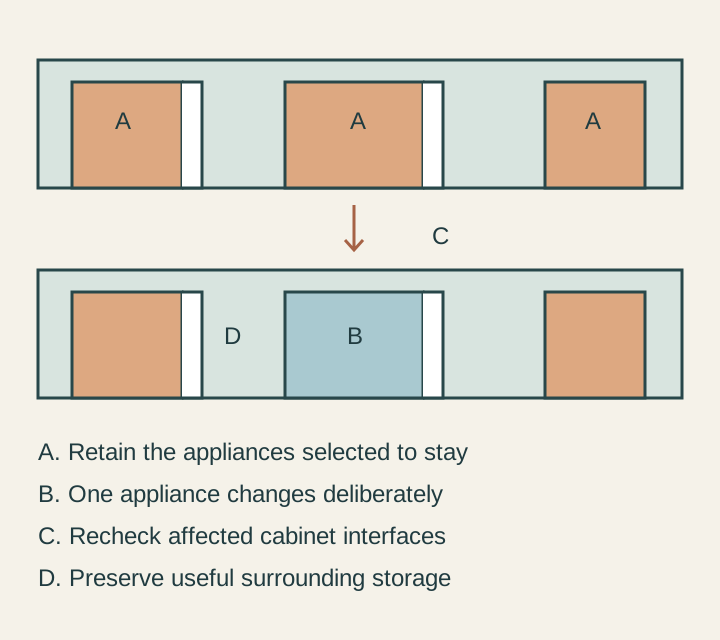
A household changes the refrigerator and keeps the cooking equipment
Consider a hypothetical kitchen whose oven and cooktop meet the family’s tested meal requirements. Its refrigerator no longer accommodates the regular grocery load conveniently. The owners compare retaining everything, renewing the full group and changing only refrigeration while buying the new cabinets.
The selected refrigerator option resolves the grocery problem and has an accepted cabinet arrangement. The retained cooking equipment works in the revised run, with its actual openings, support and connections reviewed. The dishwasher also passes the household’s load and control trial. The family accepts the visible differences among the fronts.
They choose selective replacement. The budget includes careful removal and refitting of the retained pieces, the new refrigerator and the cabinet changes around it. The saved purchase expense supports the drawers and preparation layout that motivated the remodel. No forecast of remaining appliance life is required to explain their choice.
If the retained cooking equipment had forced an unacceptable work-surface arrangement, the all-new option might have earned its cost. Approve each appliance’s retain-or-replace status before releasing affected cabinet openings, and keep the exact identities together. The best package is the accepted equipment group inside the kitchen you actually intend to buy.
Sources & further reading
- GE Appliances — Cooktop Buying Tips, installation information