

Buying cabinets
Indoor pizza oven or the main oven: buy the whole pizza-making arrangement
A dedicated indoor appliance needs more than its counter footprint. Compare preparation, loading, serving and cooled storage with the main-oven routine before changing the cabinet plan.
Buy a pizza routine, not just another oven
A dedicated indoor pizza oven makes sense when the household wants the specific cooking approach it offers and can support the whole pizza-making sequence in its kitchen. Keep using the main oven when its documented method meets the household's expectations and a separate station would take more useful surface or storage than the owners want to give.
The decision is not whether pizza is possible in an ordinary oven. It is whether a specialist approach is important enough to change the room. Establish that preference through the selected product's guidance or a suitable demonstration, without treating a promotional cooking result as guaranteed.
Start with the way pizza is served
Some households prepare one shared meal and sit down together. Others enjoy making and serving pizzas successively while people gather nearby. Those are different uses of the room, even before choosing an appliance.
Write the sequence the owners actually want: preparing the next base, adding toppings, loading, receiving the finished pizza, cutting and passing it to the table. This is a layout sequence, not a cooking timetable. Use the equipment and recipe instructions for actual food preparation.
Keep the ordinary number and variety of ingredients in the comparison. The preparation surface cannot be counted as an empty landing while it is carrying the next pizza and its toppings. Likewise, the table may be a useful destination without being the receiving position beside the appliance.
The operating area extends beyond the body
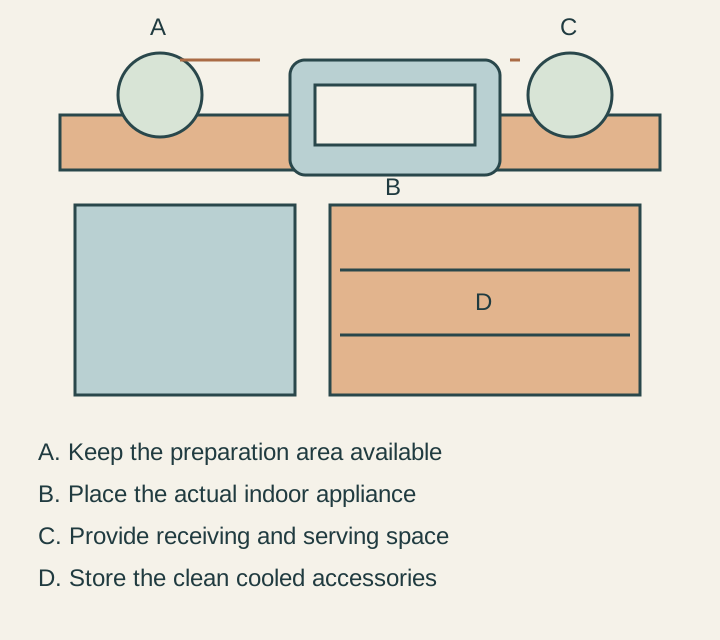
Identify an actual indoor appliance and read its placement instructions. Draw its body, required surrounding space, door movement and the user's working approach. Do not place an arbitrary pizza appliance indoors because another product in the category is intended for that setting.
Breville's Pizzaiolo manual identifies a peel and pan, excludes use inside a small-appliance enclosure and requires complete cooling before moving or storage.
Reading note: Breville USA — Smart Oven Pizzaiolo instruction book.
For that example, an attractive closed appliance garage cannot be assumed to be the operating position. A storage cabinet and a permitted working location are different parts of the plan. Follow the selected product's actual instructions rather than copying a generic clearance from a similar oven.
Represent the loading accessory through its intended movement. A compact body does not tell you where the hand and handle will travel. Use cold, empty outlines at the planning stage and retain the working area required by the exact selection.
Keep preparation and receiving distinct when they overlap
If the household wants to prepare the next pizza while the current one cooks, show both jobs at once. Place the board and ingredients, then the receiving arrangement. Do not solve the drawing by moving an active appliance or by counting its open door as a worktop.
The serving route matters as well. A person carrying finished food should not need another person to clear the toppings first. Establish where cutting and passing happen, and which part of the room remains available for the people who are eating rather than cooking.
This can reveal that the appliance's preferred location is on a different counter from the preparation zone. That may work, but the complete transfer should be acceptable. The shortest visible counter run is not necessarily the best working sequence.
Keep the main oven's remaining job explicit
A dedicated pizza appliance does not establish that the household can omit its main oven. List the ordinary baking and roasting vessels that still need a documented cooking arrangement. Retain that arrangement unless the selected equipment genuinely supports the full brief.
For many buyers, the real comparison is an added specialist station versus pizza within the retained main oven. The specialist purchase therefore carries its own counter, storage and installation consequences while the main oven remains.
If the main-oven method is satisfactory, identify its actual trays or other permitted accessories and their storage. The main-oven option also has a preparation and receiving sequence; compare that complete routine rather than an idealized version that occupies no counter.
Give the equipment a place after the meal
The period after cooking can affect the next task. An appliance that must cool before moving remains in its permitted location until it can be handled as instructed. Do not count the counter as recovered immediately because a nearby cupboard is large enough to hold the appliance later.
If the plan stores the appliance, check its actual body and handling route in the condition allowed by its instructions. A low deep compartment may accept the object on paper while making retrieval unattractive to the person expected to use it.
Provide storage for clean accessories after their required care. Broad flat parts, handles and boards can need different compartments. Specify what is actually purchased instead of assuming the existing tray slot has space for everything.
A family keeps a station only after the full trial
Imagine a hypothetical household that wants successive pizzas as a regular shared cooking activity. Its first sketch places a specialist appliance on the only broad preparation counter. Cold outlines show the next pizza displacing the receiving arrangement.
A revised plan puts the permitted operating location on another checked surface and retains preparation and serving positions. The appliance stays there through its instructed cooling period; an accessible storage compartment fits it afterward. Accessories receive measured places, and the main oven remains for ordinary baking.
The owners accept that complete allocation and compare the real installed quotation with the retained-main-oven alternative. They choose the specialist arrangement because they want its documented approach and the room now supports their preferred gathering.
A household that only occasionally wants pizza may prefer to preserve the surface and cabinet for everyday preparation. Either choice can be sound. The purchase succeeds when preparation, the selected cooking method and the room afterward all fit the kitchen the owners intend to use.
Sources & further reading
- Breville USA — Smart Oven Pizzaiolo instruction book