A magnifying mirror inside the cabinet or on its own wall arm?
Choose the close-up view you can comfortably use, then decide whether it should depend on the medicine cabinet. An independent wall-arm mirror can leave cabinet selection open; an in-cabinet mirror keeps the accessory behind the door.
A magnifying mirror can be useful without determining the entire medicine-cabinet purchase. First establish which reflected view helps with the task and where you can use it comfortably. Then compare a mirror that comes out of the cabinet with a separate wall-arm mirror. The former puts the accessory away behind a door; the latter lets you choose the storage cabinet independently and use the small mirror without opening it.
The distinction matters when an attractive cabinet package includes a magnifier you have never tried. Its presence on the feature list is not enough. A good purchase should support the close-up task, the ordinary mirror view and the way the household retrieves toiletries. If the accessory is the only reason to change an otherwise suitable cabinet, compare the independent option before committing to the whole package.
What the named examples actually offer
Robern describes POMM as a 3x pull-out magnifying mirror mounted inside a medicine cabinet. Its position and angle adjust, and it nests inside when stored.
The separate Robern 7M0008WUFN76S wall-mount mirror has a standard mirror on one side and 7x magnification on the other. The face pivots to change the view.
These are manufacturer examples of different arrangements, not a statement that usaKT carries either item. They are also not equivalent devices with different mounting brackets. One example provides cabinet-based magnification; the other lets the user turn between normal and magnified reflections on the small mirror itself. Decide whether that change of view matters before comparing appearance or finish.
Do not treat the larger magnification label as an automatic upgrade. Look into the actual mirrors while doing the intended task. Check whether you can find the area you want to see, maintain a comfortable position and move back to an overall view without awkward readjustment. A paper outline can test occupied space, but it cannot show the reflection or establish a usable viewing distance.
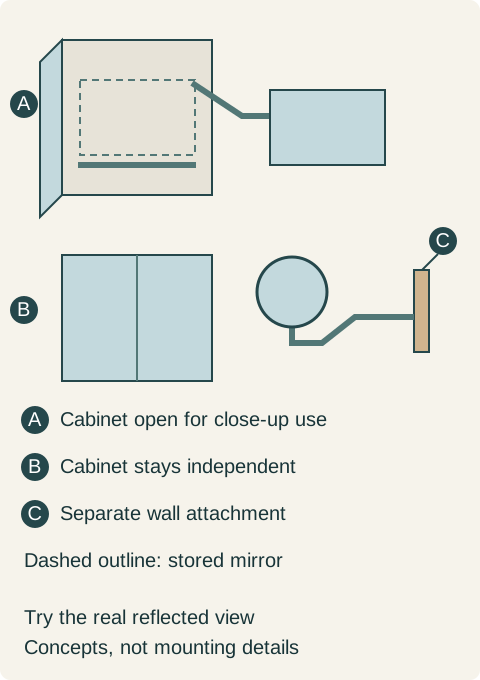
Teaching example Concept diagrams, not installation drawings. A shows a magnifying mirror pulled out from an open cabinet; the dashed rectangle is its stowed position. B shows a separate wall-arm mirror beside a closed cabinet. C marks the independent wall attachment. Mirror shapes and arm paths are simplified; the drawing does not simulate magnification.
Buying the cabinet-mounted arrangement
An in-cabinet mirror makes sense when you want the accessory hidden and are happy to open the cabinet whenever you use it. Review the interior as a working arrangement: where the mirror parks, what remains reachable while it is extended, and whether the selected shelf layout still accommodates the toiletries you intend to keep there. A clear countertop does not automatically mean the interior works well.
The POMM installation sheet linked by the product page is an older drawing with separate Uplift and M Series mounting illustrations. It does not establish that every current Robern cabinet accepts the accessory. Confirm the exact cabinet, accessory and mounting arrangement together; an old family name is not proof of compatibility with a newer family.
This is a buying condition, not a suggestion to improvise an attachment inside any cabinet. Ask the supplier to identify the intended configuration in the order. If the desired cabinet cannot accept it, compare another complete arrangement before changing the cabinet merely to preserve the accessory. The useful storage and the main mirror still have to justify the purchase.
During the demonstration, use the cabinet as you would at home. Open it, bring the small mirror forward, retrieve the grooming item, use the mirror, then put both away. An accessory that looks unobtrusive when parked can still interrupt that sequence. Conversely, a compatible interior that works smoothly can make the concealed option a sensible choice without adding another object to the wall.
Buying the independent wall-arm arrangement
A separate wall mirror makes the storage purchase less dependent on the magnifier. You can retain a suitable medicine cabinet or select it for shelf access and main-mirror use. The wall attachment becomes a separate part of the project, with its own location and installation review. The manufacturer supplies a wall-mounting procedure for the named wall model; the cabinet side is not an interchangeable mounting surface.
Compare the room with the arm both in use and parked. Pay attention to the actual small-mirror position, nearby lighting and the way you return to the main mirror. This is more than checking whether the arm fits between objects. The user needs to see the task clearly in the available light and reach the grooming supplies without repeatedly interrupting the view.
The separate mirror remains visible when stored, which may be an acceptable trade for keeping the cabinet closed. Include it in the elevation with the main mirror and light. Otherwise a cabinet selected for a clean appearance can acquire an unplanned accessory beside it. Choose the complete composition while the attachment location can still be reviewed.
The household keeps the cabinet and adds the wall mirror
In a hypothetical renovation, a couple has already selected a medicine cabinet whose shelves suit their daily supplies. One person wants a close-up view for a short grooming task and then an ordinary view of the result. An alternative cabinet package includes a pull-out magnifier, while the original cabinet can remain in the design with a separate wall-arm mirror.
They try real examples of both mirror arrangements. For this user, the cabinet-mounted view is usable, but opening the cabinet and returning to its main reflection interrupts the preferred routine. The independent double-sided mirror lets the user switch views at the small mirror, with the storage cabinet closed. The installer reviews a suitable wall attachment location, and the light and arm positions work in the room trial.
They buy the original cabinet configuration and the separately specified wall mirror. They accept the visible parked arm because it provides a useful change of view without giving up the storage arrangement they already prefer. The decision is based on that observed task, not on assuming that more magnification is always better.
Another buyer may reach the opposite result after the same trial. If the cabinet-mounted view is comfortable, the verified interior accommodates it, and concealment matters more than switching faces, the cabinet accessory may be the better complete purchase. The useful comparison ends with a cabinet, mirror arrangement and attachment plan that work together, not simply a magnification number on a specification list.
Pure White
Cream White
Light Warm Gray
Gray
Navy
Black
Oak Tone
Dark Walnut Tone
Design study These finish studies are design references, not a list of currently orderable colors. Screens and lighting change the appearance; compare a physical sample before choosing.See all finish options →
Build the layout from the actual compacts, palettes, bottles and tools, then test whether they can be identified, removed and returned without dismantling the arrangement.
The sample shows the door frame, a separate center panel, the face frame and the cabinet box. Each component has its own place in this Shaker construction.
Shaker construction: door frame, center panel, face frame and cabinet box. The cutaway helps locate these parts; confirm each material in the specifications for the selected cabinet.
01 / Door frame
The Shaker door has rails and stiles around a separate center panel. The frame and center panel are different components; confirm their materials in the specifications for the selected cabinet.
02 / Face frame
The face frame surrounds the opening at the front of the cabinet box and sits behind the doors. The face frame, door frame and cabinet box are separate parts.
03 / Cabinet box
The sample exposes the cabinet sides, interior surfaces and layered edges. The image does not establish the wood species or material specification of a selected cabinet.