

Buying cabinets
Buying Kitchen Cabinets Yourself vs. Through a Contractor
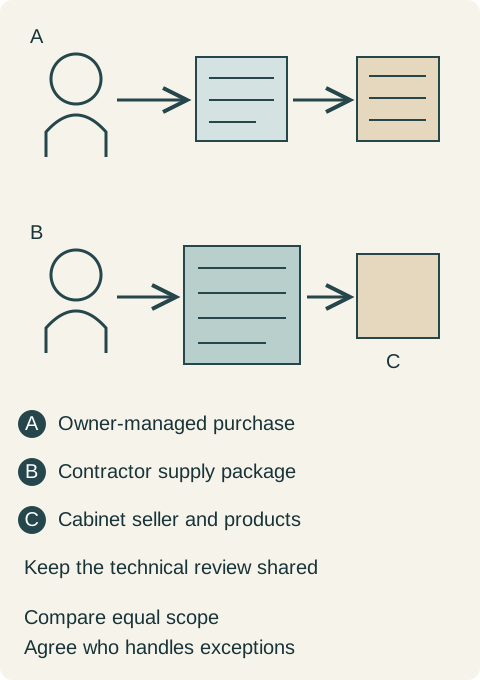
Compare the same cabinet package with its design, ordering and receiving work included. A lower product invoice can still leave coordination tasks for the homeowner; a contractor’s supply price should explain the services it adds.
Compare the work attached to the cabinets
Buying cabinets yourself can work when you are willing and able to manage the seller's ordering process and the project has an installer who accepts the resulting supply arrangement. Having the contractor supply them can work when its price includes useful coordination you would otherwise perform or buy separately. Compare the same products, necessary work and problem-handling route before deciding from the cabinet invoice alone.
The choice is about who manages a portion of the remodel, not whether the homeowner has good taste or the contractor knows every cabinet line. An owner can select the appearance while a contractor coordinates supply. An owner can also purchase directly while retaining design and installation help. State the arrangement instead of treating either label as a complete scope.
Keep the technical review connected to the purchase
Whoever places the order needs the same accepted room measurements, cabinet schedule, finish choices and appliance information. If the homeowner buys, the installer should review the intended package before release within the agreed service. Paying the supplier does not automatically include field measuring or make an installer responsible for a drawing that person never reviewed.
KraftMaid's purchasing FAQ directs buyers through its retailer route rather than a factory-direct purchase. That is an example of why the actual seller and order process matter. It does not identify which route usaKT.com or another supplier uses for a particular order.
Reading note: KraftMaid — Cabinet Purchasing FAQs.
Ask who resolves a fit question. A cabinet seller can explain its product, while the project needs someone to reconcile that information with the room and installation. Those roles may sit within one business or across several. Keep the current accepted drawing and a named contact available to everyone who needs to act on the purchase.
Find out what the contractor’s supply price includes
Request a description of the services attached to the quoted cabinets: design coordination, field review, order entry, receiving, storage, carry-in, assembly where relevant, and follow-up on shortages or damaged goods. Do not assume that a higher price includes every one of those tasks. Ask which are supplied, which are separate and who performs them.
Likewise, do not treat the difference between the supplier's invoice and the contractor's supply price as pure profit without checking scope. The contractor may be selling additional work, assuming a coordination role or simply quoting a different product package. Compare the actual contents before discussing whether the additional price is worthwhile.
A cheaper homeowner purchase can still be a good choice. The useful test is whether the remaining work is identified, affordable and realistically manageable. If an owner enjoys coordinating suppliers and has appropriate receiving support, paying separately for those tasks may suit the project. The comparison should acknowledge that accepted effort rather than pretending the effort disappears.
Decide who receives and checks the goods
For an owner-managed purchase, specify the delivery endpoint and who will receive, unload, move and retain the cabinets. Confirm what the seller includes. A contractor scheduled to install later may not be available to accept an unexpected freight arrival, and an installation quote may not include the work of opening and reconciling every carton before that date.
For contractor supply, ask the same practical questions. Will the cabinets go to the contractor's warehouse, the project or another location? What does the receiver check, and how are unresolved items communicated? A supply arrangement is easier to value when its receiving responsibilities are described as actual tasks.
Retain the product labels and accepted order list in either route. If a wrong-handed cabinet or missing finished panel is identified, the order contact needs enough information to request the correct response. Establish who makes that contact and who tells the installation team whether work can proceed. The answer should not be discovered after the crew arrives.
Put the two prices on an equivalent basis
In a hypothetical comparison, the homeowner receives an $8000 cabinet quote. The direct route also requires $600 of receiving and carrying work and $400 of separately purchased coordination, producing $9000. A contractor quotes $9200 for the same accepted cabinet package and those stated tasks. The difference is $200 in this invented example, not the apparent difference between the product invoice and the contractor's total.
The hypothetical comparison changes if the contractor's $9200 omits one of those tasks, or if the homeowner can perform it without buying that service and willingly accepts the work. Keep that decision visible. These figures are not local prices, typical markups or a prediction of either route's savings.
Compare exclusions as carefully as inclusions. Countertops, installation labor, disposal and plumbing can sit elsewhere in the remodel budget, but they should have the same treatment in both alternatives. A cabinet-supply choice is not resolved by placing a complete kitchen construction quote beside a cabinet-only invoice.
Choose a communication route for changes and exceptions
If the owner orders, agree how a contractor's field finding reaches the cabinet seller and who authorizes a changed purchase. The installer should not silently substitute a product, and the owner should not approve a seller's alternative without bringing its installation consequences back to the project. A direct purchasing arrangement still needs a shared technical decision.
If the contractor supplies, the owner should receive a clear record of the accepted products and changes. Delegating purchase coordination does not require accepting an unidentified cabinet package. Keep product selection, approval and what was actually ordered connected, so later questions can be answered without reconstructing an informal conversation.
Ask how each business handles its actual shortages, damage reports and replacement requests. Confirm the available process and responsibilities, rather than assuming one route guarantees faster service. This article does not assign liability or invent reimbursement terms; the purchase needs its real terms understood before release.
A small price difference can buy useful coordination—or unnecessary duplication
Imagine a homeowner who has already selected a cabinet line and worked through the layout with its seller. The contractor's supply proposal repeats design work that the owner has completed, while its installation team is willing to review an owner-purchased order. The owner confirms separate receiving support and keeps the ordering task. The direct arrangement fits because the remaining work is understood.
Another homeowner cannot attend deliveries and wants a single project contact to reconcile the supply before the installation crew starts. The contractor identifies receiving, storage, order coordination and discrepancy follow-up in its package. Once prices are compared at equal scope, the homeowner accepts that supply service rather than managing it personally.
Both choices can be well considered. Select the one that matches the actual team's capacity and accepted responsibilities. Before ordering, make sure the seller, purchaser and installer know which arrangement was chosen and have the same product and room information to carry it out.
Sources & further reading
- KraftMaid — Cabinet Purchasing FAQs