

Design & industry
Homecrest’s 2026 introductions: Wisp, Woodland and a stepped Ridgemoor door
The coordinated introduction offers a different neutral-color decision alongside a more outlined door. Compare the new finishes with the new profile as a room composition, without assuming every neutral or framed door gives the same result.
Homecrest’s current introduction brings new neutral finishes and a newly detailed framed door into the same selection conversation. The useful question is whether their combination changes the room in a way the owners actually want. Someone seeking a quiet backdrop may respond differently from someone who wants the cabinetry to carry a visible architectural outline. Neither preference is answered by calling everything transitional.
The manufacturer’s program page presents Wisp and Woodland finishes alongside the new Ridgemoor door. Its URL and linked brochure identity place the introduction in the current annual program; the page does not establish an exact first-sale day.
Reading note: Homecrest: 2026 product introductions.
Ridgemoor adds a line inside the frame
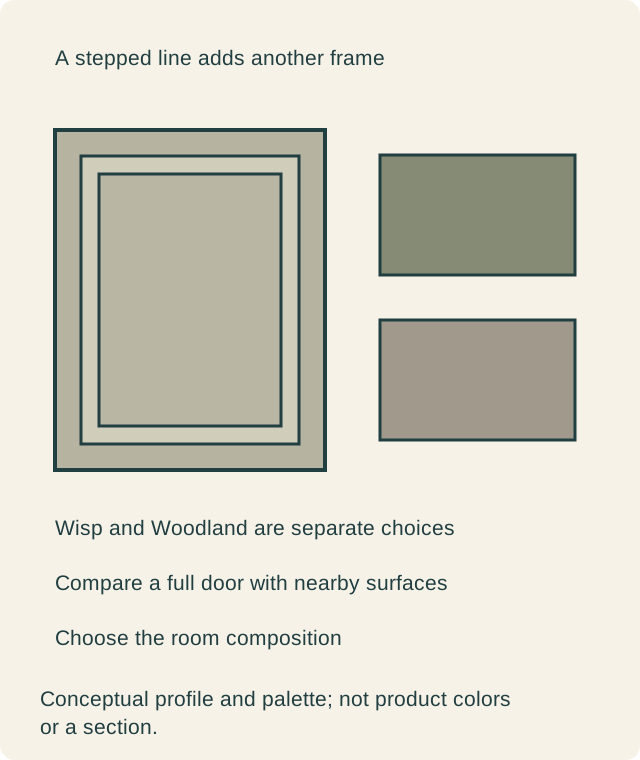
Homecrest describes Ridgemoor as Shaker-inspired with a stepped inside profile. Its displayed configuration identifies a five-piece shape and painted hardwood. These are manufacturer-specific descriptions, rather than evidence that every framed door has the same construction.
Reading note: Homecrest: Ridgemoor door.
The step matters because it introduces another visible boundary between the outer frame and center. A buyer considering this introduction should decide whether that extra line is the desired detail. On a broad bank of doors, repeated internal outlines may supply the structure the room lacks. In a compact arrangement with many small fronts, the same idea may feel more active than intended.
Do not ask a color chip to settle that decision. Look at the new door itself, including the inner detail from the room’s normal approach. If the outline is the attraction, retain enough surrounding calm to see it. If the project wants cabinets to recede behind a patterned countertop, a less articulated alternative may remain a better choice despite the new introduction.
Wisp creates a particular neutral starting point
The current Wisp product page describes green and brown undertones and lists the finish on painted hardwood, including Ridgemoor among the available door styles. That establishes a specific combination worth requesting as a sample; it does not establish its appearance in another kitchen.
Reading note: Homecrest: Wisp on painted hardwood.
For a room retaining brown flooring, the useful comparison is whether the candidate connects pleasantly to that floor while still giving the cabinets a distinct presence. Put the actual floor and countertop beside it. A neutral that is agreeable on a blank sample wall can become a more obvious color when it meets another material.
The green direction may be welcome as a restrained alternative to a more explicit green cabinet. It may also be the very quality a buyer does not want. Do not hide the observation behind the word neutral. Ask whether the household likes that relationship with the permanent surfaces, rather than trying to prove that the finish has no character at all.
Woodland offers a different comparison
Homecrest describes Woodland as a midtone greige combining warm and cool undertones. Its painted-hardwood product page also lists Ridgemoor. This supports comparing the new finish-and-door combination without assuming that every other door, material or accessory is offered identically.
Reading note: Homecrest: Woodland on painted hardwood.
Woodland should enter the review as its own candidate, rather than as a guaranteed bridge between disagreeing surfaces. In a kitchen with a cool-looking countertop and warmer floor, a middle-looking sample can be appealing. The actual result still depends on which junction dominates the room and how much cabinet area surrounds it.
Compare each new finish separately with the materials that will remain. Keeping competing sample doors beside each other throughout the review can exaggerate differences the completed room will never contain. First identify the distinction, then remove the unused candidate and judge the selected arrangement on its own.
The profile can supply structure while the finish supplies restraint
The release is interesting because color and profile need not perform the same job. A buyer may want the stepped line to give shape to otherwise restrained cabinets. Another may prefer the color’s presence while keeping the front simpler. Trying the new finish only on the most elaborate available sample can blur those separate intentions.
If the provider can show alternatives, compare the finish on Ridgemoor and on a simpler front, then compare the new finishes on the same door. The exercise does not require ranking all framed doors. It answers whether this specific introduction achieves the desired balance of outline and background in the proposed room.
A hypothetical retained-floor kitchen
Imagine owners keeping a brown wood floor and a pale countertop with a cooler-looking pattern. They initially favor Wisp on a flat sample because it seems connected to the flooring. Once shown on the stepped door, they find the repeated inner lines more prominent than they expected across the wall cabinet group.
They do not immediately request a lighter paint. Instead, they separate the decisions: whether they want Ridgemoor’s outline, and which finish works best beside the retained surfaces. In this hypothetical case, they keep the new door for the main cabinet group and choose Woodland after viewing the complete sample with their countertop. This is an example of a preference, not a prediction about either color.
Another household could reach the opposite result and keep Wisp on a different front. The new collection is useful when it broadens a real choice, even if the final order does not combine every new element. Buying a coordinated introduction does not require using it as an indivisible package.
Bring small fronts and nearby details into the composition
The main sample may be a large door, while the kitchen contains shallow drawers, a tall pantry and appliance panels. Ask how the proposed door family treats those fronts. The amount of visible center and the repeated outlines should be understood at the sizes actually drawn, without inventing dimensions from a promotional photograph.
Keep the intended handle and countertop edge nearby. A substantial pull beside an articulated inside frame can create more visual activity than the same pull on a flat field. That may be attractive, but the owners should see it as a combined choice. An isolated close-up of the new color cannot show the complete result.
Record the selected combination, then confirm the project offer
Keep the chosen door, material and finish together in the order, along with the drawer-front and visible-end arrangement. The product pages provide a manufacturer reference; the project provider must identify the actual parts quoted and the applicable supply terms. Publication context does not reserve a production slot.
The strongest reason to choose this introduction is a clear improvement in the room’s composition: the desired neutral beside the retained materials, and the desired amount of outline across the cabinets. Preserve that physical sample and the selected combination so later revisions can be assessed against a concrete design decision.
Sources & further reading
- Homecrest: 2026 product introductions
- Homecrest: Ridgemoor door
- Homecrest: Wisp on painted hardwood
- Homecrest: Woodland on painted hardwood