Buying cabinets for Hawaii: mainland order or on-island supplier?
Compare the complete cabinet package after ocean transport, island receiving and replacement planning. A mainland cabinet price is not yet the cost of a usable kitchen at your property.
Compare a finished purchase, not two cabinet price tags
For a Hawaii kitchen, a mainland cabinet order is worth considering when the desired product and the complete transport arrangement justify it. An on-island supplier may offer a more convenient purchase, but a nearby showroom does not necessarily mean the entire order is already on the island. Ask where the actual cabinets will come from, then compare both proposals through delivery to the same agreed receiving point.
The buying decision involves more than adding a freight allowance. You need the cabinet package, the mainland receiving arrangement if one is used, ocean transport, island handling and the final route to the property to work together. If an essential panel is omitted, correcting it may involve another transport decision rather than a quick trip back to the supplier.
Establish what is on the island now
Ask an on-island seller which items in the proposed order are physically available and which would arrive later. Separate display samples from saleable inventory, and distinguish a cabinet reserved for your order from a line that the seller can generally obtain. Do the same with a mainland offer. A product family described as stocked does not establish that every unit, finished side and trim piece in your design is ready.
Use the same approved cabinet schedule for both proposals. Match assembly condition, door style, finish, internal fittings and exposed ends before comparing the transport. An on-island alternative may be a useful different package, but it should be presented as that alternative. Otherwise a missing tall cabinet or changed drawer system can look like a shipping saving.
Include the person who will check site dimensions and coordinate installation. Buying on the island and having the cabinets installed are separate services unless the accepted proposal combines them. Likewise, the ability to purchase online does not assign someone to verify the final room measurements. Keep those responsibilities visible in either option.
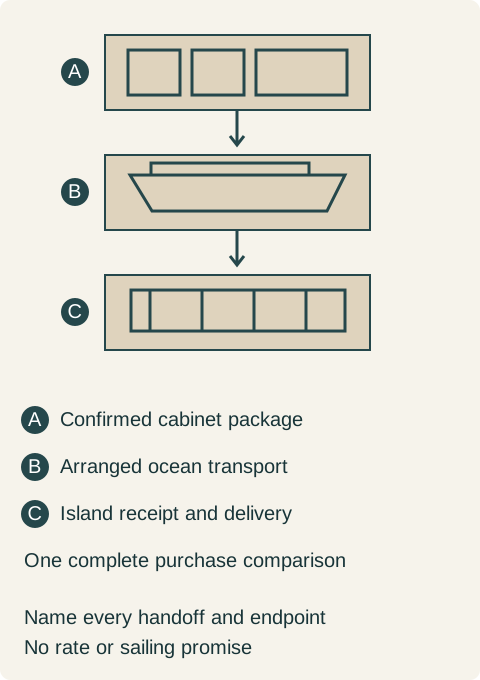
Teaching example Conceptual mainland purchase route: A is the confirmed cabinet package, B the arranged ocean leg, and C island receiving and onward delivery. The actual route may include other transfers. This diagram does not describe a booked service or sailing.
Choose the transport arrangement for the actual order
DHX lists both less-than-container-load and full-container-load ocean services between the mainland and Hawaii. These are transport options to quote, not evidence that either is automatically cheaper for a cabinet order.
In a less-than-container-load arrangement, ask the provider how your packaged order is received and handled within its service. For a full-container proposal, establish who loads, secures, receives and unloads the container and whether the destination can support that plan. Compare the actual offers. Do not assume that a whole kitchen requires a whole container, or that sharing capacity always produces the better complete price.
Give the quoting party the shipping dimensions, weights and package count supplied for the selected cabinets. Flat-pack and assembled orders can present different packed shipments, and long panels or moldings must be included. If the packing information is preliminary, label it that way. The quote needs to be reconciled when the real shipment is ready rather than treated as fixed by an early kitchen rendering.
If several vendors feed the shipment, appoint a coordinator
DHX also describes project consolidation by purchase order, timing or project phase. That is a separately arranged logistics function, not something created merely by sending several purchases to one warehouse address.
If the cabinets, handles and other ordered components come from different sellers, establish who can receive each shipment, identify it, record condition and hold it for the planned movement. Ask what inspection and reporting the actual service includes. A warehouse receipt showing that cartons arrived is not necessarily a check that the cabinet schedule is complete or the finish is correct.
Decide what happens when an essential part is late. The choices might include holding the consolidated shipment, releasing a genuinely usable phase or arranging separate transport for the missing component. Obtain the consequences for the actual booking. Do not assume a delayed end panel can simply be added after the rest of the order has entered a closed shipping process.
Name the island endpoint, not just Hawaii
Provide the actual island, address and receiving arrangement. Ask whether the offered service reaches the property or an intermediate facility, and whether another transfer is involved. Honolulu should not be treated as shorthand for delivery to every Hawaii project. The parties quoting the route need the real destination before price and timing can be meaningfully compared.
A container arrival, freight availability for collection and a residential delivery appointment are different events. Obtain the provider's process for the selected service, including the receiving notice and any collection or delivery arrangements. Keep a dry, secure place for the cabinets that meets the selected manufacturer's storage guidance. The installation date should follow a feasible delivery and inspection plan, not only a published vessel schedule.
Work through the missing-piece scenario before ordering
Imagine a homeowner comparing an on-island cabinet package with a mainland package in a preferred door style. The mainland cabinet subtotal is lower. Its first transport estimate, however, ends at an island receiving facility. It does not include the local movement and handling the project needs, and the cabinet list omits a finished end beside the refrigerator.
The buyer corrects the item list, obtains a quote through the actual receiving point and asks how a missing or damaged part would be identified and supplied. The seller confirms the ordering process for replacements; the transport coordinator describes how a later shipment would be arranged, without promising that it would follow the original shipment's price or timing.
Only then does the homeowner compare complete offers. In this example, the corrected mainland proposal still suits the preferred style and the planned receiving arrangements, so the buyer accepts it. If the missing scope had removed that advantage, the on-island proposal would have been the reasonable choice. Neither outcome follows from geography alone.
Release the order with one coherent receiving file
Keep the approved cabinet schedule, packing information, delivery scope and each responsible contact together. Link receiving records from any mainland consolidation to the island receipt so the project can identify where each package was handed over. Follow the actual seller and transport provider procedures for exceptions; this guide does not determine who bears a particular loss or replacement charge.
Before release, resolve the quote exclusions that matter to your route and retain the accepted terms. A mainland offer becomes useful when the desired cabinets, transport and local handling form a purchase the project can actually receive. An on-island offer deserves the same scrutiny. The better choice is the complete arrangement that meets the kitchen plan and the household's practical requirements.
Pure White
Cream White
Light Warm Gray
Gray
Navy
Black
Oak Tone
Dark Walnut Tone
Design study These finish studies are design references, not a list of currently orderable colors. Screens and lighting change the appearance; compare a physical sample before choosing.See all finish options →
The sample shows the door frame, a separate center panel, the face frame and the cabinet box. Each component has its own place in this Shaker construction.
Shaker construction: door frame, center panel, face frame and cabinet box. The cutaway helps locate these parts; confirm each material in the specifications for the selected cabinet.
01 / Door frame
The Shaker door has rails and stiles around a separate center panel. The frame and center panel are different components; confirm their materials in the specifications for the selected cabinet.
02 / Face frame
The face frame surrounds the opening at the front of the cabinet box and sits behind the doors. The face frame, door frame and cabinet box are separate parts.
03 / Cabinet box
The sample exposes the cabinet sides, interior surfaces and layered edges. The image does not establish the wood species or material specification of a selected cabinet.