Handleless grip channels change the cabinet, not just the door
A recessed rail creates room behind the front edge for fingers. Choose its place in the cabinet before fixing drawer fronts, appliances and the visual lines across a run.
A handleless kitchen with grip channels still opens by pulling. Fingers enter a recess behind the front edge and draw the door or drawer outward. The recess must be built into the cabinet arrangement; removing a bar pull from an ordinary front does not create it. Choose this construction before approving front sizes and appliance positions.
Häfele's archived Gola overview shows profiles recessed into the cabinet carcase, with different applications below a countertop, between fronts and vertically between doors. These drawings explain the architecture. They are not a current stock list or permission to apply an old dimension to a different cabinet system.
A cabinet rail and a shaped front are different purchases
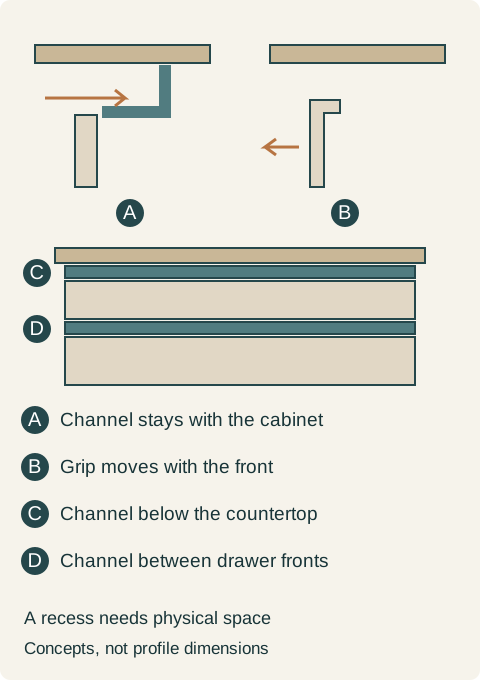
A recessed cabinet profile stays in place as the drawer moves. A grip shaped into the front, or a suitable edge pull attached to it, travels with the front. Both can produce a clean elevation, but they do not reserve the same space or use the same construction. Identify which one the quote includes rather than relying on the word handleless.
For the cabinet-mounted version, review a section through the actual counter, profile, drawer front and drawer box. Finger space is a physical zone. A line on an elevation cannot show whether a hand can curl behind the edge or whether the drawer box or counter overhang blocks that approach. There is no universal deduction that converts ordinary drawer fronts into channel fronts.
A middle channel must serve the intended grasping edges between drawers; the upper channel works under the counter. Coordinate the whole stack, preserving its selected boxes and usable clearances as well as its visible proportions.
Teaching example Conceptual sections compare a cabinet-mounted recessed channel with a grip formed in the moving front. The lower elevation distinguishes the channel below the counter from the one between drawers. No dimensions or installation details are specified.
The rail has ends, corners and interruptions
Häfele's archived middle-profile sheet shows connectors to the cabinet inside panel, separate end caps and corner pieces. A length of aluminum alone is not the complete installed grip system. Match the required components to the chosen profile and cabinet construction.
An oven, dishwasher or tall cupboard can interrupt the horizontal line. Draw the end condition and the appliance's own opening method. A decorative strip crossing an appliance front does not establish that the appliance can be pulled from that strip. A tall door also needs a usable grip location even if the lower drawers use horizontal channels.
Keep useful drawers before pursuing an uninterrupted line
Consider a bank that stores cutlery, bowls and deep pots in separate drawers. A revised elevation adds a channel merely to continue a neighboring visual line; the offered cabinet configuration would replace the direct cutlery drawer with an inner drawer behind a larger outer front. The household wants direct access to cutlery, so it retains that opening method and accepts a break in the channel line. The supplier develops the supported profile layout around this choice. The extra opening step is not hidden behind a cleaner rendering.
Try a representative assembled grip, including its return edge and finished front thickness. If fingers cannot comfortably hook behind it, compare another supported grip or a conventional pull before ordering. Grip comfort, drawer access and the completed run must work together; none is proved by the absence of visible handles.
Pure White
Cream White
Light Warm Gray
Gray
Navy
Black
Oak Tone
Dark Walnut Tone
Design study These finish studies are design references, not a list of currently orderable colors. Screens and lighting change the appearance; compare a physical sample before choosing.See all finish options →
Hardware controls how a cabinet opens, what you can reach and where your hand goes. Compare the complete operating arrangement, then record the actual parts.
Front proportions do not tell you the usable height inside. Group the actual objects, test their stored and removal positions, then compare the drawer combinations the selected cabinet system supports.
The sample shows the door frame, a separate center panel, the face frame and the cabinet box. Each component has its own place in this Shaker construction.
Shaker construction: door frame, center panel, face frame and cabinet box. The cutaway helps locate these parts; confirm each material in the specifications for the selected cabinet.
01 / Door frame
The Shaker door has rails and stiles around a separate center panel. The frame and center panel are different components; confirm their materials in the specifications for the selected cabinet.
02 / Face frame
The face frame surrounds the opening at the front of the cabinet box and sits behind the doors. The face frame, door frame and cabinet box are separate parts.
03 / Cabinet box
The sample exposes the cabinet sides, interior surfaces and layered edges. The image does not establish the wood species or material specification of a selected cabinet.