Push-to-open and soft-close can work together when the hardware is designed and specified for that combination. Adding a generic push latch to an existing soft-close drawer or door does not establish compatibility. Choose a documented system for the actual front, runner or hinge arrangement, then demonstrate the full opening, closing and reset sequence before approving the order.
Diagram Opening assistance and soft-close are distinct functions. The selected system documentation determines which components can be combined.
Describe the behavior you expect
Push-to-open begins an opening action after pressure on the front. Soft-close controls the closing movement near the end of travel. These functions occur at different points in the operating sequence. The purchase question is whether the specified assembly coordinates them, including keeping the front closed and becoming ready for the next push.
Blum describes TIP-ON BLUMOTION as mechanical opening support combined with soft-close for named compatible drawer systems. This is a useful example of a documented combination. It does not mean any separately purchased opening device will cooperate with any soft-close runner, or that the same arrangement applies to a hinged door.
The specification should name the runner or hinge system, opening device and any required connecting, retaining or synchronizing components. Ask the supplier to identify which parts are included and which must be selected separately. “Push open, soft close” in a quote leaves too much unresolved if the actual hardware combination is not recorded.
Distinguish doors from drawers and keep different front types identified in the order. A demonstration on a light sample front is not enough for a different installed front and load arrangement. Provide the planned front construction and the relevant operating conditions so the supplier can select the appropriate configuration from its own documentation.
Include the front gap and installation conditions
The front needs the operating relationship specified for its system. Record the manufacturer’s required gap, adjustment and mounting conditions without substituting a generic dimension from another product. The desired visual spacing should be reviewed alongside the hardware requirements, before a tightly fitted front becomes an installation problem.
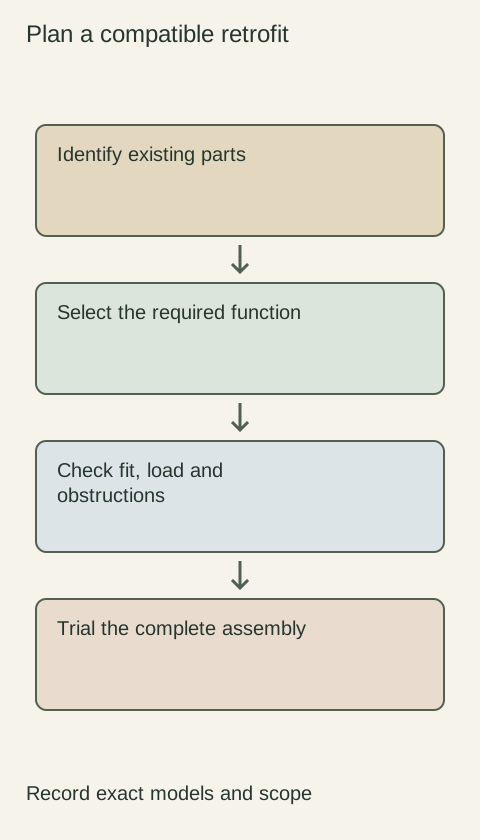
For a retrofit, have the existing mechanism identified before ordering an add-on. Determine whether the proposal retains the current runners or hinges, replaces them or requires changes to the front and cabinet. A part that physically fits inside the cabinet may still be unsuitable for the intended sequence. Adhesive placement or improvised extra force is not evidence that the mechanisms are compatible.
Test a complete sequence, not a single opening
Imagine a sample drawer that pops out when pressed during a sales demonstration. After being pushed closed, however, it remains slightly proud or does not respond reliably to the next press. The first opening looked successful, but it did not verify retention, closing and readiness for repeated use.
Use the documented operating method on a representative assembly, including normal loading within its approved conditions. Observe where pressure is applied, how the drawer moves out, how it closes and whether the next cycle behaves consistently. Include the user’s ordinary reach and hand position. If the demonstration requires an unexplained special gesture, resolve that detail before describing the system as convenient for the intended user.
Keep substitutions tied to the demonstrated result
The acceptance record should identify both the hardware and the expected sequence: press to initiate opening, operate the drawer or door, close as instructed and repeat. Record any separately required components and the version of the installation information used. A substituted runner carrying a soft-close label is not automatically equivalent if the original opening arrangement depended on another system.
At installation review, investigate inconsistent operation through the specified adjustment and troubleshooting process. Do not assume that striking the front harder or removing a component is a normal solution. Preserve the operating instructions with the cabinet records so another user can repeat the intended motion and future repairs can retain compatibility. The purchase is complete when the whole sequence works as agreed, not when both feature names appear on a list.
Pure White
Cream White
Light Warm Gray
Gray
Navy
Black
Oak Tone
Dark Walnut Tone
Design study These finish studies are design references, not a list of currently orderable colors. Screens and lighting change the appearance; compare a physical sample before choosing.See all finish options →
A painted door, a wood-grain side and a plywood cabinet box can belong to the same cabinet. Here is how to read those parts, what the sample photos actually show, and which details to put on a quote.
The sample shows the door frame, a separate center panel, the face frame and the cabinet box. Each component has its own place in this Shaker construction.
Shaker construction: door frame, center panel, face frame and cabinet box. The cutaway helps locate these parts; confirm each material in the specifications for the selected cabinet.
01 / Door frame
The Shaker door has rails and stiles around a separate center panel. The frame and center panel are different components; confirm their materials in the specifications for the selected cabinet.
02 / Face frame
The face frame surrounds the opening at the front of the cabinet box and sits behind the doors. The face frame, door frame and cabinet box are separate parts.
03 / Cabinet box
The sample exposes the cabinet sides, interior surfaces and layered edges. The image does not establish the wood species or material specification of a selected cabinet.