

Buying cabinets
GE Profile at KBIS 2026: turn the kitchen program into a useful cabinet brief
The dated program combines new receiving, refrigerated-tray and washing ideas. Compare their real tasks and front arrangements before allocating cabinets to a connected-kitchen image.
Read the kitchen program as several physical decisions
The useful cabinet response to GE Profile's KBIS kitchen program is to separate what changes a task location from what changes an opening or decorative front. A new receiving feature at the refrigerator does not allocate the adjacent grocery counter. A different washing front does not preserve the old cabinet-panel order automatically.
Treat this as a report on one dated program, rather than a shopping list requiring every demonstrated appliance. Choose the features that answer a real project need and identify their supporting cabinet work. The full-room demonstration is an introduction to those choices, not evidence that its exact arrangement suits another household.
What the announcement establishes
GE Profile's February 17, 2026 announcement includes a refrigerator barcode scanner, independent dishwasher drawers, a panel-ready dishwasher, and a side-by-side refrigerator with tracks for a half baking sheet.
Reading note: GE Appliances — GE Profile Life, Uncomplicated at KBIS 2026.
Those limited descriptions establish features to investigate on actual offered models. They do not establish a kitchen-wide performance result, the accuracy of an assistant, or the availability of a particular combination today. Keep the dated release beside the current itemized offer rather than treating the source page's URL as the product schedule.
Put the barcode demonstration where groceries actually arrive
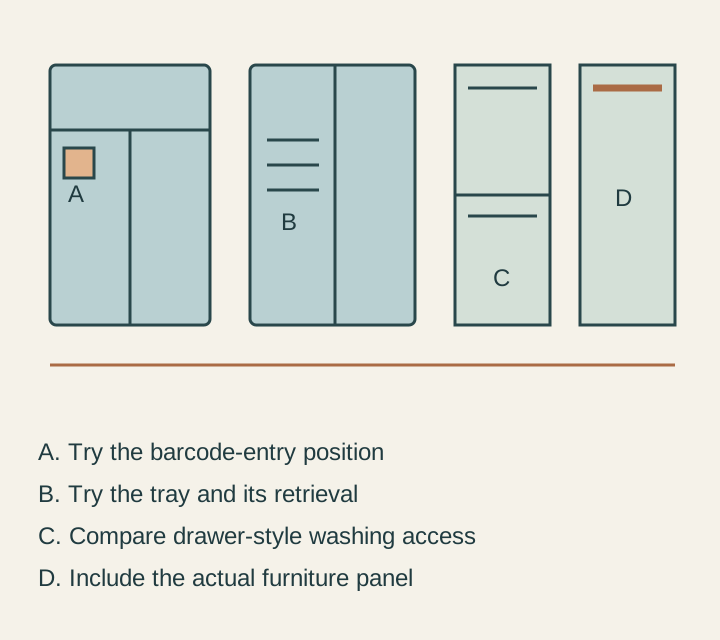
A shopper interested in the refrigerator feature should try the proposed entry action with representative clean packaging in an appropriate demonstration. Observe where the person stands, holds an item and puts it down afterward. That physical sequence is different from a presentation showing only the information appearing on a screen.
Now add the actual grocery-unloading surface and refrigerator opening. If scanning would make the receiving counter inaccessible, the project needs a different placement or routine. The barcode feature does not create somewhere to place bags, sorted groceries or packages that have not yet been handled.
Ask for the selected product's documented information flow as a separate demonstration. What is entered, what the user checks and what happens next? Do not credit an automatic purchase or a complete inventory merely because a scanner exists. For the cabinet brief, retain the practical receiving position only if the household expects to use it.
Test the tray arrangement without counting the same volume twice
The refrigerator idea involving tray support raises a different question: which real tray, covered dish or ordinary food group would use that arrangement? Bring clean representative shapes to the actual candidate. Check insertion, support and removal according to the product instructions.
Evaluate the complete grocery load in the same state. A tray added to a photograph may occupy space previously shown holding another group. Decide what moves and whether its new position is acceptable. Do not turn an extra support position into a second copy of the compartment's volume.
Then check the cabinet wall and approach. The selected refrigerator still has its own full opening, surrounding construction and operating movement. A useful internal tray arrangement may justify that candidate, but it does not answer whether its door and the neighboring pantry can be used as planned.
Compare the washing architectures before drawing the fronts
The program places different washing-front ideas in view. For a buyer considering drawers, try the actual ordinary load and its retrieval. Identify which parts of a recurring meal use each compartment and what remains available during the household's intended sequence. Do not assume that a front drawing describes every operating combination.
For a buyer considering a furniture-panel dishwasher, choose the exact supported panel arrangement along with the appliance. The matching door material, handle, fabrication and installation belong in the order. A generic cabinet front on the rendering is not a supplied panel.
These are alternatives to evaluate, not proof that the household needs both. If the existing wash routine is satisfactory, a newly shown front architecture still needs a benefit worth the complete replacement. If it solves a recurring loading or access problem, preserve that demonstrated result instead of explaining the decision solely by a coordinated logo.
Keep the other cabinet contents in the comparison
Show the cabinet plan that surrounds each viable equipment selection. A new opening may remove a drawer or change the width of an adjacent run. Name the utensils, containers or supplies displaced and test their new compartments.
The same applies to a receiving counter enlarged around the grocery routine. Its benefit may be worthwhile, but any tall storage removed to create it still held actual contents. A connected-kitchen image should not make the dry-food collection disappear.
Use one consistent household brief across alternatives. Retain the same groceries, hand tools and ordinary dish load unless the owners consciously change them. Otherwise a new package can seem to solve a problem because its comparison silently omits the difficult objects.
Price the selected subset as a complete project
Ask for the exact products and necessary accessories, with fronts and cabinet changes clearly separated. An event program is not necessarily a retailer's fixed bundle. A buyer may choose a useful subset or a different candidate after the physical trial.
Include installation and the changed furniture work in each viable offer. If a furniture panel is required, list who supplies, prepares and fits it. If a refrigerator changes the receiving arrangement, include the actual counter and cabinet revision. Do not assign a universal savings claim to the program.
A household buys the receiving improvement, not the whole display
In a hypothetical project, the owners are interested in keeping grocery entry coherent. A demonstration of their proposed refrigerator helps them define a receiving position, but the initial cabinet drawing leaves no clear surface for the unhandled bags. The revised plan preserves a practical unloading counter and checks the full food collection.
The ordinary dish load already works in a different selected dishwasher. The family does not replace that decision solely to reproduce the event display. It also declines a tray-based storage idea that would displace a food group it values more. Its final equipment and cabinet list is a deliberate subset of ideas that passed.
Another household might place greater value on a washing-front change and retain its existing receiving routine. The program is useful when it creates a precise demonstration and a better cabinet brief. Its headline alone cannot establish which part of the kitchen should receive the budget.
Sources & further reading
- GE Appliances — GE Profile Life, Uncomplicated at KBIS 2026