Furniture linoleum cabinets and tabletops: what is underneath the matte surface?
Furniture linoleum is a thin facing, not a complete door or structural top. Select the supporting panel, reverse face and edge together with the tactile finish.
Furniture linoleum can provide a softly matte surface for a cabinet front or a tabletop, but the roll of facing material is not the finished furniture component. The panel underneath determines much of the thickness, rigidity and fastening arrangement. Select the appearance together with the complete panel and its intended use; a color sample alone cannot answer those construction questions.
A surface material with its own factory finish
Forbo's US technical sheet describes a paper-backed furniture linoleum with a factory-applied acrylic finish and a nominal gauge of 2 mm. It is a flexible facing material. Calling a cabinet door linoleum does not identify its structural core, and quoting that gauge as the door thickness would omit most of the assembly.
The product's role is closer to a selected surface on a panel than to a standalone solid board. A thin sample is useful for feeling the texture and viewing the color. It cannot demonstrate whether the assembled door stays flat, how an edge feels against a forearm, or whether a tabletop has the required support. Ask to see a complete finished corner as well as the loose swatch.
Do not substitute a floor-covering product merely because its description also says linoleum. Specify the furniture product and the panel construction used by the fabricator. A familiar material name is not a substitute for the actual product's application instructions, surface coating and intended assembly.
The underside belongs in the specification
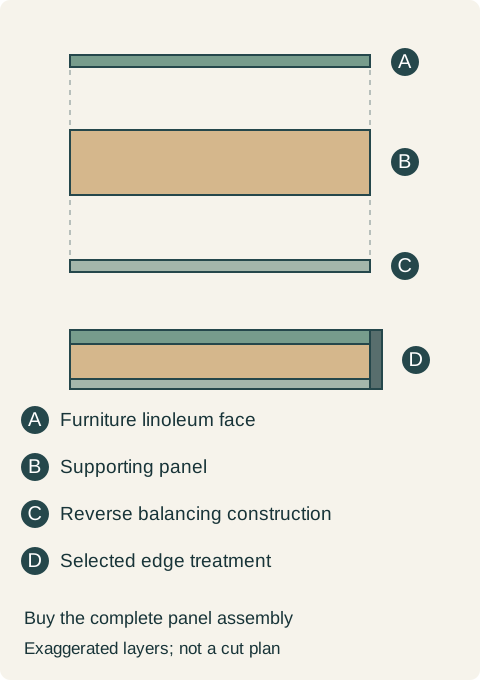
Forbo's furniture application guidance calls for balancing the opposite face of the panel and describes both matching material and alternative backings. That is part of making the panel, not a decorative extra that can be ignored because the back of a door is less visible. The fabricator should identify the selected reverse construction and its adhesive system.
Consider a hypothetical door using an 18 mm core and a 2 mm facing on each side. The simple layer sum is 22 mm before adhesive and production tolerances. It is not an approved hinge-boring dimension, but it shows why an order based only on the core thickness can misdescribe the completed front. A different balancing system would produce a different stack.
Review the actual finished thickness when coordinating handles, hinges and the relationship to neighboring fronts. Do not turn the example into a universal requirement to use identical faces on every product: the chosen fabricator must resolve the permitted assembly. The buyer's task is to compare complete fronts, not a finished front against another quote for an uncovered board.
Teaching example Exploded concept of a furniture-linoleum-faced panel. The substrate and reverse construction are separate parts of the finished component. Layers are exaggerated; this is not a fabrication or load-bearing specification.
The edge determines how the assembly is experienced
Forbo's application sheet illustrates a clean-cut edge exposing the panel material, such as plywood or dark MDF, and a covered edge using a separate band. These produce visibly different objects even when the top surface is identical. An exposed plywood edge emphasizes the layered substrate; a covered edge can continue or contrast with the surface color.
For a desk or breakfast table, inspect the junction where an arm rests on the edge. For a cabinet front, examine the corners and the transition to any handle recess. Do not approve a rounded edge from a photograph of a square-edged sample. The facing, core and edge treatment must meet in the form the shop will actually produce.
A dark edge can be intentional against a pale matte face. If that is the design, show it on the finished corner sample rather than describing the whole component as a single color. The same principle applies to visible undersides on a table: matching the top does not make the back disappear when people sit nearby.
Choose the intended work, not just the room name
An eating or writing surface beside the kitchen is not automatically the same application as a wet sink surround or a place where food is cut directly. Define how the surface will be used before selecting the assembly. The cited furniture documentation does not, by itself, approve every wet-area detail, hot appliance or direct-cutting use.
For a cabinet door, discuss repeated handling and the cleaning expected near the proposed location. For a table, discuss objects dragged across it, writing, serving and any protective accessories. These are practical use descriptions the supplier can evaluate. They are more informative than simply asking whether the product can go in a kitchen.
Forbo's US technical sheet cautions against adhesive tape because it may damage the factory coating. Protection during moving or installation therefore needs its own plan; a strip of tape is not a harmless default just because it will be removed later.
The manufacturer's furniture care sheet calls for soft cleaning methods and advises against abrasion. Keep that guidance with the selected component rather than improvising a polishing treatment to make a matte surface shiny. The desired feel and sheen are part of what was purchased.
A breakfast-table choice carried through to the edge
Imagine an eating and homework table beside the kitchen, with no sink and no direct food cutting planned on its surface. The owner compares an exposed plywood edge with an applied wood edge, both shown as completed samples. The exposed layers feel too visually busy beside the cabinet doors, so the owner chooses the wood-edged sample after checking its corner and the arm-resting junction in person.
The order then describes that edge, the linoleum face and the balanced reverse as one assembly, with the table maker responsible for the core and support arrangement. It does not adopt the earlier thickness calculation as structural approval. The wet sink worktop remains a separate material selection. This is a complete use-and-appearance decision: a quieter eating surface with a chosen tactile edge, not a promise that one roll product suits every kitchen task.
Compare a finished sample with a finished price
For a cabinet front, request the face, reverse, edge and hardware preparation as one defined delivery. For a tabletop, add the support arrangement and visible underside. A quotation for facing material by area should not be compared directly with a fabricated component that includes the core, balancing, edging and machining.
Keep a complete corner sample and the assembly description together. If a later revision changes the core or reverse layer, reconsider the finished thickness and edge appearance even when the color number remains unchanged. The matte surface may be the reason you noticed furniture linoleum, but the complete panel is what you will touch and operate every day.
Pure White
Cream White
Light Warm Gray
Gray
Navy
Black
Oak Tone
Dark Walnut Tone
Design study These finish studies are design references, not a list of currently orderable colors. Screens and lighting change the appearance; compare a physical sample before choosing.See all finish options →
A painted door, a wood-grain side and a plywood cabinet box can belong to the same cabinet. Here is how to read those parts, what the sample photos actually show, and which details to put on a quote.
The hidden back of a veneered panel is part of its construction. Specify it with the face, core and bonding method before assuming a decorative panel will remain flat.
Inspect finished corners, shelf edges and accessible surfaces, and obtain the care instructions for the actual interior rather than judging it only by color.
The sample shows the door frame, a separate center panel, the face frame and the cabinet box. Each component has its own place in this Shaker construction.
Shaker construction: door frame, center panel, face frame and cabinet box. The cutaway helps locate these parts; confirm each material in the specifications for the selected cabinet.
01 / Door frame
The Shaker door has rails and stiles around a separate center panel. The frame and center panel are different components; confirm their materials in the specifications for the selected cabinet.
02 / Face frame
The face frame surrounds the opening at the front of the cabinet box and sits behind the doors. The face frame, door frame and cabinet box are separate parts.
03 / Cabinet box
The sample exposes the cabinet sides, interior surfaces and layered edges. The image does not establish the wood species or material specification of a selected cabinet.