

Buying cabinets
Front controls or top controls: choose how you will use the dishwasher
Decide what you need to see and operate before choosing a cleaner-looking front. Then compare the actual door, handle, loading and cabinetry together.
Choose the daily sequence and the front together
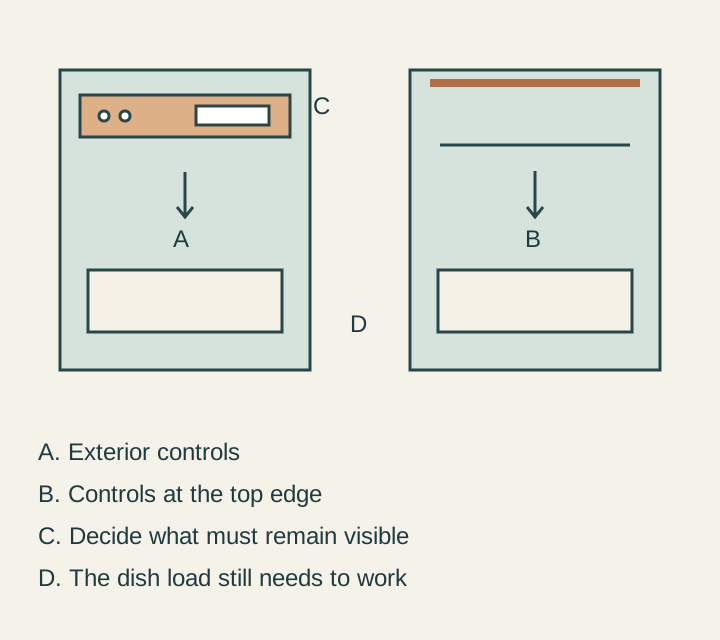
Choose front controls when seeing and using the actual exterior panel is valuable in the household’s routine. Choose top controls when its opening-and-setting sequence works and you prefer the accepted closed front. Neither location establishes better washing. The dishwasher still needs to accommodate the load, operate conveniently and fit the complete cabinet plan.
Begin with the moments when someone asks whether the dishwasher is running, finished or ready to start. Where are they standing, and what information do they actually need? A preference for an uninterrupted front is valid, but it should not quietly remove information the family relies on.
Control location does not specify every other feature
Whirlpool distinguishes exterior front controls from controls on the top edge of the door, generally concealed when closed. Status displays and operating sequences still need checking on the actual candidate.
Reading note: Whirlpool — Top Control vs. Front Control Dishwashers, control locations.
Do not infer a handle shape or front projection from the control category. Compare the selected pocket grip or projecting handle in the room. A top-control machine can be shown in a photograph with a very different handle from the one offered; a front-control label does not supply its installed depth.
Likewise, a concealed panel is not proof that the appliance accepts a cabinet front. If you want furniture integration, shortlist models expressly designed for it and include the panel and permitted handle in the cabinet scope. The control decision and the panel-ready decision overlap without being identical.
Rehearse setting, starting and returning
With the actual model’s instructions available, follow loading, choosing the intended cycle, starting and closing. Then rehearse the ordinary situation in which someone returns to the machine. Where is its relevant status information and how is it understood?
Do not create a universal restart procedure from another brand’s demonstration. If the family commonly adds a forgotten item or changes a selection, ask how the candidate handles that sequence. Buy an operation everyone accepts instead of assuming that hidden and visible buttons behave alike.
Try the controls from the intended user’s normal position, including reading the labels and distinguishing selections. A clear product photograph does not reproduce the person’s viewing angle beneath the real countertop. This is a personal-use check, not a general accessibility certification.
Look at the machine from the places people use
If you want to check status from the dining area, stand in that actual direction in the layout or a suitable demonstration. An indicator visible directly in front may disappear behind a peninsula return. If the candidate uses a light projected elsewhere, identify the relevant surface and verify what the documentation says it communicates.
If you prefer no visible controls, inspect the complete front rather than an ideal blank rectangle. Handle, indicator, badge and seams may remain part of the model. Decide which visible elements are acceptable before altering cabinet hardware to compensate for a dishwasher selection still in doubt.
An exterior display that suits one family can be visually distracting to another. The right answer is the accepted actual front in this room, not a claim that one format looks more expensive or professional.
Check loading before paying for the interface
Place the ordinary bowls, glasses, plates and awkward utensils in the candidate racks. Keep the same accepted load in both comparisons. Better control visibility does not rescue a rack arrangement the household dislikes, and a beautiful hidden panel does not create room for an incompatible serving piece.
Then follow unloading to the actual cabinets with the appliance door open. If the preferred candidate has a different handle or front movement, include neighboring drawers and the position of the person. The small control strip does not eliminate the rest of the dishwasher’s working footprint.
For households concerned about unintended operation, inspect the candidate’s documented lock or control behavior and how adults use it. Do not treat concealed controls alone as a protective feature. A buying guide should compare the supplied function rather than promise what a location prevents.
Price a finished front without changing the baseline
Compare dishwasher, required finishing pieces, panel where supported, installation and any cabinet or toe-kick differences. Keep common work common. Do not let a higher-feature candidate’s unrelated drying or rack upgrade become evidence that its control location costs more.
Imagine a hypothetical household that watches dishwasher status from the kitchen table. A front-control candidate shows the information they use from that position. The top-control candidate’s particular indicator is not convenient from the accepted table view, although the owners like its quieter-looking front.
Both machines pass the same loading and cabinet checks. The family chooses front controls and accepts the visible strip, retaining the already selected cabinet pulls. It does not claim cleaner dishes or greater reliability from that choice.
A different family may prefer the top-control operating sequence and have no need to read the display from across the room. Keep model identity, accepted operation, visible front and cabinet relationship together. The useful purchase is the dishwasher the household can understand and use in its finished kitchen.
Sources & further reading
- Whirlpool — Top Control vs. Front Control Dishwashers, control locations