

Kitchen planning
French top or separate burners: which cooking arrangement belongs in your kitchen?
A French top suits cooks who want to move vessels across a graduated heated surface. Compare that workflow with individually controlled burners, the rest of the cooking appliance and the preparation counter before giving it permanent space.
Buy the way you want to manage several pans
Choose a French top when moving pots across a graduated heated surface is a cooking method you want to use regularly. Choose separate burners when you prefer each vessel to stay at its own controlled position. A French top is not simply a more impressive-looking replacement for unused burners, and its large continuous surface should not be mistaken for an equally large food-contact griddle.
The important purchase is the completed cooking arrangement. Consider the French top together with any adjacent burners, the oven arrangement, ventilation and the counter used for ingredients and serving. An attractive specialty surface can be the wrong choice if fitting it removes the preparation area that makes ordinary meals manageable.
Understand what changes under the pans
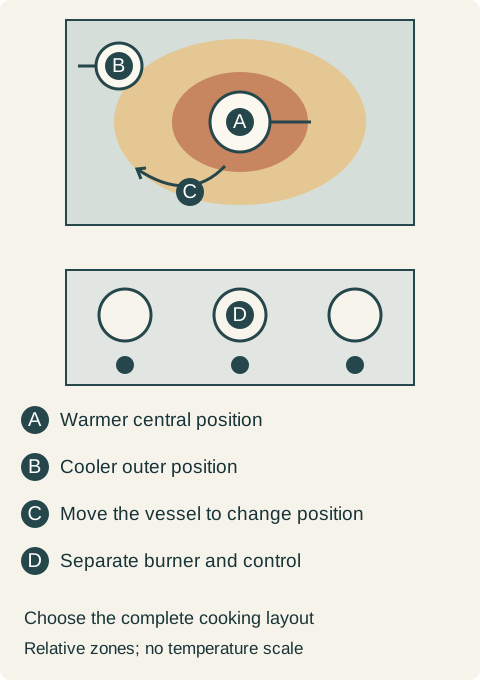
Wolf describes its French top as a surface heated by a central flame, with a hotter center and cooler outer positions. Cooks change heat exposure by moving cookware. Food must remain in pots or pans rather than being cooked directly on the plate.
Reading note: Wolf — Cooking with a Wolf French Top.
That creates a different relationship between the cook and the appliance. With separately controlled burners, the owner can select a burner and adjust its setting while leaving a pan in place. With the French-top method, changing a vessel's position is part of managing the meal. The relevant question is whether that movement is comfortable with the household's actual pots, handles and neighboring cookware.
A broad empty plate does not tell you how freely a group of vessels will move. A large pot may occupy the route another pan needs. Handles can cross, and the preferred destination may already contain a different vessel. Before selecting the appliance, arrange the intended cold, empty cookware on a representative surface and walk through the movement. That checks geometry; a supervised demonstration under the manufacturer's instructions is needed to judge cooking behavior.
Look at the ordinary meal, including its transitions
Start with a meal the household really prepares, not an imagined restaurant service. Describe which vessels are used together, which stay in place and which need to move as the meal progresses. Include the lid that comes off and the utensil that must be set down. A layout that fits the pan bases but has nowhere for those objects has not resolved the cooking station.
Consider a heavy covered pot. If the owner dislikes moving it during cooking, reserve a suitable independently controlled position or choose a different arrangement. Do not assume enthusiasm for a French top makes every vessel convenient to slide. The purchase needs to work for the person who normally cooks, including the tasks that person finds awkward.
Also consider short, simple meals. A cook may enjoy a specialty surface during extended weekend preparation yet prefer a conventional burner for an ordinary weekday task. That is a reason to examine the complete combination, not a reason to label either habit wrong. Determine whether the remaining independently controlled positions can serve the household without routinely crowding the new surface or the adjoining counter.
Compare it with the right alternative
If the main wish is to cook food directly on a broad plate, compare the appropriate griddle arrangements instead. A French top does not satisfy that wish merely because its surface looks solid. If the wish is to accommodate a particular round-bottom wok, assess the explicitly supported wok arrangement; this guide does not authorize changing the French-top center or adding an improvised support.
If the real problem is that a large skillet blocks nearby pans, examine a complete burner layout before assuming a French top solves it. The new plate may allow a different arrangement, but it cannot make the cookware smaller. Review all vessels together and the path for moving them. A specialty feature is useful only when it changes the problem that prompted the purchase.
Separate the desire for another cooking position from the desire for this particular method. An owner may need a better organized conventional cooktop, a different appliance size or more preparation counter instead. Compare those alternatives as completed kitchens. The appearance of a professional cooking line is not evidence that the household needs every surface offered in it.
Keep the cabinet and counter consequences visible
Locate the accepted cooking appliance in the proposed run and retain a practical place for ingredients, utensils and serving pieces. The warmed plate does not become an ordinary preparation counter because no pan is sitting on one part of it. Keep the counter's preparation role separate from the cooking surface's operating role.
Review storage around and below the actual appliance. A broader cooking configuration may rearrange the drawers where the household expects pots and utensils to live. Show the replacement storage with the intended contents instead of describing lost cabinetry as a minor adjustment. It is possible to gain an appealing cooking method while making the rest of the meal less convenient.
The completed quote should include the selected appliance configuration and the work needed for its installation and ventilation. Those requirements come from the actual products and the project assessment. This guide supplies no universal hood size, clearance, fuel provision or countertop opening. An appliance-only price does not show the cost of changing the kitchen around it.
A French top earns its place without replacing every burner
Imagine a household planning a new cooking run. The main cook often prepares a meal with several smaller saucepans and wants to move them among different heating positions. A large covered pot is also used, but the cook wants it to remain at its own independently controlled position. The initial French-top proposal accommodates the smaller vessels but leaves that large pot competing for their movement space.
The owners compare a conventional burner arrangement with a French-top combination that retains a suitable separate burner for the large pot. In a supervised demonstration they prefer managing the smaller pans on the graduated surface. A cold cookware arrangement then shows that the separate pot position leaves the intended movement route clear. The preference is based on their actual meal, not a promise that a French top cooks everything better.
The first cabinet layout makes this combination fit by consuming the nearby preparation counter. The owners reject that layout. The revised plan moves their previously proposed display section elsewhere and preserves a preparation area beside the accepted cooking run. The remaining cabinet storage is checked with the retained cookware, and the installation proposal includes the chosen ventilation and connection work.
They select the combined arrangement and accept its total project price. They also decline a separate griddle because direct-on-plate cooking is not the missing function in their kitchen. The result is a deliberate cooking and storage plan, rather than a collection of specialty features purchased because they were available.
When separate burners are the better purchase
Stay with individually controlled burners if the household mainly wants vessels to remain in place, finds the movement awkward or cannot preserve a useful preparation area in the French-top proposal. A cooking arrangement that follows familiar habits can be the more considered purchase. There is no need to buy an unfamiliar workflow to make a kitchen look ambitious.
Before ordering, identify the actual configuration and retained cooking positions, confirm the entire room proposal and review the manufacturer's current care and operating instructions. Brand examples here explain the comparison; they do not establish that USA KITCHENS & TOPS stocks or represents the appliance. Buy the arrangement that makes the household's complete meal workable, including what happens around the heated surface.
Sources & further reading
- Wolf — Cooking with a Wolf French Top