FreePower’s February 20, 2026 announcement describes FreePower for Countertop 2, claims up to 65W per device with larger-device applications including laptops and tablets, and gives Fall 2026 as its availability plan. This is the manufacturer’s announcement, not confirmation that every laptop can charge wirelessly.
Public material was reviewed on October 23, 2026. The seasonal date above remains the announcement’s stated plan; this review does not establish current order acceptance or delivery.
Decide what should stay on the counter
Embedded charging is most useful to examine when a device already rests in a predictable place. A phone left beside a seating position asks a different question from a laptop moved around during homework. List the actual device models and where people use them before selecting a charging location. The kitchen is buying a powered surface assembly, so the benefit should survive an ordinary day of cooking, eating and clearing the counter.
FreePower’s general FAQ describes integration during countertop fabrication and a mounting system permitting removal. It also lists 65W as maximum power draw for the platform described there. That input figure is not the new announcement’s per-device output claim; the documents must not be combined into an invented specification.
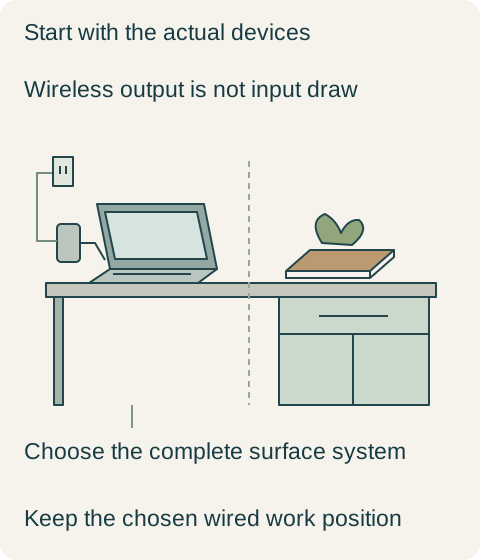
Teaching example Hypothetical homework kitchen: the selected arrangement keeps a wired laptop position separate from food preparation. This is a task-placement diagram, not an electrical installation detail or a tested FreePower configuration.
A wattage headline does not identify the receiving device
Keep the proposed charger generation and its compatible receiving devices together. A number on a laptop’s wired power adapter does not, by itself, establish wireless compatibility. Nor does a general phone-charging demonstration show the behavior of the household’s tablet or computer. The relevant demonstration uses the intended device and the specified charging arrangement. Describe any needed accessory openly, including its position and how the device is picked up or moved.
This also changes how to compare the cost with ordinary charging. The embedded option involves the countertop work, charging equipment, supply and service access. An external charger is a different purchase with different placement and replacement choices. Compare complete arrangements that perform the same task. Hiding the charger is valuable only if the user still has a convenient place to leave the device and can retrieve it without rearranging the kitchen.
The light effect is a separate material choice
FreePower’s material guidance distinguishes translucency from clarity: a surface can transmit different amounts of light and can alter the perceived color. It also notes variation within a stone piece. A photographed glowing Halo is therefore not a preview of every slab.
Place the charging zone on the slab layout as well as the room plan. If the glowing effect matters, evaluate the selected material at the intended location instead of approving only a showroom’s different surface. If the effect does not matter, still identify how users find the working zone. Do not let an appealing light demonstration determine the stone before the rest of the countertop’s appearance and use have been considered.
A homework kitchen keeps an ordinary countertop
In a hypothetical remodel, the family’s main charging need is a laptop used for homework at the dining end. Their existing computer uses its documented wired charging arrangement, and they do not want to replace it or add an unverified receiving accessory. The phone is normally taken to another room. An embedded charging surface would therefore leave the important daily task dependent on the same wired connection.
They select an ordinary, unpowered countertop and a planned wired charging position at the dining end, with the electrical work assigned to the responsible professional. The cable route is kept out of food preparation, and the laptop and charger can be removed when the family clears the table. They give up the disappearing charging-zone effect and keep the slab appearance they prefer. This completes the design without reserving a speculative opening for an unspecified future module.
A household that routinely parks compatible phones on the counter may reach a different result. In that case, the device list, approved surface arrangement and service access belong in the order before fabrication. The useful advance in the new announcement is the proposed wider device scope. Its value to a particular kitchen depends on those devices actually belonging to the supported system, rather than on a larger wattage number alone.
Pure White
Cream White
Light Warm Gray
Gray
Navy
Black
Oak Tone
Dark Walnut Tone
Design study These finish studies are design references, not a list of currently orderable colors. Screens and lighting change the appearance; compare a physical sample before choosing.See all finish options →
Size the drawer around the outlet box, cable-management arms and plugged-in devices. An outlet face that fits the back panel does not prove that the whole assembly can move.
The quarter’s current-activity and near-term readings pointed in different directions. For cabinet businesses, that distinction matters when choosing between preparing for demand and committing to additional inventory.
The sample shows the door frame, a separate center panel, the face frame and the cabinet box. Each component has its own place in this Shaker construction.
Shaker construction: door frame, center panel, face frame and cabinet box. The cutaway helps locate these parts; confirm each material in the specifications for the selected cabinet.
01 / Door frame
The Shaker door has rails and stiles around a separate center panel. The frame and center panel are different components; confirm their materials in the specifications for the selected cabinet.
02 / Face frame
The face frame surrounds the opening at the front of the cabinet box and sits behind the doors. The face frame, door frame and cabinet box are separate parts.
03 / Cabinet box
The sample exposes the cabinet sides, interior surfaces and layered edges. The image does not establish the wood species or material specification of a selected cabinet.