Fluted or satin glass cabinet doors: decide what should remain visible
Choose a cabinet insert by the view through it, not just the pattern on its surface. Linear texture and etched haze answer different design preferences and can also be combined.
Choose fluted glass when you want a visible linear pattern and are willing to judge the contents through that pattern. Choose a satin etched alternative when a more uniform softened view suits the room. Neither name guarantees that stored objects disappear. If hiding recognizable packages is essential, compare an opaque front too. The useful decision starts with what may remain visible when the cabinet is filled, closed and seen from its normal viewing position.
Texture and etching are not opposite categories
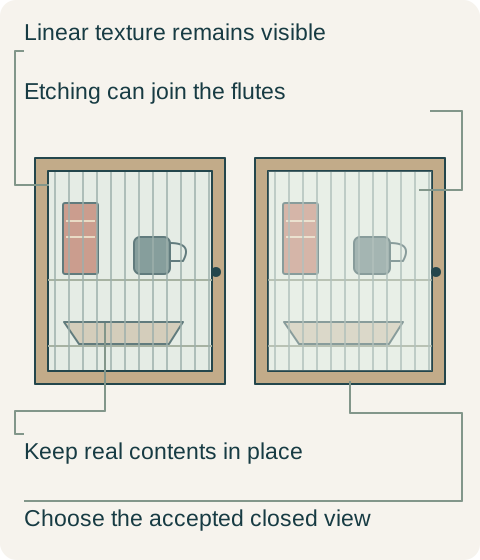
Bendheim describes European Clear Fluted as concave linear glass that bends light to obscure the view. Its European Etched Fluted combines those flutes with an etched surface. The catalog therefore includes a combination, not simply a choice between mutually exclusive treatments.
Bendheim explains that etched glass diffuses transmitted light and offers different opacities and patterns. A satin appearance consequently needs a specific product selection; the word etched does not establish a single, universal concealment level.
Write the visibility requirement before choosing the pattern
Separate three possible aims: seeing a collection clearly, enjoying hints of its colors and shapes, or concealing ordinary storage. A person who likes the outline of wine glasses but dislikes reading package labels has a different brief from someone who wants every decorated plate legible. Describe that brief in ordinary language. It is more useful than asking for privacy glass without explaining which view is unwelcome.
Teaching example Hypothetical comparison of linear glass and a combined etched linear option in a filled cabinet. Shapes and haze are conceptual, not measured optical performance or reproductions of any specific product.
Place the objects that are hardest to accept behind the candidate panel, not only the attractive pieces. Include a strongly colored carton, a dark mug and the normal stack of bowls if those are real contents. Observe whether the objection is a recognizable shape, readable lettering or a large patch of color. These are separate reasons to reject a view. Losing fine lettering does not necessarily solve a distracting color patch.
Make a comparison that represents the closed cabinet
Use safely supported samples or an assembled demonstration arranged by the supplier. Keep the contents, background and lighting unchanged while switching glass. View from the dining seat and the usual standing position, then from the approach to the room. Looking at a loose sample held directly against a white page answers a different question from seeing a filled cabinet across the kitchen.
Use the intended object positions. Do not push everything against the back solely to improve the demonstration if everyday storage needs the front of the shelf. Also compare the intended cabinet lighting on and off. Record which arrangement you actually accept, rather than treating a particularly flattering photograph as proof that the effect remains identical in every setting. This is an appearance trial, not a laboratory opacity rating.
The lines belong to the whole elevation
Put the intended pattern direction on the door drawing and look at the pair of doors together. Vertical stripes beside broad horizontal shelf fronts create a different composition from a plain satin field. A narrow glass opening may show very little of a broad pattern. Judge its actual visible area inside the frame, not a large unframed sample that the final door will never resemble.
Do not rotate a directional piece at installation to solve an ordering mistake without reviewing the result. The agreed elevation should show the actual orientation and the intended exposed face. For a wall with both large and small glass doors, decide whether the same treatment still works across those openings. A consistent glass name does not automatically produce equally prominent patterning in every door size.
A breakfast cabinet keeps color but softens the view
Consider a hypothetical breakfast cabinet holding everyday mugs, bowls and a few tall packages. Its owners want a lighter-looking front than an opaque door, but do not want the packages to dominate the dining view. In their demonstration, clear fluted glass gives the stripes they like, while the bright cartons still attract attention. They do not approve it merely because the lettering is less distinct.
They compare plain satin glass and an etched fluted option with the same contents in their normal shelf positions. The plain field looks too featureless beside the neighboring cabinet fronts. The combined treatment gives the preferred linear surface while softening the contents enough for these owners. They select that demonstrated option and accept the remaining muted color shapes. Packages do not have to be moved to imaginary overflow storage to make the choice work.
The order retains the tested lighting arrangement and specifies the same vertical orientation on both doors. The owners reject an offer to substitute clear fluted glass simply because its groove pattern looks similar in an empty sample. Their approved result includes both the line pattern and the etched treatment. If the original goal had required complete concealment, this accepted view would not meet that different brief.
Buy the selected insert as part of a usable door
After choosing appearance, carry the exact glass identity into the completed front specification. Have the door provider resolve the insert construction, fit and retention with the selected frame. The optical choice does not establish a suitable thickness, door weight or hardware combination. A quote for a glass-ready frame also needs an identified party supplying and fitting the chosen insert; the pattern name alone does not complete that scope.
Review access to both faces for normal cleaning with the actual retaining details in place, and keep the selected glass care instructions. Do not infer from a soft-looking surface that abrasive cleaning is appropriate. Before accepting delivery, compare the empty doors for consistent treatment and orientation, then look at a representative filled cabinet. The purchase succeeds when the working cabinet preserves the view you selected, including whatever you agreed would remain visible.
Pure White
Cream White
Light Warm Gray
Gray
Navy
Black
Oak Tone
Dark Walnut Tone
Design study These finish studies are design references, not a list of currently orderable colors. Screens and lighting change the appearance; compare a physical sample before choosing.See all finish options →
Low-iron glass reduces the green cast in a display, especially along exposed shelf edges. It does not by itself remove reflections or change the structural glass specification.
Compare the actual countertop products, heat-source routine and fabrication proposal. A fired porcelain slab and resin-bound quartz are different materials, but neither label replaces a complete kitchen specification.
The sample shows the door frame, a separate center panel, the face frame and the cabinet box. Each component has its own place in this Shaker construction.
Shaker construction: door frame, center panel, face frame and cabinet box. The cutaway helps locate these parts; confirm each material in the specifications for the selected cabinet.
01 / Door frame
The Shaker door has rails and stiles around a separate center panel. The frame and center panel are different components; confirm their materials in the specifications for the selected cabinet.
02 / Face frame
The face frame surrounds the opening at the front of the cabinet box and sits behind the doors. The face frame, door frame and cabinet box are separate parts.
03 / Cabinet box
The sample exposes the cabinet sides, interior surfaces and layered edges. The image does not establish the wood species or material specification of a selected cabinet.