Flip-top grooming table or a fixed top with a separate mirror?
A mirror concealed in the top changes the surface available during grooming. Compare the open table, the actual mirror view and the work required to close it again.
Choose a flip-top grooming table when the concealed mirror and storage support a routine that can use the remaining fixed surface. Choose a separate mirror and fixed top when the whole work area must remain available during that routine. The closed photograph is a poor basis for comparison because opening the mirror changes what the top can do.
A hidden mirror is also a moving piece of furniture
IKEA's BRIMNES assembly shows the basic distinction clearly: a fixed top over a drawer sits beside a hinged mirror lid and storage compartment. With the lid raised, the mirror is available and the compartment is open, but that part is no longer a flat tabletop. The instructions also show wall attachment; the moving lid does not make the furniture independent of its specified installation.
This dressing table is a structural example, not a recommendation to install bedroom furniture beside a wet basin. For a bathroom or adjoining dressing alcove, specify furniture appropriate to the actual location. Keep the washbasin, splashing and the dry preparation task separate when deciding where such a station belongs.
The attraction is understandable: the closed piece can look like a simple table, while the open piece presents a mirror and current supplies. But do not count the same hinged panel as a permanent landing area and an available mirror at the same moment. Anything normally resting on that panel has to move before it can rise.
Test the view while the working items are out
Set the seating and mirror relationship with the actual user. A mirror inside a lid has a position governed by the furniture and its permitted opening, rather than the independent mounting choices of a wall mirror. Do not alter the support or hinge travel to make the view work. If the user must hold the lid or adopt an awkward position, that candidate has not passed.
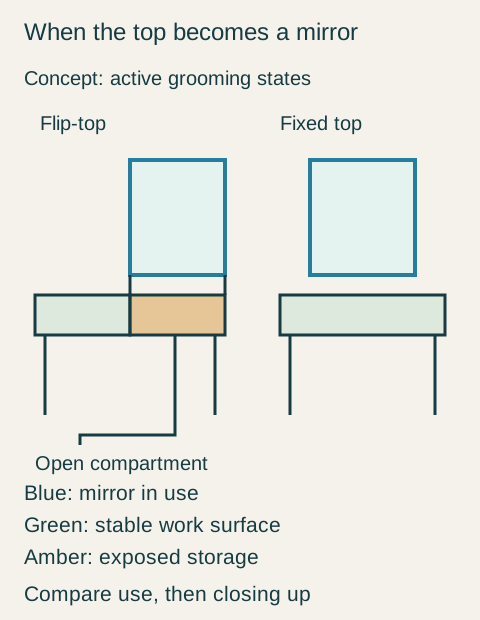
Teaching example Concept comparison: at left, the blue mirror lid stands above an open amber compartment, leaving only the green fixed portion available as a work surface. At right, a separate blue mirror leaves the green top continuous. The diagram compares operating states, not IKEA dimensions, mirror angles or bathroom suitability.
Then place the open compact, tools and other items used during the routine on the surface that remains fixed. The recessed storage compartment may make supplies easy to see, but its bottom is not automatically a comfortable application surface. Check the transition from picking up an item to using it in front of the mirror.
Include any light or powered accessory in its intended position. Its base, cord or handle must not occupy the lid's motion or closing joint. Use the selected furniture and accessory instructions for that arrangement; a tidy closed rendering does not establish a suitable cable route.
Compare an ordinary morning and the return to a closed table
In a hypothetical dry dressing alcove, the owner initially prefers a flip-top table because the mirror can disappear after use. Her normal routine, however, keeps an open palette beside a freestanding task mirror and a small tray of current products. Opening the proposed lid removes the surface on which she intended to leave that tray. The fixed portion can support either the palette or the tray comfortably, but using both forces repeated transfers into and out of the recessed compartment.
She also wants to leave the current products ready for the next morning. Closing the table would require returning every item below the lid and moving the task mirror elsewhere. Leaving the lid open would remove the particular visual benefit that justified this design. The issue is not total storage volume; it is that her preferred ready-to-use state conflicts with the table's closed state.
She therefore chooses a fixed preparation top, a separately positioned mirror and a drawer for reserve items. The daily tray stays on the agreed work area without obstructing the mirror. The same seat, palette and tray are tested in that arrangement before the furniture is selected.
When the flip-top option earns its place
A person who prefers to put the complete routine away after each use may reach the opposite conclusion. The hinged mirror can then reveal a useful group of supplies, and the remaining fixed area may comfortably support the items actually used outside the compartment. Test the complete return sequence as carefully as the initial setup.
Buy the arrangement whose active and closed states both suit the room. The benefit of concealment is real only if restoring that appearance is a routine the owner wants to perform.
Pure White
Cream White
Light Warm Gray
Gray
Navy
Black
Oak Tone
Dark Walnut Tone
Design study These finish studies are design references, not a list of currently orderable colors. Screens and lighting change the appearance; compare a physical sample before choosing.See all finish options →
Define whether the seated task needs a preparation surface or the basin itself, then test the actual user and seating with the full underside, mirror, storage and route included.
Build the layout from the actual compacts, palettes, bottles and tools, then test whether they can be identified, removed and returned without dismantling the arrangement.
Consider a separate area when a defined group of grooming steps can be completed there with its own working surface, view and supplies, while the route to any required basin use remains practical. An empty counter elsewhere is only a candidate until the complete task has been tested.
The sample shows the door frame, a separate center panel, the face frame and the cabinet box. Each component has its own place in this Shaker construction.
Shaker construction: door frame, center panel, face frame and cabinet box. The cutaway helps locate these parts; confirm each material in the specifications for the selected cabinet.
01 / Door frame
The Shaker door has rails and stiles around a separate center panel. The frame and center panel are different components; confirm their materials in the specifications for the selected cabinet.
02 / Face frame
The face frame surrounds the opening at the front of the cabinet box and sits behind the doors. The face frame, door frame and cabinet box are separate parts.
03 / Cabinet box
The sample exposes the cabinet sides, interior surfaces and layered edges. The image does not establish the wood species or material specification of a selected cabinet.