

Buying cabinets
Fisher & Paykel at EuroCucina 2026: integrated kitchen planning
The Milan program puts modular cooking, stone-front dishwashing and a new oven into one material composition. Use the actual display to define the result, then separate the supported assemblies for a US cabinet purchase.
A continuous appearance is not one continuous component
Fisher & Paykel's Milan presentation offers a useful way to discuss a kitchen that reads as a material composition rather than a lineup of appliances. For the cabinet buyer, its value lies in seeing how different working objects can participate in that composition. The installation still consists of different assemblies.
That distinction matters when a showroom image inspires one broad instruction such as carry the stone everywhere. A countertop, a moving dishwasher front and an oven surround have different jobs. Decide which visual relationships the project wants, then preserve the actual support and movement of each part.
What was shown, and where
Fisher & Paykel's April 21, 2026 report describes its Milan exhibition with flush modular induction, stone-front DishDrawer dishwashers and a new Minimal Style oven with steam assist.
Reading note: Fisher & Paykel USA — Nature–Ritual at EuroCucina 2026.
This is an exhibition report, including a program presented on the manufacturer's US site. It does not establish that every displayed configuration is available or approved for an American project. Keep the exhibition identity distinct from the actual regional products and documents offered to the cabinet supplier.
The stone stops being a fixed surface at the dishwasher
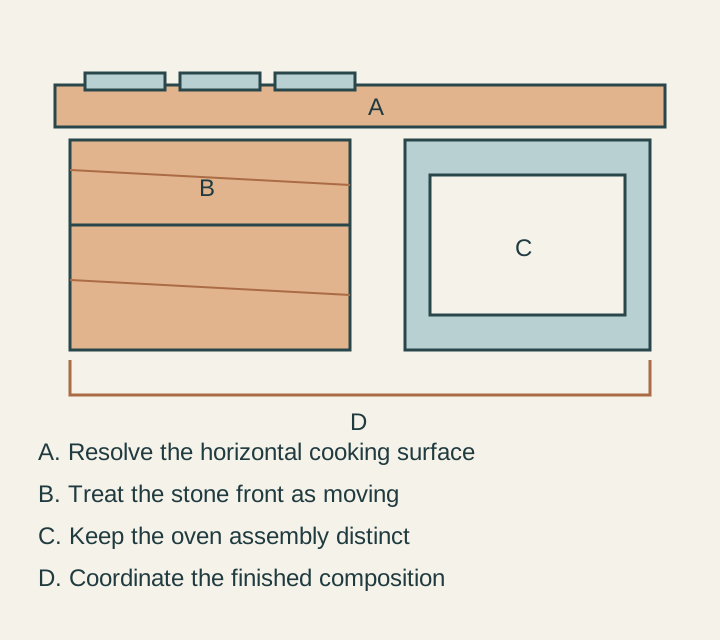
The important design idea is not simply that stone appears on a front. The material participates in a working appliance face. A project following that idea needs the selected appliance's supported panel construction, attachment, handle or opening arrangement and complete finished weight.
Do not send a surface sample to the stone shop and assume it has specified the panel. The backing, exposed edges, preparation and appliance attachment belong to a completed assembly. A surface suitable for the counter does not automatically establish a suitable moving front.
Study both closed and open states. The pattern can appear coherent across the room while separating when the drawer moves. Decide which joints remain visible and what the edges look like in the user's hand. A photograph of a closed monolithic block does not show that experience.
The same care applies when a different material is chosen for the project. The display can inspire a quiet surface relationship without obliging the owner to reproduce its exact material treatment.
Modular cooking changes the top and what survives beneath it
The horizontal part of the composition depends on exact modules and their supported combined installation. Establish whether the offered arrangement uses particular interfaces, openings or other required pieces before asking the countertop fabricator to make a visually continuous surface.
Now place the actual bodies and connections below that surface. A clean-looking top cannot be used to promise a complete ordinary drawer bank underneath. The remaining usable compartments must be drawn around the selected installation and checked with the retained tools.
Place the ordinary cold cookware on the layout as well. The preferred material composition should still support the household's working group and a usable receiving surface. Do not extend a decorative pattern into a region the product reserves for another function.
This part of the Milan idea is about composing equipment into a surface. It does not mean the modules become generic holes that any later appliance can replace.
A new oven is another assembly in the same view
The oven idea should be assessed with the actual offered cooking functions and the household's vessels. The appearance can relate to the room without dictating which cavity or companion appliance is needed. An attractive arrangement does not establish that the family wants every demonstrated function.
For a steam-related candidate, identify the exact product and its documented water, care and installation arrangements. A feature description does not settle whether the project uses a reservoir, a connection or some other model-specific method. Do not add pipework or remove storage based on a broad program name.
Keep the supported opening and surrounding construction visible in the same elevation as the patterned fronts. A shared line can be a design intention without becoming a physical filler through an appliance opening. This is where the cabinet composition must respect each distinct working part.
Bring the composition into a US quotation
Ask for an actual regional equipment list before placing the exhibition's forms in an order. Identify which candidate reproduces the wanted interaction and which only offers a related visual idea. If the exact shown treatment is unavailable, choose a supported alternative rather than describing the show image as a confirmed deliverable.
Assign responsibility for the moving panel, countertop fabrication, cabinet structure and appliance installation. Each should work from the same identified products and drawings. A project that has separate specialists still needs someone to reconcile their interfaces.
Then quote the material composition at its completed scope. Include the fronts, supports, finishing, appliance accessories and cabinet changes that the selected plan requires. No exhibit description establishes its installed cost or a manufacturer's universal material premium.
One project keeps the horizontal idea and changes the moving face
Imagine a hypothetical homeowner drawn to the unified kitchen scene. The project has a suitable actual modular cooking offer, but the proposed dishwasher panel treatment has not been supported for the selected regional model. The owners do not order a loose stone sheet and leave the attachment to the installer.
They keep a supported horizontal surface arrangement and select a different completed front for the dishwasher. Samples establish a deliberate relationship rather than an imitation of an unresolved exhibit detail. The oven candidate is separately chosen around the real vessels and wanted functions.
The resulting kitchen is still informed by the exhibition. It has a coherent composition whose parts can actually move, be accessed and be supplied for the project. Another project may obtain a supported version of the more continuous treatment. The useful lesson from Milan is to design those working assemblies together, while retaining the exact evidence that makes each one possible.
Sources & further reading
- Fisher & Paykel USA — Nature–Ritual at EuroCucina 2026