

Design & industry
Fabuwood Siena doors: texture and cabinet construction options
The new door uses surface direction and touch instead of applied trim. Compare that visual idea across the actual elevation, then keep the chosen Illume or Ovela cabinet construction explicit.
Fabuwood’s Siena introduction gives a buyer a specific alternative to adding more profile detail: keep a slab-like geometry and let direction and texture provide the interest. The buying decision has two parts. First decide whether that visual movement improves the actual cabinet elevation. Then select the complete cabinet behind the front, because the compatible frameless offers do not have the same interior construction simply because the door can look alike.
Fabuwood’s article dated 2026-10-12 introduces Siena with vertical and horizontal grain expression, textured finishes and no applied trim, for Illume and Ovela. The publication date supplies context; it does not independently establish the first day of sale.
Reading note: Fabuwood:Siena introduction,October12,2026.
Direction becomes a visible design element
The attraction is not another molding added to an otherwise plain front. It is a surface that can carry more activity while keeping the overall geometry restrained. Look at a representative full door rather than enlarging a finish chip and assuming it explains the whole composition.
Do not infer the door’s material or fabrication from the direction of the visible grain. A framed-looking pattern does not by itself establish separate solid-wood members or a particular joinery method. Have the provider identify the actual proposed front, while judging the directional effect as the appearance the household is choosing.
This can suit a buyer who wants more interest than a quiet slab but does not want additional applied lines. Another household may prefer the uninterrupted calm of its original plain front. The new format earns its place when the actual surface supplies the right amount of movement, not because every minimalist room needs texture.
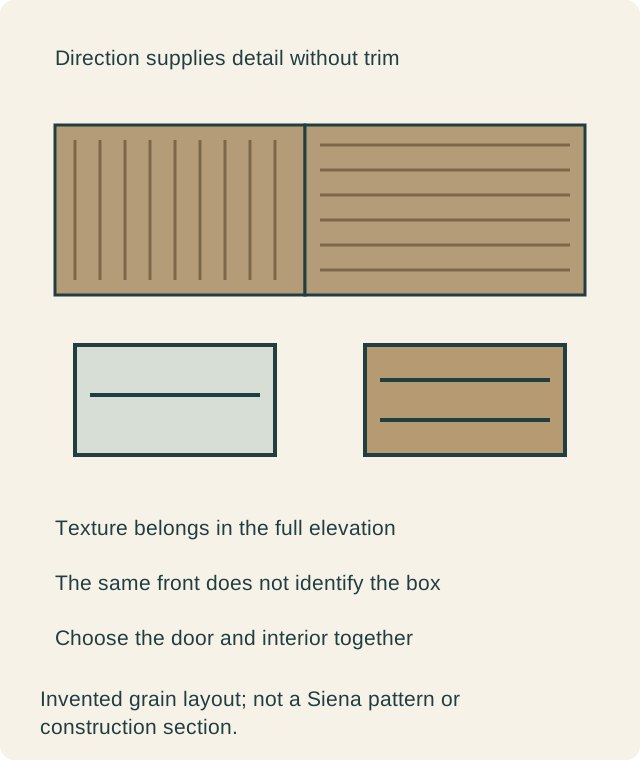
The elevation needs more than one attractive close-up
Show how the selected appearance is used across tall fronts, drawers and neighboring cabinets. The door’s directional expression should be assessed at the sizes and positions actually proposed. A pattern that works on a broad sample can read differently when the visible field is narrow or interrupted by handles.
Stand back and identify where the eye travels. The kitchen might need a strong tall group while the wall cabinets stay quieter. It might instead use the new door as a limited island feature. Neither arrangement requires repeating the most active part everywhere merely because it is newly offered.
Touch should support the visual reason for choosing
Handle the actual finished sample as the provider allows. Decide whether the texture is pleasant near the pull and on the surfaces the household regularly touches. A photograph can show direction, but it cannot establish the feel of the quoted front.
Keep the expected care information with the actual material and finish. Do not assume a wood-looking texture should receive a natural-wood maintenance routine. The buyer needs the delivered surface identified, not an attractive description that leaves its care to guesses based on the pattern.
Illume is a specific cabinet proposal
The current Illume specification identifies engineered furniture board, white-linen interiors, Blum MERIVOBOX metal drawers and adjustable legs. These describe the existing cabinet system that can be proposed with the new front; they are not all newly introduced features of Siena.
Reading note: Fabuwood:Illume specifications.
View that completed interior with the intended contents. Decide whether its visual background and actual drawer arrangement fit the household. If organizers are already selected, compare them with the quoted drawer’s usable space. The door sample does not answer that interior question.
Ovela keeps a different interior and base arrangement
Ovela’s current page identifies plywood construction, natural-veneered interiors, wood dovetail drawers and a built-in recessed toe kick. It supplies a different cabinet proposal behind the compatible door, rather than an identical box with another collection name.
Reading note: Fabuwood:Ovela specifications.
Compare the complete interior and installation proposal on its own terms. A buyer may prefer the wood drawer’s appearance or the other system’s metal expression. Do not claim that one whole cabinet is superior from that difference alone. Ask what the selected configuration includes and how it serves the planned kitchen.
The base arrangement also belongs on the actual cabinet drawing. The maker and installer should identify their completed assembly. The buyer should not have to discover that a visually similar front was quoted on a different system than the one demonstrated in the showroom.
A hypothetical kitchen limits the directional feature
Imagine owners seeking a calm kitchen who find their original flat front too quiet. Siena’s sample gives them the tactile and directional interest they wanted. When shown across every elevation, however, they find the combined movement stronger than expected beside the retained floor.
In this hypothetical case, they keep the new front on the tall cabinet group and choose a quieter neighboring surface. They also compare the actual compatible cabinet interiors before selecting the system for that group. The decision preserves the new door’s useful role without treating it as a requirement for every cabinet.
Another household might use it more broadly and like the repeated direction. That outcome can be equally deliberate. The useful review is the room’s actual distribution of texture and the complete cabinet offer, not a generic promise that a new slab will make every kitchen warm or effortless.
Keep the front choice separate from a material assumption
If a quotation changes from one compatible cabinet system to the other, review the interior and base proposal even when the door name remains. The visible face can stay familiar while other parts of the purchase change. Record those differences explicitly rather than carrying over an old description.
Likewise, if a different front is proposed, compare its actual direction and touch. A broadly similar wood appearance may not provide the same visual structure. The specific reason for selecting Siena should remain recoverable in the sample and elevation, rather than being reduced to the word textured.
Finish with a complete, deliberate combination
The order should identify the selected cabinet system, front, actual finish, interior, drawer arrangement and relevant visible ends. Keep the complete sample and the accepted distribution of the new surface with the drawing. Current supply belongs to the project’s own offer, not to a publication date.
This introduction is useful when surface direction replaces detail the household does not want, while the cabinet behind it still supports everyday use. The buyer should leave with both decisions made: what the room will show, and which complete cabinet will deliver it.
Sources & further reading
- Fabuwood:Siena introduction,October12,2026
- Fabuwood:Illume specifications
- Fabuwood:Ovela specifications