

Construction & materials
Enameled lava-stone countertops: choose the glaze, edge and whole assembly
Treat enameled lava as a completed countertop system. Review its colored surface, exposed edges, joints and service proposal before planning the cabinet beneath it.
Choose an enameled lava-stone countertop for the completed colored surface and the fabricated shapes you can actually approve. Do not evaluate it as an ordinary uncoated stone slab that happens to be blue or green. The edge, joints and service method belong in the same selection as the glaze. An appealing color sample is a useful beginning, but the purchase is a countertop assembly that must suit the kitchen and the cabinets beneath it.
Identify the surface that will be used
Pyrolave presents enameled lava for kitchen countertops, backsplashes and sinks. This establishes an offered material format; it does not describe every product sold with a volcanic-stone name.
Reading note: Pyrolave: Kitchens, enameled lava application.
Ask the provider to identify the actual manufacturer and surface system. A natural lava sample and an enameled example are not interchangeable color references. Nor is a porcelain image an adequate substitute simply because its color seems close. Record the supplied material and completed finish together, then review the fabrication proposal specific to that combination.
This matters especially when a design begins with an inspirational photograph. The visible color may carry most of the composition while the photograph conceals the edge, seams and underside. Separate the feature that attracted you from the parts that remain unknown. You can keep the original design intention while asking for a product and assembly that make it concrete.
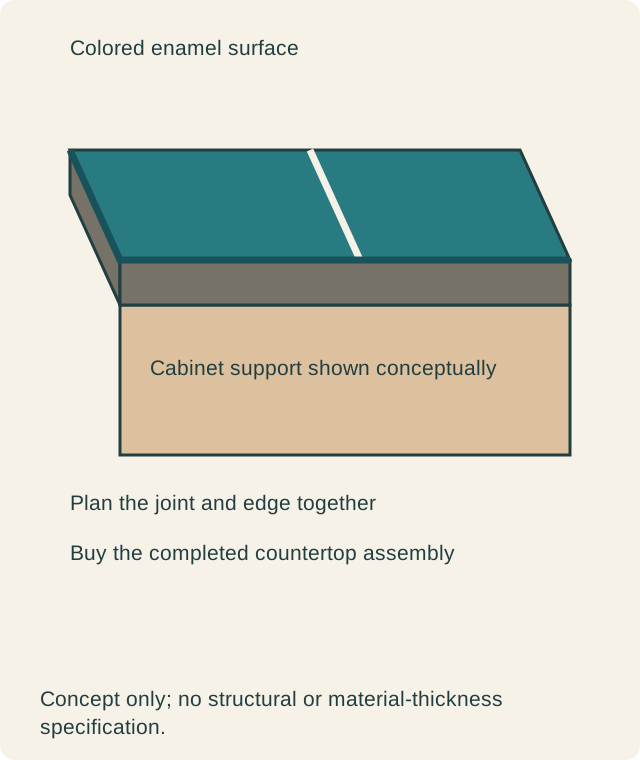
Let a finished edge join the color review
A flat chip shows a limited portion of the countertop. Request a representative finished edge or a corner example in the proposed glaze. Look at how the horizontal surface turns toward the cabinet face and how the outline reads beside the chosen door profile. A rounded front and a sharply defined front create different compositions even when they carry the same color.
Also decide which surfaces are intended to remain visible. An island viewed from the dining side exposes a different perimeter from a top held between walls. Ask how the offered edge terminates at a short return or a backsplash junction. These are reasons to review a completed detail; they are not permission to invent a field-cutting or edge-repair method after fabrication.
Plan seams as visible parts of the design
Pyrolave’s professional guidance addresses color-matched joints and chip repairs separately. Their inclusion is a reason to plan those details rather than assume the finished surface has no joints or repair needs.
Reading note: Pyrolave: Professional assembly, care and repair guidance.
Have the fabricator place the actual proposed pieces and joint lines on the kitchen drawing. Compare that map with sink and appliance positions, visible edges and access for installing the pieces. A long uninterrupted island in a rendering is still only a design intention until the supplied fabrication plan supports it. Avoid selecting a cabinet layout on the assumption that any desired top can arrive in one piece.
A color-coordinated joint can remain a visible line under some lighting. Ask for a representative completed example and decide whether the location is acceptable. The useful conversation concerns the real joint and its setting, not an unsupported promise that the word matched means invisible. If the location compromises the focal view, revise the layout while the design is still open.
Keep cabinet support and decorative thickness separate
The visual depth of an edge is a design characteristic; it does not by itself describe the weight, support or attachment of the countertop. Give the responsible cabinet and countertop providers the same identified material, piece layout and finished edge proposal. They need to coordinate the actual assembly rather than work from different interpretations of a product photograph.
Where the design includes an overhang, a sink or an appliance opening, obtain the fabricator’s applicable detail and coordinate it with the cabinet drawing. This article does not assign a universal support spacing or allowable projection. A manufacturer's general kitchen page cannot approve a particular cabinet run. The buyer’s decision becomes actionable when a named fabricator accepts the intended layout with a defined installation proposal.
A hypothetical blue island changes its perimeter detail
Imagine a kitchen with plain wood cabinets and a blue enameled-lava island top as the principal color accent. The first concept uses a visually heavy rounded edge. Beside the slim cabinet fronts, the owner finds that outline too dominant. A representative alternative edge preserves the blue horizontal field while giving the perimeter a quieter appearance. The owner selects that finished detail after viewing it alongside the actual cabinet sample.
The fabricator’s piece map also places a joint across the first preferred seating view. The designer revises the arrangement so the accepted joint location is less prominent, then confirms that the changed pieces still belong to the offered fabrication plan. The hypothetical project keeps the distinctive material because the edge and layout now support its purpose. It does not claim that every manufacturer can make the same shape or eliminate the same seam.
If the owner had required a completely unbroken appearance and the offered assembly could not provide it, a different material or a smaller focal surface would have been the clearer choice. The colored glaze is not a reason to ignore an unresolved piece map. A selection can remain attractive and still be unsuitable for a specific geometry.
Discuss service before describing the surface as effortless
Read the care instructions for the supplied enameled product. Do not automatically transfer polishing, sealing or cleaning routines from an unrelated natural-stone countertop. Ask who assesses an impact or edge chip and how the provider distinguishes an ordinary cleaning question from a repair. A documented service route is more useful than a broad claim that the material needs no attention.
Request realistic expectations for a repaired location, particularly where a pendant light or window makes reflections conspicuous. A repair method being available does not establish that every repair disappears. Do not test an installed edge or an approved sample with improvised impacts or chemicals. The selection discussion should establish what the provider offers and what appearance the owner is willing to accept.
Buy the countertop that belongs to the cabinet design
Keep the material identity, approved glaze sample, edge example, piece-and-joint drawing and coordinated support proposal together. Include the agreed service contact and product-specific care information. If the order later changes to a different surface system, review those details again rather than carrying the original approval across by color alone.
At that point the choice has a practical result: a defined colored countertop, a perimeter that suits the fronts, and joints accepted in their actual locations. The cabinet provider can coordinate with a real fabrication proposal. The owner can judge the complete surface without relying on a sample chip to answer questions it was never large enough to show.
Sources & further reading
- Pyrolave: Kitchens, enameled lava application
- Pyrolave: Professional assembly, care and repair guidance