

Design & industry
Dura Supreme’s 2026 Reeded and Batten panels: texture moves beyond the door insert
The full-panel expansion and new beveled Batten option create different choices for island backs and broad fixed faces. Compare their role across the elevation rather than enlarging a door-insert image.
Dura Supreme’s panel introduction matters because it expands where texture can appear, not merely because it adds another decorative door option. The full-panel format lets a buyer consider a broad fixed face as a distinct part of the cabinet composition. The new Batten direction offers another rhythm beside the Reeded treatment. Decide which surface should carry that rhythm before turning a small sample into an island-wide design.
Dura Supreme adds full-size Reeded panels to its existing insert/panel range and introduces beveled Batten panels associated with Hudson and Carson Shaker styles. This identifies new product formats, not unlimited panel dimensions.
Reading note: Dura Supreme: Reeded and Batten panel introduction.
The official news index dates this panel entry as 2026-06-17. That is its publication date.
Reading note: Dura Supreme News: panel introduction dated June17,2026.
Full panels change the scale of the decision
A door insert is divided by its surrounding frame. A broad island back can read as a larger uninterrupted field, even though its actual fabrication still needs a piece layout. The release therefore opens a useful question: should the island’s fixed face provide the texture while the working doors stay quieter? That is different from choosing a textured front for every cabinet.
Review the whole face from the dining or living side, where the broad panel will be seen. Then compare it with the sample at close range. The effect that feels subtle in a hand sample may become the room’s strongest repeated pattern. Decide whether that is the desired role before adding another texture to the backsplash or the neighboring tall cabinets.
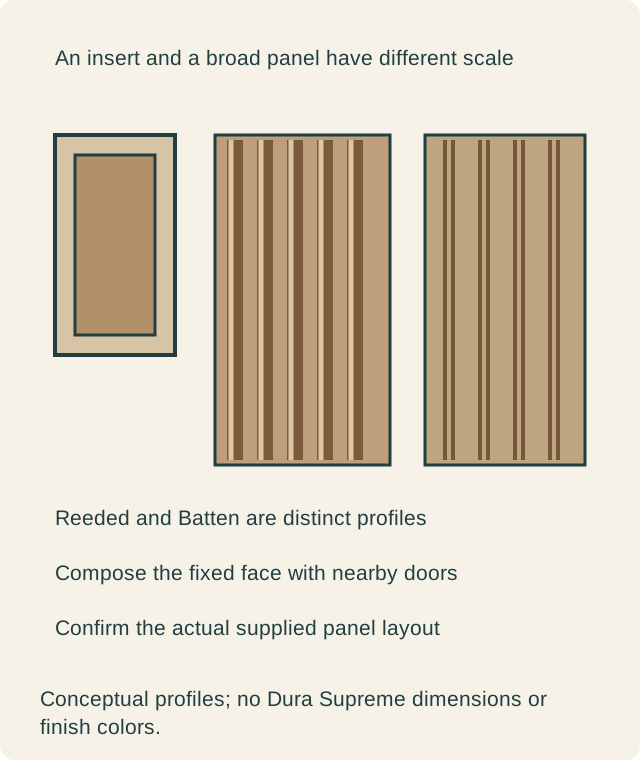
The new Batten option is not another name for Reeded
Ask to see the offered profiles side by side. Compare the size and character of their shadows rather than choosing by terminology alone. A rounded rhythm and a more angular one can relate differently to the same plain cabinet front. The release’s connection to named Shaker styles gives a concrete combination to inspect, without establishing that every door and panel should be matched automatically.
Put the candidate against the actual front family. The purpose is to judge whether the broad field supports that front’s proportions. If the panel is intended as contrast, say so. If a coordinated profile relationship is essential, request the supplied pairing. A style label does not show the junction between a fixed face and the moving door beside it.
Give the broad panel one clear job
An island back may face stools, a dining table or an open approach to the kitchen. Choose which view should organize the composition. The texture can define a calm boundary to the kitchen or become a deliberate focal element. It need not perform both roles equally from every direction. Identify the priority view before deciding how much of the island receives it.
Also consider the furniture already in that view. Chair backs, table edges and nearby shelves can introduce strong repetitions of their own. A panel that looked restrained beside an empty island can become busy with the actual seating. Compare those elements together. You may preserve the preferred panel by simplifying the companions rather than abandoning texture entirely.
A larger format still needs a real piece layout
Ask the provider to show the actual supplied panels and their joints on the elevation. Full-size is a product-format description, not a guarantee that every proposed island face will be one piece. Include the ending at the floor or toe area, the edge below the countertop and any transition to a smooth return. The order should describe a buildable face rather than a repeated pattern stretched in a rendering.
If the fixed back also contains a service opening or another required visible element, place it on that same elevation. Compare how its boundary interrupts the rhythm instead of concealing it in an idealized blank field. A plain border around the opening can be a coherent part of the design if the provider offers an appropriate assembly. Moving or covering a necessary access point just to preserve a repeated line would leave the project unresolved. The panel purchase should include the accepted appearance of these real interruptions.
Keep the panel separate from any structural role unless the responsible provider assigns that role. A decorative fixed face may be part of a broader cabinet assembly. The release does not approve its support, attachment or field alterations. The design review should resolve the visible arrangement while the cabinet provider supplies the applicable construction detail.
A hypothetical Shaker kitchen chooses Batten for the fixed back
Imagine a kitchen with simple Shaker working fronts and a broad island back facing the family room. A full Reeded trial creates more rounded shadow than the owner wants beside the existing seating. A representative Batten trial has the rhythm the owner prefers with the proposed front family. The owner selects it for the fixed back, keeping the working doors in their previously accepted design.
The provider shows a piece map with an intentional border and a smooth side return. The owner accepts those transitions rather than asking for an unsupported wraparound effect. This hypothetical choice uses the introduction’s actual expansion to solve a broad-face composition. It does not assert that Batten is universally quieter or that Reeded cannot work with Shaker cabinets.
Another room could choose Reeded as its principal texture and simplify the neighboring surfaces. A kitchen whose island already carries a patterned stone could keep a smooth back. The new formats increase the available design directions; they do not make every room need a textured island. The selected treatment should still have a specific purpose in the completed room.
Keep the material, finish and maintenance discussion complete
Confirm the actual panel construction and finish in the proposal. The release’s profile descriptions do not identify every underlying material or guarantee that the same finish is available on every companion piece. Compare a completed corner or edge where those details will remain visible. A plain return can be a deliberate design choice when it is shown and accepted.
Use the care instructions for the supplied finish and review ordinary access for wiping the profile. Do not infer a universal cleaning problem from texture, or assume its appearance eliminates visible wear. The buyer needs an acceptable finished object, with a routine the household is willing to use. A profile demonstration should not become an improvised abrasion test.
Record the new format as part of the actual cabinet proposal
Keep the profile selection, finished sample, piece map and assigned locations together. Show which doors and returns remain plain. If the chosen panel layout changes, review the entire fixed face again rather than accepting a new joint arrangement by color alone.
The introduction adds value when it lets texture occupy the right surface at the right scale. A broad fixed panel and a door insert are different design opportunities. Choosing deliberately between them produces a more useful room than repeating the newest pattern everywhere it can be drawn.
Sources & further reading
- Dura Supreme: Reeded and Batten panel introduction
- Dura Supreme News: panel introduction dated June17,2026