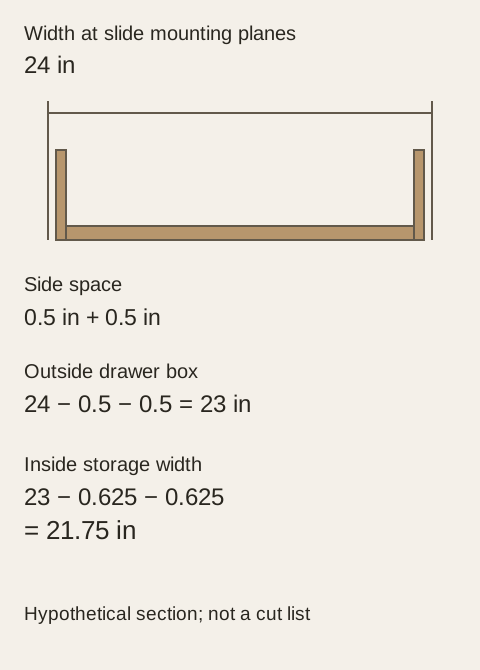
For a side-mounted drawer slide, the important width is the space between its mounting surfaces and the outside of the drawer box. The decorative front can overlap the opening and tells you little about that space. Before choosing replacement hardware or comparing cabinet drawers, identify the slide model and put the opening, box and storage measurements on separate lines.
Name the surfaces before subtracting
Picture a drawer removed from its cabinet. The cabinet has an opening through which the box travels; the slides attach to surfaces on either side. In a frameless cabinet those surfaces may be the cabinet sides. In a face-frame cabinet, spacers or mounting brackets can establish a narrower track. Measure the working distance between those mounting planes, not whichever interior dimension is easiest to reach.
Now separate the drawer parts. The decorative front is the piece you see when the drawer is closed. The box has its own outside width, and the storage area inside that box is narrower again because the sides have thickness. Confusing any of these dimensions can produce a plausible subtraction that describes the wrong part. Label the front separately rather than using its width to order the box.
Work from the mounting opening to the storage width
In this hypothetical example, the distance between the cabinet mounting surfaces is 24 inches. Assume the selected side-mount system requires exactly 0.5 inch of nominal side space on each side for this calculation. The outside box width is therefore 24 − 0.5 − 0.5 = 23 inches. That is the outside of the wood box, not the width available for a tray inside it.
If the same hypothetical box has 0.625-inch sides, the inside width is 23 − 0.625 − 0.625 = 21.75 inches. A 22-inch-wide organizer would be too wide even though it sounds smaller than the 23-inch drawer. Check an organizer’s actual maximum outside width, including rims and handles, rather than relying on a product name or the cabinet’s nominal size.
These assumed dimensions explain the relationship between parts. They do not set a fabrication tolerance or specify a usaKT.com drawer. Accuride’s order checklist uses the difference between the cabinet opening and outside drawer width to explain side space. The exact allowance and tolerance still come from the installation sheet for the selected slide.
Teaching example Hypothetical front section: a 24-inch mounting opening minus 0.5 inch on each side gives a 23-inch outside box. Two 0.625-inch sides leave 21.75 inches inside. The slide model determines actual dimensions and tolerances.
A correct total gap does not prove the drawer is centered
In a second hypothetical example, suppose that 24-inch opening contains the 23-inch box, but the measured gaps are 0.375 inch on one side and 0.625 inch on the other. Their sum is still 1 inch. Dividing that sum by 2 gives 0.5 inch, yet neither side actually has that gap. The average conceals an off-center box. This example is a geometry check, not a claim that either measured gap is acceptable for a specific slide.
Record the left and right gaps independently at the front and rear mounting locations. A cabinet can have the expected opening at its face while narrowing farther back. If the readings differ, identify whether the box, mounting planes or cabinet assembly is responsible before selecting replacement parts. Do not force the drawer through a tight section to establish a fit.
Account for the face frame and the mounting arrangement
A face frame may project inward beyond the cabinet side. A side-mounted slide then needs an approved arrangement that places its working track where the drawer can pass the frame. Adding the full interior cabinet width to a box order ignores that obstruction. Conversely, subtracting the frame twice can make the box unnecessarily narrow. Use a section drawing through the actual slide position.
If the cabinet uses rear brackets, identify their model and mounting requirements as well. A familiar slide length does not establish bracket compatibility or where the cabinet member sits. When comparing complete new cabinets, ask for the actual drawer-box dimensions and hardware arrangement. A generic description such as “soft-close drawers” does not answer either question.
Do not carry the side-mount formula into an undermount order
An undermount system supports and locates the box differently. Its instructions may specify drawer-side thickness, a recessed bottom, rear preparation and locking devices as well as width. Blum’s US TANDEM product information identifies concealed runners and a drawer-side thickness range. That is a reminder to match the box to the selected runner, not evidence that all concealed slides share one deduction.
Before switching from side-mount to undermount slides, obtain the exact runner’s drawer-construction drawing. Check which width the drawing calls out: inside box width, outside box width or cabinet opening. Then check the remaining geometry. A box that meets one width formula can still have the wrong bottom recess or rear arrangement. Budget a new box if the existing one cannot meet the specified construction without an unapproved alteration.
Turn the measurements into a useful cabinet comparison
For a new kitchen, compare usable storage at the drawer you actually plan to fill. A nominally equal cabinet width can contain different box widths because of frame construction, slide hardware and side thickness. Those differences matter for a broad baking tray or a fitted divider, but width alone does not measure the whole drawer. Check clear height, depth and the path through the opening as separate dimensions.
Give the cabinet supplier the dimensions of any organizer you already own and ask for a confirmed fit in the chosen drawer. If you are buying replacement hardware, provide the slide identification and a labelled sketch of the mounting opening and box. Keep the current hardware until the replacement configuration is established; a photograph without dimensions rarely resolves a width question.
Before approving an order, retain the model-specific drawing beside your measurement notes. Record which dimensions describe the front, outside box, inside storage and left/right slide spaces. That small distinction prevents a common mistake: ordering something that fits the cabinet’s advertised size but not the working drawer inside it.
Pure White
Cream White
Light Warm Gray
Gray
Navy
Black
Oak Tone
Dark Walnut Tone
Design study These finish studies are design references, not a list of currently orderable colors. Screens and lighting change the appearance; compare a physical sample before choosing.See all finish options →
Hardware controls how a cabinet opens, what you can reach and where your hand goes. Compare the complete operating arrangement, then record the actual parts.
The sample shows the door frame, a separate center panel, the face frame and the cabinet box. Each component has its own place in this Shaker construction.
Shaker construction: door frame, center panel, face frame and cabinet box. The cutaway helps locate these parts; confirm each material in the specifications for the selected cabinet.
01 / Door frame
The Shaker door has rails and stiles around a separate center panel. The frame and center panel are different components; confirm their materials in the specifications for the selected cabinet.
02 / Face frame
The face frame surrounds the opening at the front of the cabinet box and sits behind the doors. The face frame, door frame and cabinet box are separate parts.
03 / Cabinet box
The sample exposes the cabinet sides, interior surfaces and layered edges. The image does not establish the wood species or material specification of a selected cabinet.