Dovetail or dowel drawer corners: what the joint does and what it leaves unanswered
Dovetails interlock shaped wood; doweled corners connect parts through fitted holes. Judge the corner and the complete drawer separately before paying for a construction label.
A dovetail corner can be a worthwhile construction choice, but its presence does not settle the whole drawer decision. Its pins and tails provide interlocking geometry at the box corner. A doweled corner uses fitted dowels and its specified bonding arrangement. Compare their actual construction and workmanship, then check the bottom, runner attachment and intended use. A visible joint is evidence of a detail, not a complete performance rating.
Follow the pull from the handle to the box
Many cabinet drawers have a decorative front attached to a separate box front. Pulling the handle loads that attachment before the force reaches the box corners and runners. On another construction, the visible front may be part of the box itself. Identify which arrangement you are inspecting. A handsome corner behind a separate front cannot explain how that front is retained.
Ask for a view that shows the applied-front attachment and the box corner as different details. Also identify the rear corner rather than assuming it matches the front. Notches, clips and hardware preparation may change the rear geometry. The correct comparison uses the complete drawer supplied for the chosen cabinet, not a loose showcase corner from another product.
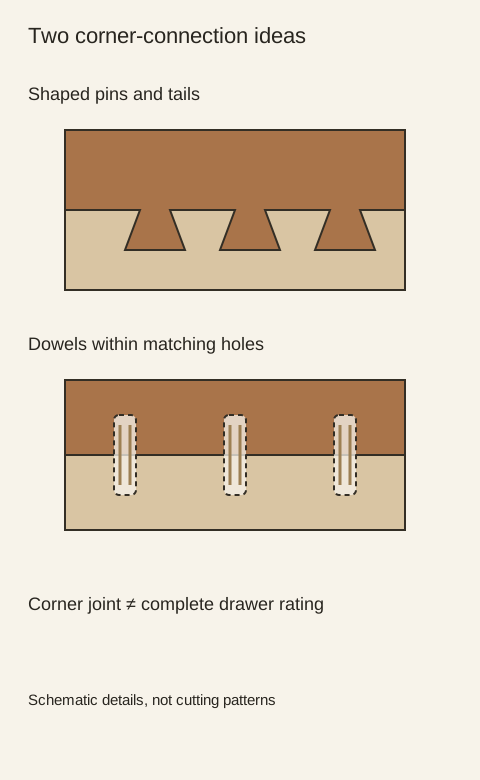
Diagram The shapes explain different ways to connect wood parts. The drawing is not a machining pattern, a strength test or a rating of a usaKT.com drawer. Prepare and save project notes →
Dovetail geometry resists separation in a particular direction
The flared tails and corresponding pins interlock so that the parts do not simply pull straight apart across the connected corner in the restrained direction. The joint still has an assembly direction, and glue, fit and sound material remain relevant. More visible tails or more dramatic angles do not independently establish better performance. A small damaged pin can matter more than an impressive pattern in a photograph.
Through dovetails show the joint at the end of both pieces; a half-blind arrangement conceals it from one face. The difference can serve an appearance requirement without becoming a universal quality hierarchy. Conestoga describes interlocking pins and tails in its drawer program, while the USDA explains the role of interlocking surfaces and bonding area in wood joints. Neither source supplies a load rating for a different finished drawer.
A doweled corner should be evaluated as its own assembly
Dowels extend into corresponding holes and can provide internal bonding surfaces at a corner. Their diameter, engagement, spacing and the surrounding material belong to the maker's detail. A smooth outside face does not mean the corner has no joinery. Conversely, visible circular marks do not prove how deeply a dowel engages or whether the adhesive process was correct.
Ask how the identified drawer box is assembled and what performance information applies to it. Do not transfer a test result for a doweled cabinet base to a doweled drawer, or from one drawer material to another. AWI treats assembled casework, drawer-front testing and other performance questions as distinct methods. Matching a joint name is not the same as matching the tested specimen.
Inspect a permitted sample in ordinary light. Look at whether the adjoining surfaces meet as intended, whether an edge is chipped or a pin is visibly split, and whether the joint changes during normal opening. Distinguish a dark glue line or wood-color variation from an actual opening. A close photograph should be paired with a wider view identifying the corner and the drawer.
Do not pull sideways on a display front, hammer a corner or pry a seam to decide which joint wins. Those actions can damage the sample without reproducing a controlled test. If the joint appears loose under ordinary use, record the movement and ask for assessment. A drawer that feels smooth while empty still needs the correct documentation for its proposed contents.
A hypothetical choice between two cookware drawers
Imagine a dovetailed drawer with an attractive hardwood box, but no identified bottom construction, compared with a doweled box whose bottom, runners and intended loading are documented. The dovetails answer a corner question. They do not answer what supports the cookware. Request the missing information before deciding that the visible joinery makes the first drawer the better fit.
Now reverse the circumstances: the dovetailed option has a complete specification and the doweled sample has an unexplained moving corner. The relevant issue is the observed condition and missing evidence, not a prejudice against dowels. Ask whether the sample is damaged or representative and obtain a suitable completed sample. Choose after both candidates have been assessed for the same contents and operating conditions.
The bottom and runners remain separate decisions
The drawer bottom receives the contents; its perimeter support and any additional reinforcement form a different load path from the front corner. A dovetail does not identify the bottom thickness or show whether its edge is seated correctly. Likewise, the runner model does not establish the corner's workmanship. Review each part of the system without adding unrelated component ratings together.
Conestoga's drawer information separately identifies preparation for undermount hardware. That separation is useful: the box must match its runners, rear notches and front locking arrangement. A replacement drawer ordered only by its decorative front width and preferred joinery can fail to fit the existing system. Record actual box dimensions and the identified hardware requirements before discussing a replacement.
Decide what you value, then preserve the construction
You may prefer the appearance of exposed dovetails when a drawer is open. That is a legitimate preference, distinct from a claim about carrying more weight. You may prefer a different documented box because it provides usable interior space or a service arrangement that matters to you. State which benefit is driving the choice so that a decorative preference does not silently replace a performance requirement.
Finish references
Pure White
Cream White
Light Warm Gray
Gray
Navy
Black
Oak Tone
Dark Walnut Tone
Design study These finish studies are design references, not a list of currently orderable colors. Screens and lighting change the appearance; compare a physical sample before choosing.See all finish options →
A dado seats a panel in a channel, a rabbet seats it at an edge and a butt joint meets a surface without that recess. Geometry, retention and remaining material all matter.
The sample shows the door frame, a separate center panel, the face frame and the cabinet box. Each component has its own place in this Shaker construction.
Shaker construction: door frame, center panel, face frame and cabinet box. The cutaway helps locate these parts; confirm each material in the specifications for the selected cabinet.
01 / Door frame
The Shaker door has rails and stiles around a separate center panel. The frame and center panel are different components; confirm their materials in the specifications for the selected cabinet.
02 / Face frame
The face frame surrounds the opening at the front of the cabinet box and sits behind the doors. The face frame, door frame and cabinet box are separate parts.
03 / Cabinet box
The sample exposes the cabinet sides, interior surfaces and layered edges. The image does not establish the wood species or material specification of a selected cabinet.