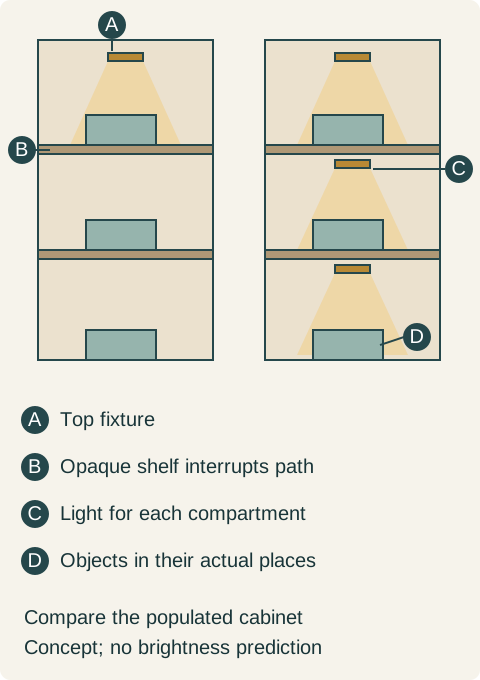
A light at the top of a display cabinet may leave the lower shelves dark
Choose display lighting with the shelves and dishes in place. Compare a top fixture, lighting for separate shelf spaces and decorative glass-edge effects before the cabinet is fabricated.
Review a display cabinet with the objects in it, not just with its lights on. An empty glass-front cabinet can look bright from top to bottom, yet the same fixture may leave dishes on the lower shelves difficult to see after the owner fills it. The lighting choice belongs with the shelf material, shelf positions and intended contents before the cabinet is made.
Start by deciding what should be visible from the room. You may want a single decorative object highlighted near the top, a collection visible on every shelf, or only a soft outline through the glass. Those are different outcomes. Buying more light output does not automatically turn one into another.
Trace a path to the objects you want to see
An opaque shelf interrupts light traveling downward from above it. A top fixture can illuminate its upper surface while leaving the compartment below dependent on other light or reflections. Increasing that fixture's output does not remove the shelf. The same applies to a large platter or dense stack that blocks a path through an otherwise transparent shelf.
Glass permits a different arrangement, but it does not make the contents transparent. Review the real plates, bowls and baskets in their planned positions. An empty glass shelf is a poor stand-in for a shelf covered with dinnerware. Check the front of the objects as well as whether the background appears bright.
There is no universal rule that every shelf needs a separate fixture. A top light may be entirely satisfactory for a sparse display with an open light path. The important question is whether the particular lower objects remain visible in the populated cabinet, from the room positions where they will be seen.
Compare fixtures and compartments together
Armacost's Wafer light is a low-profile puck fixture offered for individual or linked arrangements. That is an example of a fixture form that can be specified as part of a larger lighting package; its name does not predict the result inside a filled cabinet.
If the cabinet uses opaque shelves and each compartment needs illumination, compare a suitable fixture arrangement for those separate spaces. A vertical lighting arrangement may be another proposal. Have the supplier show the actual profile, shielding and relationship to shelf edges, rather than assuming a strip anywhere along a side will light everything evenly.
Place the proposed fixtures in the viewing study with the glass doors closed. Look from a standing approach and from nearby seats. A lamp that hides behind the door frame from one position may appear as a bright reflection from another. Review the normal dimmed evening scene too, instead of approving only the showroom's brightest setting.
The shelf and fixture thicknesses both consume space. Include the tallest stored object and the movement used to take it out. A low-profile fixture still has a body and connections; a plate that fits when standing still may hit them when tilted for removal. Keep that practical check separate from the visual review.
Teaching example Concept front elevations with opaque shelves. A top fixture lights the upper compartment on the left; fixtures in the separate compartments on the right provide a direct path at each level. Amber areas illustrate intended coverage only, not measured illumination. Objects, glass reflections and fixture glare still need a physical trial.
A glowing glass edge is a different effect
Häfele's regional Loox5 announcement describes profiles for glass-edge lighting with opal diffusers. It illustrates a decorative lighting approach, not a promise that every object on the shelf will receive useful face lighting or that the same product is offered in every market.
If you like the bright shelf outline, judge that effect for itself. Then ask whether the objects are lit as intended. A glowing edge can be attractive while the front of a dark bowl remains difficult to distinguish. Conversely, a direct fixture can make the objects clear without creating the edge effect the owner wanted.
Avoid treating a lit glass shelf as permission to change the shelf's material or support. The completed shelf still needs a suitable specification for its contents. Lighting fittings are not a substitute for the approved shelf support, and a lighting concept drawing does not establish a glass load limit.
A dinnerware cabinet keeps its wood shelves
Imagine a hypothetical kitchen with wood shelves chosen to coordinate with the cabinet interior. The owners want to display their everyday dinnerware, including tall stacks of plates on lower shelves. The initial proposal uses a fixture only at the top. In the populated trial, the upper compartment looks good but the lower collection is not lit the way they want.
They compare changing to approved glass shelves, but the actual plate stacks still block useful downward paths. They also prefer the wood shelves' appearance. Instead of paying to change the shelves while retaining the same lighting assumption, they choose a coordinated arrangement that lights the separate compartments directly.
With the selected lights and objects in place, they check the view through closed doors, seated glare and removal of the tallest serving piece. The accepted layout retains wood shelves and the intended storage. It includes the required fixture and service spaces rather than pretending they take no room.
Another owner displaying only a few transparent pieces might accept the simpler top-light arrangement. That would be a different populated trial, not evidence that the first household needed unnecessary lights. The purchase follows the contents and viewing goal.
Decide how much shelf adjustment you need
A shelf with attached lighting can bring connections into an otherwise simple height adjustment. Before buying, ask how the proposed system permits the shelf to move and how its connections remain protected and accessible. Do not assume an adjustable shelf is freely adjustable after lighting is attached.
If the household changes the display often, test an alternate intended shelf position as part of the demonstration. If it will keep a fixed arrangement, a coordinated fixed layout may be sufficient. Either choice should be clear before cabinet drilling and finishing, with the lighting supplier defining the appropriate connection and service provisions.
Include the power supply, control, fixtures and agreed installation work in the comparison. A quote for a single top puck is not equivalent to a complete multi-level system, but the more elaborate package is worthwhile only if it produces a result the owner needs. Approve the filled cabinet, not a count of lamps.
Pure White
Cream White
Light Warm Gray
Gray
Navy
Black
Oak Tone
Dark Walnut Tone
Design study These finish studies are design references, not a list of currently orderable colors. Screens and lighting change the appearance; compare a physical sample before choosing.See all finish options →
Tempering improves resistance to breakage, but it does not make an otherwise identical glass shelf stiffer. A bending concern needs a shelf-design decision, not just a different processing label.
A light rail can hide a fixture while also blocking useful light. Compare the work surface and seated sightline before finalizing the cabinet underside.
The sample shows the door frame, a separate center panel, the face frame and the cabinet box. Each component has its own place in this Shaker construction.
Shaker construction: door frame, center panel, face frame and cabinet box. The cutaway helps locate these parts; confirm each material in the specifications for the selected cabinet.
01 / Door frame
The Shaker door has rails and stiles around a separate center panel. The frame and center panel are different components; confirm their materials in the specifications for the selected cabinet.
02 / Face frame
The face frame surrounds the opening at the front of the cabinet box and sits behind the doors. The face frame, door frame and cabinet box are separate parts.
03 / Cabinet box
The sample exposes the cabinet sides, interior surfaces and layered edges. The image does not establish the wood species or material specification of a selected cabinet.