Will tempered glass stop a cabinet shelf from bending?
Tempering improves resistance to breakage, but it does not make an otherwise identical glass shelf stiffer. A bending concern needs a shelf-design decision, not just a different processing label.
No: replacing annealed glass with tempered glass of the same size and thickness will not, by itself, reduce its deflection under the same load and support conditions. Tempering can still be important to the specified strength and breakage behavior. It simply addresses a different property. When selecting a glass cabinet shelf, distinguish how much it bends in use from whether the complete shelf assembly has adequate resistance to failure. A strong-sounding material description cannot answer both questions at once.
Strength and stiffness describe different behavior
Vitro’s TD-113 explains that heat strengthening and tempering do not change glass’s modulus of elasticity, the material property used to describe stiffness. They introduce surface and edge compression balanced by tension within the glass. This changes its resistance to breaking, while equivalent glass dimensions under the same load still deflect equally. The document’s worked example concerns architectural wind loading. Its general material distinction is useful for shelves; its building-glass loads and deflection numbers are not a cabinet shelf rating.
Think of the purchase question in two parts. A shelf that resists breaking may still bend enough to look wrong in a carefully aligned display. Conversely, a shelf that appears straight while empty has not demonstrated its behavior with the intended contents. An empty showroom sample can establish color and edge finish, but it cannot establish loaded appearance. The buyer needs the shelf assembly evaluated for its actual supports and contents, with both structural suitability and the expected movement addressed. Neither an attractive unloaded photograph nor the word tempered supplies that information.
Keep geometry and support conditions in the comparison
The same-load comparison only works when the shelf geometry and support arrangement are also the same. A thicker section, a different span or a changed support arrangement is a different design, not evidence that tempering changed the material’s stiffness. Likewise, plates spread along a shelf and a concentrated stack at its center do not describe the same loading case. For procurement, the useful object is the shelf together with its supports and loading assumptions. Record those conditions when a supplier presents a rated or evaluated alternative, rather than reducing the comparison to glass type alone.
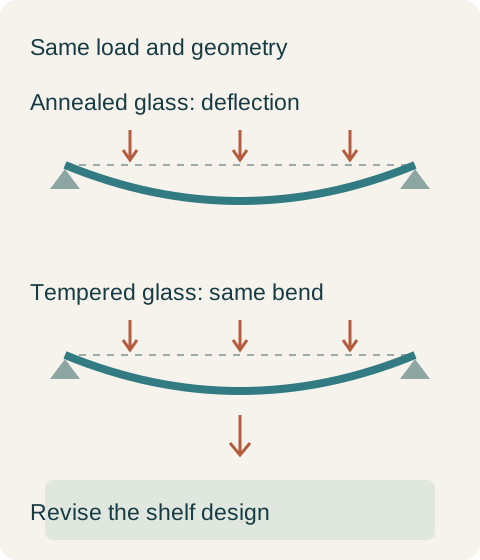
Diagram Equal conceptual deflection for equal dimensions, load and supports. Curves are exaggerated and not a load test, capacity chart, shelf thickness recommendation or breakage comparison.
A continuous display gives way to a supported arrangement
In a hypothetical display-cabinet review, the planned long shelf shows more loaded deflection than the owner accepts. The proposed first remedy is tempered glass with unchanged thickness, span and supports. The owner rejects that remedy as an answer to bending, while retaining the required glass-processing specification. Instead, the design adds a central cabinet divider and uses shorter, separately supported shelves. A revised shelf evaluation covers the actual contents and support details, and the completed trial has the accepted loaded appearance. The owner approves that arrangement and accepts the visible divider as the price of the chosen result.
The decision changes the display composition. A continuous row of objects is now divided into groups, and long objects that previously occupied the full opening may no longer fit. That is why adding support should be decided as part of the cabinet design, not improvised after delivery. If the uninterrupted opening were essential, the alternative review would need to address another evaluated section or support system. The owner in this example prefers the divider; the article does not prescribe that solution for every shelf or assign it a load capacity.
Heat-strengthened and fully tempered are not interchangeable names
Vitro’s heat-treatment guidance distinguishes the more rapid quench used for fully tempered glass from heat strengthening. Their break patterns differ: fully tempered glass breaks into many small pieces, while heat-strengthened glass produces larger fragments. The document also notes that tempered fragments may leave their support system after breakage. Thus a requirement concerning what happens after a shelf breaks is separate from both its stiffness and its intact strength. The cabinet’s specified glass construction must address that requirement; changing to another heat-treated category simply because it sounds similar is not an equivalent purchase.
Do not turn the stiffness explanation into a reason to substitute ordinary annealed glass for a specified tempered shelf. Equal deflection does not mean equal breakage behavior. The approved assembly may deliberately require tempering even after the span or support design has been changed. Similarly, a claim that a panel is stronger does not establish that its supports, retainers or cabinet sides can carry a new loading arrangement. The complete load path remains part of the decision, including the parts that do not appear in the glass description.
Finish the shape before heat treatment
Vitro states that heat-strengthened and tempered glass cannot safely be cut after heat treatment. Resolve the final shelf outline and any required fabrication before that stage. In the hypothetical divider redesign, the original full-width tempered shelf is not treated as stock to cut into the new shelves. New correctly sized parts are fabricated for the revised arrangement. This is a production consequence of the design change, not a reason to compromise the selected glass construction to salvage an already purchased panel.
When comparing the final alternatives, keep strength, loaded deflection, breakage behavior and appearance as separate acceptance questions. A supplier’s evaluation should correspond to the exact thickness, span, supports and loading case offered. If those change, the earlier evaluation no longer describes the same assembly. For the owner, the resulting choice can remain straightforward: preserve the open display and buy an evaluated system that achieves it, or accept a visible support arrangement that achieves the desired performance. Tempering may be part of either solution, but it is not a substitute for making that design choice.
Pure White
Cream White
Light Warm Gray
Gray
Navy
Black
Oak Tone
Dark Walnut Tone
Design study These finish studies are design references, not a list of currently orderable colors. Screens and lighting change the appearance; compare a physical sample before choosing.See all finish options →
A compact nested stack can still be heavy and awkward to separate. Check lifting, usable height and the complete drawer assembly before assigning the storage.
Compare the actual countertop products, heat-source routine and fabrication proposal. A fired porcelain slab and resin-bound quartz are different materials, but neither label replaces a complete kitchen specification.
The sample shows the door frame, a separate center panel, the face frame and the cabinet box. Each component has its own place in this Shaker construction.
Shaker construction: door frame, center panel, face frame and cabinet box. The cutaway helps locate these parts; confirm each material in the specifications for the selected cabinet.
01 / Door frame
The Shaker door has rails and stiles around a separate center panel. The frame and center panel are different components; confirm their materials in the specifications for the selected cabinet.
02 / Face frame
The face frame surrounds the opening at the front of the cabinet box and sits behind the doors. The face frame, door frame and cabinet box are separate parts.
03 / Cabinet box
The sample exposes the cabinet sides, interior surfaces and layered edges. The image does not establish the wood species or material specification of a selected cabinet.