

Buying cabinets
Automatic dishwasher dosing or detergent for each load: buy the routine you will maintain
Compare the step automatic dosing removes with the replenishment, product choice and cabinet storage it still needs, while checking the complete dishwasher and ordinary meal load.
Compare the omitted step with the work that remains
Choose automatic detergent dosing when adding detergent for each load is a meaningful recurring inconvenience and the household accepts the selected system's replenishment, permitted consumables and care. Choose conventional dosing when the existing routine is straightforward, preferred detergent choice matters more, or the automatic candidate compromises a more important dishwasher task.
The purchase concerns the whole appliance and its neighboring cabinets. An automatic dispenser does not load plates, put clean cups away or create an empty cleaning-supply cabinet. Define the specific step it removes before paying for the feature or reorganizing the washing area around it.
Identify the exact dispensing architecture
Miele lists automatic dispensing with integrated PowerDisk on the cited dishwasher. That is a named equipment arrangement, not a promise that any dishwasher accepts any refill product.
Reading note: Miele USA — G 7186 SCVi SFP AutoDos, automatic dispensing feature.
Have the seller identify the actual dispensing component, compatible consumables and supplied equipment for the candidate. Distinguish a replaceable cartridge from a reservoir that is filled in another manner. Similar automatic labels need not describe the same ownership work.
Do not assume that a conventional detergent compartment remains available or that switching between methods works in a particular way. Ask for the exact manual's answer before counting that flexibility. If the household intends never to use the automatic function, compare a suitable conventional candidate as well.
Follow the real close-of-meal sequence
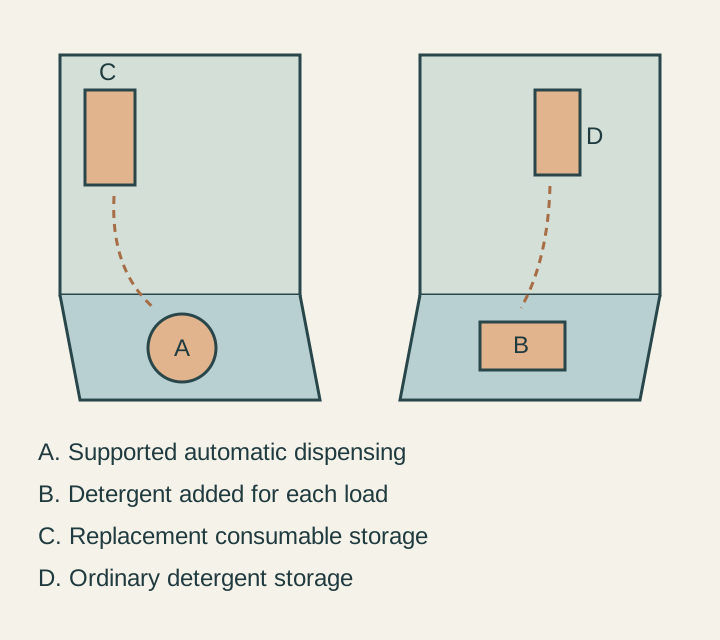
Start with the loaded dishwasher at the moment someone is ready to run it. Follow the normal conventional routine: retrieve the permitted product, add it as directed, return it to storage, choose the accepted program and start. Identify the action the household actually wants to avoid.
For the automatic candidate, demonstrate the supported start sequence and how the user knows whether dispensing is selected and supplies are ready. Do not equate automatic dosing with automatic starting or remote operation. Those are separate functions that may have different conditions.
A family that shares the job should agree who checks replenishment and owner care. Removing a small action from every load can be useful, but only if the remaining periodic action has an accepted owner. Leaving it unspecified does not make the dishwasher independent of the household.
Try the replacement task before assigning cabinet storage
Use the product's demonstration or instructions to understand opening, handling and installing the permitted refill. Test reach and handling with a clean inactive representation when appropriate. The person who normally starts the dishwasher may not be the person who can comfortably replenish its dosing component.
Follow the replacement package from its intended storage place to the machine. With the dishwasher open, can that cabinet open and can the user stand where needed? A package stored in the closest cabinet may be inaccessible precisely when the door is down.
Give unopened replacements a real home under their product storage directions. Retain their labels and packaging as required. Do not pour a proprietary consumable into another container or invent a refill method to make the cabinet drawing look tidier. A storage plan must accommodate the product the selected system actually uses.
Keep the intended detergent choice visible
If a particular permitted detergent is important to the household, check its compatibility with the proposed dosing method before buying. Do not infer interchangeability from color, texture, branding or an online description of another model.
Compare the exact replenishment products and ordinary purchasing arrangement the owner is willing to maintain. An advertised starter supply does not establish the continuing cost or current local availability. Record a checked current quote separately from any demonstration of operation.
This is not a detergent-performance comparison. Automatic dosing alone supplies no evidence of better cleaning, reduced resource use or a health benefit. If an owner has a separate treatment or ingredient requirement, confirm the product information relevant to that need rather than treating the appliance feature as its answer.
The normal dish load still decides the machine
Load the representative plates, bowls, glasses, utensils and machine-suitable cookware in a single supported arrangement. Do not show the automatic dispenser with an easy demonstration load and the conventional candidate with every difficult pan.
Inspect any loading restrictions around the selected dispensing equipment under its manual. A closed door is not enough to establish that all intended parts can operate as directed. Keep the final load configuration with the model identity so a later substitution does not erase the trial.
Repeat unloading into the planned cabinets. A premium dosing feature does not justify a rack that the user cannot comfortably reach or a dishwasher door that blocks the only everyday dish drawer. If the automatic candidate loses that task, compare another candidate or accept conventional dosing.
Compare complete purchases and ownership choices
Have the installer confirm each exact model's enclosure, front, connections, door operation and access requirements. Do not assume that a common commercial width makes the same panel or adjacent cabinet arrangement appropriate.
Compare appliance price, required installation, accepted accessories and any cabinet changes. Then compare consumables using the actual proposed products and an honestly stated household use assumption. Do not invent a universal cost per wash, savings period or replacement interval for either category.
Separate reasons for the price difference. If the automatic model also changes racks, drying or controls, the entire premium is not the cost of dosing. The owner may value the whole combination, but should know what was selected.
A shared household buys conventional dosing
Imagine a hypothetical household in which the last person loading normally starts the dishwasher. The group expects automatic dosing to simplify that handoff. During the trial, however, nobody accepts the candidate's replenishment task or its required product purchasing routine.
The conventional candidate accepts the full dinner load and the household's permitted chosen detergent. Its closed supply cabinet can be opened from the accepted start position, and the users agree who completes the ordinary load-and-start action.
They buy the conventional installation and preserve the planned storage. Another household that accepts the refill task and genuinely dislikes the per-load step may choose automation. Save the dispensing method, compatible product, replenishment responsibility and complete cabinet arrangement together. That is the usable routine being purchased.
Sources & further reading
- Miele USA — G 7186 SCVi SFP AutoDos, automatic dispensing feature