

Buying cabinets
Filter pitcher vs. installed kitchen filter: use and storage
Keep the treatment goal fixed while comparing manual refill, carrying and pitcher storage with connected dispensing, cabinet equipment and maintenance access.
Choose the routine the household wants to repeat
Keep a filter pitcher when the specific product meets the established treatment goal, its filling and carrying routine is manageable, and it has a genuine storage position. Buy an installed system when the actual connected dispensing task is worth the equipment, installation and maintenance space, and the complete arrangement works with the kitchen's cabinets.
Hold the treatment goal constant. This is not an assumption that a pitcher and any installed filter provide the same treatment. First identify suitable actual candidates; then compare what the household does to obtain and store the water. A convenient container cannot compensate for a product that does not meet the chosen purpose.
Verify each candidate before comparing convenience
CDC directs buyers to check the specific filter's label and product certification listing for what that model is certified to remove. A category name alone is not the relevant claim.
Reading note: CDC — About Choosing Home Water Filters, specific product certification.
Keep the actual product and compatible consumable with that verification. If a suitable candidate is not yet identified on one side, do not present the two options as equivalent completed purchases. Resolve the missing selection before committing cabinet space around it.
Once suitable candidates are established, compare the household's real tasks. Do not turn the installed proposal's larger component list into evidence of a health benefit, or treat the pitcher's familiar appearance as proof that all replacement filters are interchangeable.
Walk through a complete pitcher refill
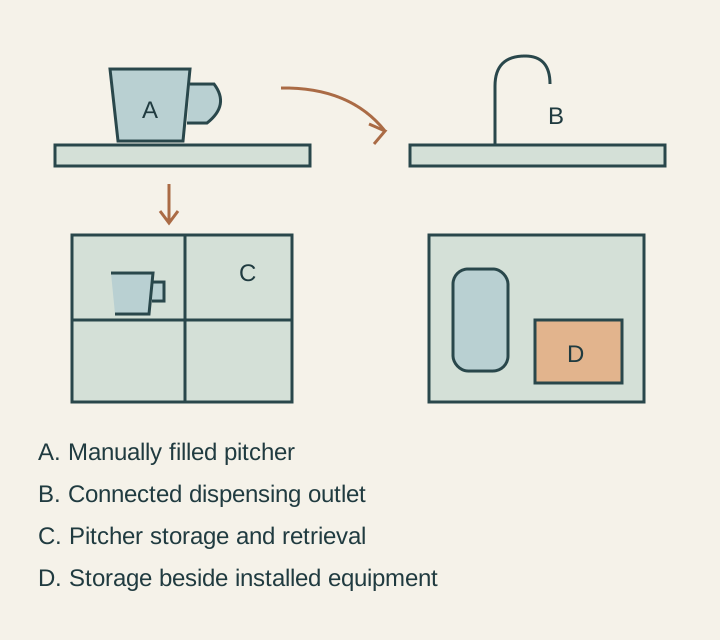
Use the actual pitcher, its lid and the household's normal filling position. Follow taking it out, carrying it to water, filling as directed, waiting or dispensing as applicable, and returning it. An empty pitcher on a shelf does not show the handling of the filled container.
Try the intended user's grip and movement with a suitable cool, stable demonstration. The owner needs to accept the weight and route actually involved. Do not count a high refrigerator shelf as useful merely because an empty display vessel can be placed there.
Identify who refills it and when. If everyone pours but nobody returns a ready supply, the hardware has not resolved the shared routine. The household can choose a clear responsibility or a different arrangement rather than expecting the container to organize the job.
Give the pitcher its ordinary home
If the proposed use includes refrigerator storage, check the actual pitcher in the intended permitted position with normal food already present. Include height, width, lid, handle and the movement needed to take it out. A door bin and an internal shelf offer different access to test.
If it remains on a counter under the product's allowed conditions, mark its complete operating and refilling position. Keep the normal preparation tools there during the comparison. A pitcher that is always moved away for chopping still occupies someone's work and needs a destination.
Do not claim that the pitcher saves cabinet space without counting its own storage and permitted replacement supplies. It may avoid the installed system's equipment while using a valuable food-storage or counter position instead. Compare those actual places.
Follow connected dispensing with the retained bottle
On the installed candidate, use the everyday bottle, glass and any regularly filled cooking vessel. Confirm the actual outlet, controls, approach and where the container can wait. A new small faucet is not automatically useful simply because a deck position is available.
For delivery behavior, consult the chosen system's specifications and a suitable demonstration. Decide whether the complete filling routine works at the household's recurring busy moment. Do not infer a universal speed, unlimited supply or immediate delivery from the word installed.
Add another person doing ordinary sink work. Independent water controls can still share a crowded basin and standing position. If the reason for installation is fewer trips, make sure it does not replace those trips with a bottleneck at the main washing place.
Count the actual cabinet and countertop changes
Draw the complete selected system with the sink underside, drain, disposer where present and other retained equipment. Include only components actually required for that candidate, together with its specified access.
The installer should define the supported connection and outlet arrangement. If the countertop is retained, have its responsible professional confirm any mounting work. Do not assume that a visible empty spot permits a new hole or that replacing the main faucet avoids every alteration.
After the equipment and maintenance movements are reserved, place the usual cleaning supplies in the remaining regions. Name anything displaced and its new storage position. The connected system does not earn its convenience by quietly occupying a bin still shown as available in the cabinet schedule.
Compare care and the complete purchase
For the pitcher, identify the prescribed cleaning, consumable replacement and permitted storage routine. For the installed system, identify its actual replacement access and owner or service responsibilities. Follow each product's instructions without assigning either category a universal interval.
Compare complete current purchases. The installed proposal includes system, appropriate outlet or fixture pairing, necessary components, installation and affected cabinetry or top work. The pitcher proposal includes the actual suitable product and any storage changes the household chooses to make.
Then consider the correct replacement products and ongoing care the owner is willing to maintain. Do not claim a standard cost advantage, guaranteed service life or payback. A preference for manual refill can be reasonable even where installation is feasible, and a recurring refill burden can justify a connected proposal without inventing savings.
A pitcher loses its promised storage position
Imagine a hypothetical household whose selected pitcher serves its established treatment goal. The first kitchen sketch assumes it will fit in the refrigerator door. With the ordinary food containers present, the lid and handle do not work in that assigned position. Moving it to the main shelf displaces a covered dish used regularly.
The family also tries a countertop position, but that place is needed for preparation and there is no accepted place to move the filled pitcher during meals. The users could change their storage or refill routine; they prefer to compare a suitable connected candidate.
Its bottle-filling task works, and the complete equipment section preserves specified maintenance access. A displaced cleaning-supply group fits in a checked neighboring cabinet. The owner accepts the full installed price and care arrangement.
They choose the installed system. Another household with an easy pitcher position and a satisfactory refill routine may retain the pitcher and its existing sink base. Save the verified product, refill or dispensing trial and complete storage assignment together. The useful purchase is the one the household can repeat without borrowing space already promised to another daily task.
Sources & further reading
- CDC — About Choosing Home Water Filters, specific product certification